Retirement
When he reached his 65th. Birthday, on 28th. April, 1966, George retired from work at Maison Fittings. His boss, Mr. Lovelady, was reluctant to let him go, so dependent on him as he was for the general running of the workshop. George had worked there on and off for many years and whilst Mr. Lovelady ran the business side of the firm, it had been very much George's function to run the practical side of the production. The firm had branched out somewhat and as well as lampshades, they were now also producing other items such as ornate plastic signs for the outside of shops and public houses. Such an example was to be seen in Windsor Street, where the name of the "Windsor Castle" public house was spelled out with individual plastic letters produced at Maison Fittings. As well as making the wooden patterns, George had become skilled in forming the softened Perspex or Oroglass over the shape of the patterns and achieving consistently good results.
Mr. Lovelady asked George if he would consider going into work on a part-time basis for two or three days per week but George said that that was not his idea of retirement. He therefore left the firm for good and looked forward to his long awaited retirement from working life. His colleagues at Maison Fittings gave him a farewell party at the factory on his last day and gave him some retirement gifts, including a stainless steel garden hoe and lawn rake.
Shortly after he had left Maison Fittings, George arranged for Reg to take him by car to the factory in order to collect his tools, which were quite heavy. They found that the workshop was in a sorry state with piles of discarded and mis-shapen perspex sheets which someone had been trying to form into lampshades but had failed to get the temperature and timing right. Several times, Mr. Lovelady tried to get George to go back on a part-time basis, but George was not interested.
the garden;
a collapsed lung
On becoming 65, George became eligible for an elderly person's free travel pass issued by the Liverpool Corporation Passenger Transport Department, allowing him free travel on all bus and ferry services operated by the Corporation and all normal stage carriage services of Crosville, Lancashire United and Ribble Motor Services operating within the Merseyside Metropolitan area. With the inception of the Merseyside County Council in 1974, the Merseyside Passenger Transport Executive took over responsibility for public transport services in the Merseyside area. He did use his pass quite a lot for journeys into Liverpool when he needed to go shopping, or to other fairly local places such as Garston and Woolton. He also used the pass when visiting his son, Reg, in Hunts Cross.
George settled into retirement and greatly enjoyed the leisure time now available to him. He was able to devote lots of time to his gardening, and in the Spring and Summer months he was to be found in the garden more or less from dawn to dusk. He had always been an early riser and even in retirement he was usually up and about by about 6 am. or even earlier. All his life he had been prone to having a daytime nap if he was not actively engaged in anything. He often dozed off on the bus coming home from work, and occasionally missed his stop. When he retired, he would have a long session of gardening in the mornings, if the weather permitted, and would often retire to the greenhouse, where he had a deck chair, for an afternoon doze. He enjoyed his freedom to wear casual clothes, particularly when he spent most of his time in the summer months in his garden. He had suffered for years with athletes' foot, and after his retirement he seldom wore socks, and was usually to be found wearing open sandals.
Some time about then, George was suffering from chest trouble and was admitted to Fazakerley Hospital where he was diagnosed as having a collapsed lung. He was in hospital for about a week and after his discharge he made a full recovery. While he was a patient there he found himself in the next bed to a man with whom he had worked as a young man at the Cammell Laird shipyard in Birkenhead. George and he had plenty to reminisce about as they had been pattern makers together all those years previously.
Reg had bought a second hand sectional concrete garage which he and Norman erected at 12, Tudor Road. The garage was, however, lacking either front or side doors. Reg was able to buy double doors for the front. He also acquired a front door from his next door neighbours at No. 14, who were replacing it with a new door. Reg asked George if he could alter this second hand door so as to fit in the aperture at the side of the garage. George said it was possible and Reg took the door to George's home on the roof rack of his car. George set about the alterations to the door and in a week or so the door was ready for Reg to hang at his garage, where it still remains.
Norman and Vera were now living at 47, Chescombe Road, Yatton, Somerset, which was between Bristol and Weston-super-Mare. They had moved there in 1964. Some time in the mid 1960s George and Doris went to visit them for a short holiday. There is some doubt in the family about how they made this trip. Reg, Lyn and Brian think that George and Doris flew from Liverpool to Bristol by a Dan-Air flight which Norman had arranged, and he picked them up from Bristol Lulsgate Airport where he worked at that time, and that they flew back to Liverpool at the end of their visit. This would have been the only flight that either George or Doris ever made. Norman, who perhaps was in the best position to verify this, has no recollection of this flight and thinks that he would have remembered it well as he would have arranged for them to visit the flight deck during the flight. It seems as if this may never be resolved. During the absence of George and Doris, Lyn went to stay with Reg and Edna at Hunts Cross, which she often did at that time.
Brian left the Royal Navy about 1966, and returned to the family home at 136, Bray Road. On 29th. July, 1967 he married Ann Roberts who lived in School Way, quite close to Brian's home. Brian and Ann moved away from Liverpool following their marriage and never lived in Liverpool again.
travel pass
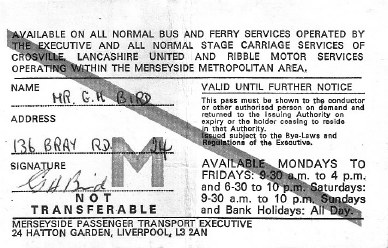
George's free travel pass · Merseyside Passenger Transport Executive
1969; the prefabs;
Robinson's Tours
On 15th. January, 1969, George's eighth grandchild, Steven Matthew Bird, was born to Ann and Brian, who were then living in Crawley, Sussex.
Later that year, on 18th. October, 1969, Lyn married Kenneth George Charmer at All Saints Church, Speke. Following the Wedding, a reception was held in an upstairs function room at the Childe of Hale Public House in Hale Village. George, who was not normally a heavy drinker, rather overdid it and eventually had to be taken home and put to bed by his son, Reg, and his neighbour, Tom Griffiths. He had, however, much enjoyed the wedding and was none the worse the next day.
For a wedding present to the newly-weds, George had made a set of dining furniture, comprising a circular table and a set of four bent-wood dining chairs. The chair backs had to be made by cutting them to shape and then softening the wood by steeping it in warm water overnight. The chair backs were then pliable enough for them to be bent over a former before they dried out, to acquire the desired shape.
Around about 1969, the prefabricated houses in Rycot Road and Clough Road were demolished. This was good news for George who had discovered that this type of prefab contained a lot of good usable wood, including some hardwoods such as mahogany. During the demolition of the houses he was able to have a chat with the foreman of the demolition team and secure a considerable amount of timber for his various construction projects. The wood for Lyn's dining suite probably originated from this source. He was always on the lookout for suitable wood and on one occasion he found an old piano at the rear of School Way. This yielded some excellent decorative fruit wood which he was able to use.
About this time, George and Doris started to take annual holidays with Robinson's Tours who specialised in providing coach holidays, mostly to the West Country. The holiday makers were picked up locally by one of Robinson's coaches, and then conveyed to Trentham Gardens, near Stoke on Trent where everyone was sorted out into parties for coaching on to their holiday destinations, such as Torquay, Ilfracombe, etc. The holiday was of a week's duration and spent in good quality hotels at the chosen resort, with full board provided. Some optional excursions were also provided during the week. George and Doris enjoyed these holidays and continued for several years, travelling to various destinations, including Newquay, Torquay, and, more often, Ilfracombe. At the end of the week, the holiday makers were coached back to Trentham Gardens and put on the appropriate coach to return them to their home locations.
prefab awaiting
demolition, 1969;
Arlington Hotel,
Ilfracombe
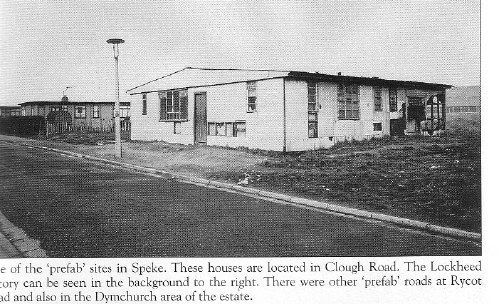
Derelict prefab, Clough Road · About 1969
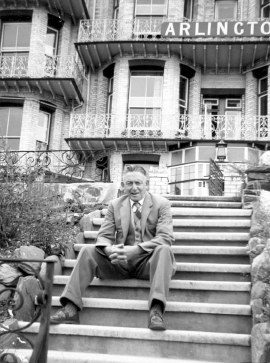
George outside the Arlington Hotel, Ilfracombe · About 1969
gardening awards
from 1969
George enjoyed going to various horticultural shows during the summer and autumn seasons, and went to Shrewsbury Flower Show on one occasion. He also went to Southport Flower Show, and the more local Liverpool Show and Woolton Show. Whenever he went to a show he always took pencil and paper and made notes of varieties of various plants, particularly dahlias and chrysanthemums, which he then tried to acquire and cultivate. He also surreptitiously took a few cuttings from fuchsia plants which he then propagated in his greenhouse. He also took an interest in other items on display, such as items of garden furniture and greenhouses. He would spend some time studying these and sketching their design, construction and measurements for future use if he should decide to make something similar for his own garden.
The Liverpool Corporation Housing Department had, about this time, inaugurated a Gardening Award Scheme aimed at promoting pride among the residents of various Corporation Housing Estates, including the Speke Estate, with regard to the appearance of their gardens. Gardens were initially noticed by the visiting rent collectors, and a short list of gardens of a standard likely to win prizes was compiled by the Housing Department. The most suitable gardens were then visited by the Housing Committee, who awarded prizes in various categories. It is not thought that householders had to enter the competition formally. George's garden was always very well kept and cultivated during the Spring and Summer seasons, but he had one disadvantage which consistently prevented him from winning the top prize. Although his front lawn was surrounded by dense and colourful flowerbeds, and he also had hanging baskets and planters, he was still growing vegetables in the longer leg of the front garden. Housing officials did tell him that this would probably detract from the overall appearance in the eyes of the judges, but nevertheless, in 1969, George and Doris received their first gardening award, a Certificate of Merit for the high standard of cultivation and appearance of the garden at 136 Bray Road. It is thought that George attended a prize giving function to receive the award at either Liverpool Town Hall or the Liverpool Blue Coat Chambers.
the library;
the barber
Some time about 1970, Doris's brother Bill, who had emigrated to Canada when he was in his teens, came back to England for a holiday. He had lived in Canada for over fifty years and had only come back a couple of times in all those years. On this occasion, his surviving relatives in Birkenhead organised a dinner party for him at the Kingsland Restaurant, Borough Road, Birkenhead. Doris and George were invited but in order to make the inconvenient journey from Speke to Birkenhead and back in the evening, Reg and Edna took them by car. On the back row of the group photograph, from the left, are Reg, Doris's sister Edna's husband, Wilf Meachin, George, Bill Jones, and Doris's youngest brother, Fred Jones. At the front, from the left are Reg's wife, Edna, Doris's sister Edna, Doris, Doris's sister-in-law, Anne, and Fred's wife, Eva.
By this time, a new Speke Central Library had been opened in Central Parade, in the heart of the almost completed Estate. George and Doris started using this new library and made regular trips there for their books. They were able to travel there by bus, using their free travel passes. George, who still had a wide taste in literature, developed a particular liking for the novels of Jeffrey Farnol, who wrote old time stories of rural life such as "Beltane the Smith".
George continued to take a daily newspaper, now preferring the "Daily Mail", and he enjoyed attempting the cryptic crossword. It sometimes defeated him and his son, Reg, who was also fond of crosswords, would sometimes confer with him about the clues and the possible solutions to the puzzle.
George had never been a letter writer by choice, but when the occasion arose he could write a good letter and his handwriting had always been excellent.
A new parade of shops had by now been built at The Crescent, off Speke Town Lane, quite near to Bray Road, and George and Doris found these shops very convenient for everyday shopping. There were various types of retail shops there, including a bakers shop, Waterworth's greengrocers, Gourley's grocers, a chemist, and a newsagents run by Mrs. Nursall who had had the Post Office and general shop in Speke Town Lane before the housing estate was built.
There was no gentlemen's hairdresser convenient in Speke at that time, and George had an acquaintance, a man called Barnes, who lived in Speke Town Lane next to The Crescent. This man used to cut George's hair in exchange for some produce such as a lettuce or some beans from George's garden.
Restaurant,
Birkenhead,
about 1970
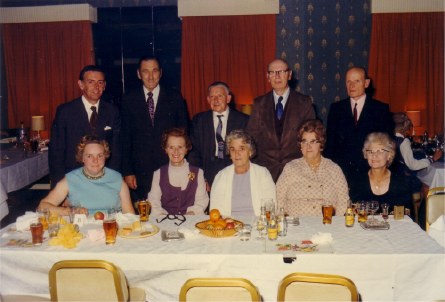
George with his Jones relatives · Kingsland Restaurant, Borough Road, Birkenhead · About 1970
Mark born
13 January 1971;
more awards
George's retirement enabled him to relax in the garden during the summer months when he was taking a rest from his physical gardening activities. He and Doris would often sit out in their deck chairs on the back lawn in the afternoons when the weather was nice. Doris appears to be knitting and the weather seems sunny as both are wearing sun hats.
George's stock of timber which he had recovered from the demolished prefabs proved very useful about this time when he decided to build himself a new greenhouse to replace the one he had had for many years and which was becoming dilapidated. He emptied the front lounge of furniture and set about building a new greenhouse in that room. His woodworking skills proved to be extremely useful as he made every component of the greenhouse himself, including the sash bars which required an enormous amount of rebating. The greenhouse measured about 8 feet by 10 feet and had low wooden sides before the glazing commenced upwards. The lounge was just about big enough to accommodate the greenhouse, and George was able to work indoors, out of any inclement weather, during the construction. When the work was complete, George and Reg carried the greenhouse out to the back garden in sections and erected it on the site of the old greenhouse. Although George was very proficient at the woodworking side of the construction, he was not very confident at cutting glass, and there was an enormous amount of glass, mostly from the previous greenhouse, but some from various acquaintances of George, to be cut to size to fit in the new structure. Reg had a little experience of glass cutting by this time, having had to maintain his own greenhouse and his home as well. He was fairly confident with a glass cutter and cut most of the panes for the new greenhouse. Incidentally, the glazing sprigs which were used in the new greenhouse were in fact the bronze pins around which the strings had been attached in the old piano which George had recovered for the wood. Once he had salvaged the wood he needed, he burned the unusable wood and then sieved the ashes to recover the pins.
In 1970 George and Doris again won a gardening award from the Housing Department. This time it was a Certificate of Merit for the high standard of cultivation and appearance of the garden at 136 Bray Road.
On 13th. January, 1971, George again became a grandfather for the ninth time when Lyn and Ken's first child, Mark Andrew Charmer, was born.
Later the same year, on 27th. April, 1971, Brian and Ann who were now living in Boston, Lincolnshire, had their second child, Emma Jane Bird, and George now had a total of ten grandchildren.
In the summer of 1971 George and Doris were again successful in the annual gardening competition when they were awarded Fourth Prize and a sum of £2.50 for the Fourth Best kept garden in the Speke and Springwood Management Area. They were probably invited to a reception at the Town Hall to receive their award.
In the autumn of 1971, George and Doris visited Brian and Ann in Boston for a short holiday. Brian drove from Boston to Liverpool to pick them up and took them back to his home. Emma was now about six months old. During their stay they enjoyed several outings with Brian and Ann and their children to places such as Skegness and Mablethorpe. At the end of this holiday, Brian drove them back to Liverpool.
The gardening club which had met in the hut in Clough Road during the Second World War was no longer in existence and George had lost his contacts for the supply of gardening sundries such as compost, seeds and peat. He had started obtaining his seeds by mail order from Unwin's Seeds of Cambridge, as did Reg, but he had no ready source for the bulkier items such as peat and growing compost. He found, through his friends at the L.M.S. Club, that there was a gardening club at the allotments at the river end of Window Lane in Garston, and he occasionally went there with Reg, who had a car, to buy at reasonable cost and bring back home heavy bags of garden supplies. He still preferred to make up special compost himself, particularly for his chrysanthemum plants, and he would make up mixtures of peat, sand and loam, to which he added other ingredients including blood and bone meal and fish meal. These latter ingredients could be bought at Caulfield's pet shop at the junction of James Street and Chapel Road in Garston. George never wasted money on buying things which could be obtained free. For example, he never bought 3-inch plastic pots for raising seedlings when he found he had a ready supply of used plastic drinking cups which one of his friends at the Window Lane allotments, who was a cleaner at the Garston bus depot, was able to obtain in large numbers.
George continued to make items of furniture including a writing bureau with a bookcase underneath. He also made a garden bench based upon a design he had studied and sketched at the Liverpool Show. He also made a large bookcase with sliding glass doors for Reg's sister-in-law, Stella and her daughter, Christine.
For the front of his house he made a sturdy wooden planter which he used to fill with bedding plants in the summer. Over his front door there was a projecting concrete lintel from which he always hung a hanging basket which he filled with a central geranium, of a variety he liked called "Paul Crampel", surrounded by various bedding plants and trailing lobelias. This basket was quite large and very old, constructed of ornate twisted wire, and dating back to Victorian or Edwardian times. It used to hang in the back yard at 76, Woodville Road, Birkenhead, when George was young. Reg is still in possession of this basket and sometimes uses it himself as part of his floral display in the summer, although it is now showing signs of its age.
In 1972, in the annual garden competition of the Housing Department, George and Doris again won an award. This time it was a Special Commendation and a cash prize of £1.50 for a garden of a high standard of cultivation in the Speke Housing Management District.
Probably in the same year, the Housing Department were undertaking general improvements to the housing stock on the Speke Estate. Part of the work involved altering the window frames by removing the numerous small panes of glass which had been a feature of the Corporation houses when they were built, and replacing them with much simpler larger sash windows. Corporation workmen were engaged in sawing out the superfluous sash bars, but George insisted on doing this himself on the frames in his own house as he considered he could do a much neater job of it.
On 27th. December, 1972, the last of George's eleven grandchildren was born. He was Neil Charmer, Lyn and Ken's second son.
Another construction job which George undertook in his retirement was building a large cupboard in the hall for hanging outdoor clothes. This was a built in cupboard, like a wardrobe, but with sliding doors and as it was quite close to the foot of the stairs he angled the side nearest to the stairs so that access to the stairs was not restricted.
In 1973, in the annual gardening competition, George and Doris were awarded a Certificate of Merit for the high standard of cultivation and appearance of the garden at 136, Bray Road, Liverpool 24 in the Speke and Springwood Housing Management District. George and Doris were unable to attend the presentation of the awards on this occasion and received a letter dated October, 1973, from G.A. Smith, the Housing Manager, enclosing their certificate. It is not known how many times they had actually attended the awards presentations for the times they had been successful.
Rita Griffiths, the youngest of the three daughters of Tom and Nell, George's neighbours, had married Kevin Reilly, whose mother owned a wool shop in Halewood, not far from George's home. George undertook to fit out the shop with wooden racks to hold and display the wool.
in the back garden
about 1970
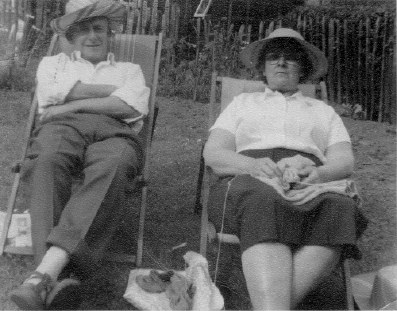
George and Doris in the back garden, 136 Bray Road · About 1970
Ilfracombe 1974;
the Metal Box Club
Some years previously, a new family had moved into 134, Bray Road, next door to George. They were George and Ginny Polhill and were related to the Adams's who had lived there previously. The Polhills had several children including a daughter, Barbara, of whom Doris was quite fond, and who had Down's Syndrome, and another daughter, Pamela, with whom Lyn was very friendly, being of about the same age as her. Barbara was in residential care but came home to her parents from time to time and Doris spent quite a lot of time with her. George and Doris got on quite well with this family, and after Ginny Polhill became a widow she went on holiday with them on at least one occasion when they went on a Robinson's holiday to Ilfracombe. This may have been the last annual holiday that George and Doris took together.
George had by now become a member of the Metal Box Club in Speke Boulevard, which was the Social Club of the Metal Box Company factory. The factory had been there since about the time that George had moved to Speke in 1938, and had undergone various changes of ownership, from being Brown, Bibby and Gregory when it had first opened when they had been printers of wrappers and cardboard boxes for the food industry. They now made such items as biscuit tins. George had never worked there but must have been able to become an associate member of the club. It was only five minutes walk from George's home to the club and he found it very convenient to go there occasionally for a drink. The L.M.S. Club at Burnsall Street, Garston, was a bus ride away and many of his old friends from there had by now probably passed away.
In the annual gardening competition in 1975 George and Doris were awarded a Special Commendation and a cash prize of £2.50 for a garden of a high standard of cultivation in the Speke Housing Management District.
George and Doris occasionally made a trip to the shopping area in the Liverpool city centre. They were able to travel free on the bus using their travel passes. If they did go shopping there they usually had their lunch in a restaurant in one of the large department stores. They sometimes used Littlewoods in Church Street, or Owen Owen in Clayton Square, but one of George's favourite cafes was the one in the British Home Stores shop in Lord Street. They would usually have a meal of fish and chips, pie and chips, or something similar, with a pot of tea.
George and Doris,
Ilfracombe,
about 1974
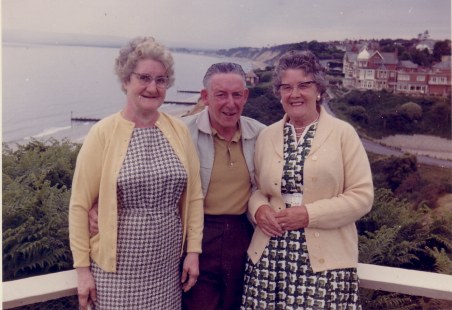
Ginny Polhill, George and Doris · Ilfracombe · About 1974
1976; Pam's
Passing-out Parade
21 June 1976
At the end of March, 1976, George was admitted to Broadgreen Hospital, Liverpool, for investigation of a bowel problem. He was only in for about a week and made a full recovery. His son, Reg, visited him several times during his spell in hospital and, on one such visit, had his bicycle stolen from the hospital grounds while he was visiting.
In April, 1976, George's grand-daughter, Pamela, followed in her father's footsteps and joined the Merseyside Police. Reg was still a serving Sergeant in the force. After her induction, Pamela went to the District Police Training Centre at Bruche, near Warrington, for her initial training course. At the end of the course, on 21st. June, 1976, she and her fellow students on the course had their Passing Out Parade. Reg and Edna took George and Doris to this event by car, and George was very proud of his grand-daughter's achievement.
In 1976, George and Doris again had success in the annual Gardening Awards when they received a Special Commendation and a cash prize of £2.50 for a garden of a high standard of cultivation in the Speke Housing Management District. This was to be the last award they received in a long series starting in 1969. They had been successful in every year since then apart from 1974, when for some reason they did not win an award. It is possible that they did but that the Certificate has not survived.
One of the difficulties George had as a gardener was that of keeping his plants watered whilst he was away on holiday during the summer months. His pot plants, particularly the late Chrysanthemums, were very quick to dry out if the weather was hot and sunny. The tomato plants in the greenhouse could also quickly dry out and needed regular watering to prevent the fruit splitting. Fortunately, as Reg lived fairly close to George he was usually able to undertake the necessary watering during George's absence.
and Doris · Bruche
21 June 1976
The last
photograph
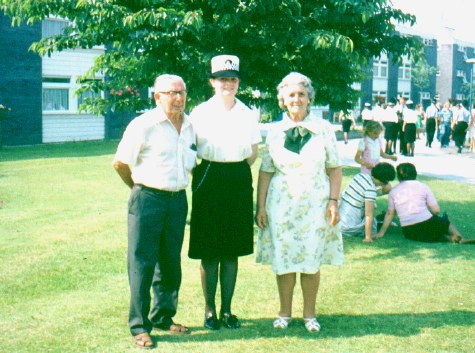
George, Pam and Doris · Passing-out Parade, Police Training Centre, Bruche · 21 June 1976. This is probably the last photograph taken of George.
Newsham General
Hospital;
30 June 1977
In the Spring of 1977 George suffered a stroke and was confined to bed at his home with Doris looking after him. After a short while it became apparent that he needed hospital attention and he was admitted to Newsham General Hospital in Belmont Road, Liverpool. He was there for quite a few weeks, initially in Richmond Ward which was quite a modern prefabricated building. Doris, Edna and Reg all visited him frequently during this period. His condition eventually deteriorated and he developed pneumonia and was moved to an older ward in a block of the hospital which had formed part of the original workhouse buildings.
On Thursday, 30th. June, 1977, Edna visited George at lunch time and he was able to eat some jelly which Edna fed to him. During that evening, Reg received a telephone call from the Ward Sister at the hospital recommending an early visit as George's condition was worsening. Reg went to the hospital and sat with George for some time until about 11.0pm. when George passed away peacefully with Reg holding his hand.
Reg, who had no car at that time, took a taxi home to inform Edna of what had occurred and then went on to Speke with Edna to inform Doris. They then took Doris to their home for the night.
The next day, Friday, 1st. July, 1977, having obtained compassionate leave from the Police in order to attend to the funeral arrangements, Reg returned to Newsham General Hospital to claim George's possessions and to attend to the necessary paperwork. He then registered the death at the Liverpool Register Office at Brougham Terrace.
The same day, Reg called at the offices of Pearson Collinson Funeral Service, 91, Allerton Road, Liverpool L18 2DD and arranged the funeral for the following Tuesday, 5th. July, 1977.
One difficulty about the funeral was the fact that Ann and Brian were at that time living in Shiraz, Persia, where Brian was working as a sales engineer for the Singer company who were supplying flight simulators to the Persian Air Force. Reg was able to get a message to Brian through his company headquarters at Crawley, Sussex, and Brian was just able to get back to England in time to attend the funeral.
The funeral took place at Springwood Crematorium at Allerton Cemetery, Liverpool, on the afternoon of Tuesday, 5th. July, 1977. Reg, Edna, Norman, Vera, Lyn, Ken and Brian were all at the cremation, as were George's brother, Reginald and his wife, Nell. George's brother-in-law, Fred Jones, was also among those present. Doris did not feel able to attend the funeral and stayed at home with her friend and neighbour, Lucy Roberts, and together they prepared refreshments for the guests after the funeral.
After the cremation, George's ashes were deposited in Section 3 of the Crematorium Gardens.
The undertaker's bill for the funeral came to a total of £212.60.
Remembrance
Springwood
Crematorium
After the funeral, Reg and Edna arranged for an entry in the Book of Remembrance at Springwood Crematorium. This book is displayed and open at the entry for George on the 30th. June each year, but can be viewed at any time on application in advance. The entry reads:
Bird, George Henry
Born 1901. At rest 1977
Beloved husband and father
Remembered by all
Always in our thoughts.
The capital letters of his name are inscribed in red and there is a coloured drawing of a red dahlia, one of his favourite flowers, to the left of the entry.
As Reg lives quite close to Springwood Crematorium he has never failed to visit the Crematorium and view the Book of Remembrance on 30th. June every year since George's death. He has also visited each year on George's birthday.
George did not live to see any of his grandchildren marry and he never became a great-grandfather during his lifetime.
Remembrance
Springwood
Crematorium
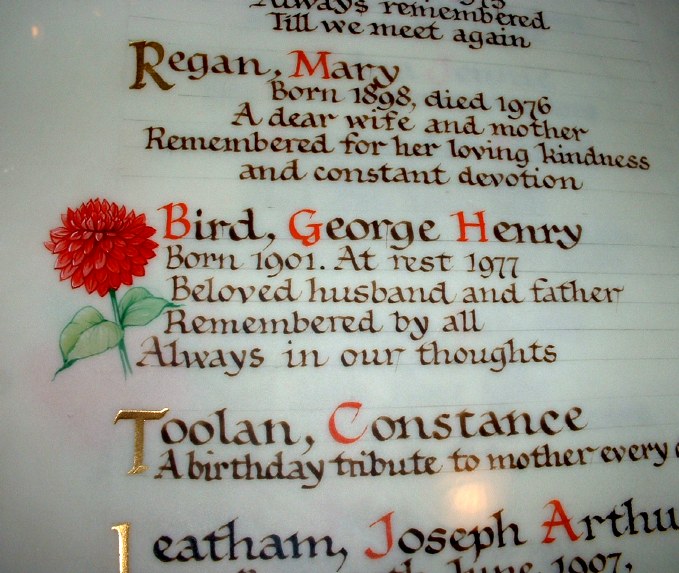
Book of Remembrance · Springwood Crematorium, Allerton, Liverpool