Aircraft Factory
Speke, 1937
Early in 1938, George decided to leave his employment at the Cammell Laird shipyard and to take employment at a new aircraft factory being built in Speke, on the southern outskirts of Liverpool. This factory was the result of the intention of the Air Ministry, some years previously, probably because of the possibility of war, to commission and build a 'shadow' aircraft production factory. Originally twenty-three possible sites had been considered and a final choice was made and plans went ahead to build it at Maidenhead. However, because of high rates of unemployment in Liverpool, coupled with an opportunity for general economic regeneration, the City Council decided to make a last ditch attempt to have the factory constructed in the City. Following some further developments at the Air Ministry and intense collaboration between Rootes Securities Ltd, who would produce aircraft on behalf of the Air Ministry, the Speke Estate (Special) Sub-committee, Corporation staff and local farmers, a radical reappraisal of the site was precipitated, and eventually the Air Ministry opted for Speke. On 15th. February, 1937, the site for the factory was officially opened by the Lord Mayor. It was estimated that the factory would cost £500,000 to build, and would be the largest factory in Europe at the time, and when in full production, would provide employment for more than 5,000 workers. Rootes Securities Ltd. were a large motor manufacturers in the Midlands, producing Humber, Hillman and Singer ranges of cars, and had extensive experience in mass production. The factory was built on farm land adjoining Liverpool Airport, which had been opened on 1st July, 1933.
At the same time as work was commencing on the new aircraft factory, work also commenced on the building of the new Speke Housing Estate which had been envisaged since Liverpool Corporation had bought the land from the estate of Miss Watt of Speke Hall in 1928. Various plans were proposed in the following years for the building of a self-contained satellite town housing 25,000 people in Speke. Various earlier plans for the town had to be redrawn in view of the construction of the aircraft factory, but finally the Speke Estate plans were finalised and work commenced on building houses and roads. The plans for the estate were ambitious, including a wide boulevard leading through the Dam Woods to the edge of the River Mersey, where a promenade would be built, together with a salt water, open-air swimming pool. Other amenities planned included a technical college, numerous schools, shopping centres, churches, a community centre, cinemas, recreation grounds and a public golf course. A spokesman for the Housing Department of Liverpool Corporation said at the time, "The estate has been planned so as to accommodate all classes of the community, thus avoiding the segregation of one class, a condition which is now widely recognised as a deterrent to social progress. The proposals are therefore for a self-contained community unit rather than for a dormitory estate for occupation only by the lower paid workers". In the event, mainly because of the Second World War, many of the ambitious plans for amenities on the estate never materialised, but Speke nevertheless became a major housing estate in the City.
Until the building of the aircraft factory and the housing estate, Speke had been a tiny village with a population of less than 400, including the surrounding farms, and all were engaged in agriculture with the exception of a blacksmith and a wheelwright. The nucleus of the village was in the area around Speke Town Lane and Speke Church Road, and consisted of only a few cottages, farms, and All Saints Church, which had been built in 1876. All Saints Church also had its own village school situated opposite to it.
George was attracted to a new job at the Rootes Aircraft Factory for two main reasons. Firstly, the pay and conditions at the factory were probably better than at the Cammell Laird shipyard, and secondly there was the opportunity to live in a brand new three bedroomed house and to give his family the chance to live in a healthy rural environment instead of the small four roomed terraced house in urban Tranmere. The fact that the new Speke houses had gardens at both the front and rear was no doubt another factor in attracting George to Speke. In fact many of George's colleagues from Cammell Lairds made the move to Speke at about the same time.
22 April 1938
There was no difficulty in obtaining houses to rent from Liverpool Corporation and when George decided to make the move in the early Spring of 1938, he and Doris apparently had 18 available houses to choose from. Building had not long commenced and at that time there were completed, but unoccupied, houses available at the top end of School Way, the western end of Bray Road near School Way, the western end of Rycot Road, and the top end of Gerneth Road near Bray Road. George and Doris chose one of the houses in Bray Road but unfortunately, before they could move in, Doris was taken ill and was admitted to St. Catherine's Hospital in Tranmere, where she required an operation. This delayed the move to Speke, but George went ahead and started work at the Rootes factory, commuting daily from Tranmere by the Ferry Boat to Liverpool and then the long bus journey to Speke.
Doris recovered well from her operation but by this time their first choice of house in Bray Road was no longer available so they had to make a second choice although there were still a good number to choose from. They decided on the house, No 136, Bray Road, and on Friday, 22nd April, 1938 they signed the tenancy agreement for their new home, the tenancy to commence from Monday, 25th. April, 1938 at a weekly rental of eighteen shillings and sixpence.
George therefore had access to the house for a week before the family moved in and he was able to make a start on digging over the gardens in his dinner times whilst working at Rootes.
George's family finally left 48, Aspendale Road in Tranmere, on Saturday, 30th. April, 1938, and moved into the new house at 136, Bray Road, Speke. This was the day of the F.A. Cup Final at Wembley when Preston North End beat Huddersfield Town 1–0 after extra time.
Doris's brother, Frederick, married Eva on 6th June, 1938 and they took over the tenancy of the old house at 48 Aspendale Road, Tranmere, although Frederick may have moved in when George and Doris moved out.
George was at the new house when the furniture van brought the furniture from Tranmere. Doris and the two boys, together with George's mother, Emily, travelled from Tranmere to Speke by ferry boat and the Crosville bus on route "A" as it then was, from Liverpool Pier Head, via Princes Road, Devonshire Road, Aigburth Road, and on through Garston. Emily had accompanied the family to help with the settling in at the new house. George's son, Reg, recalls the journey to his new home as being filled with great excitement as they travelled the eight mile journey to Speke by the bus, passing through places they had never been to before and eventually passing Speke Airport where many aircraft were to be seen.
In those days, the only road into Speke for buses from Liverpool was via Speke Road and Speke Hall Avenue and then turning into Hale Road at Speke Church, before the bus continued on its way to Warrington via Hale and Widnes. The original Speke Town Lane still existed at that time but it was a narrow winding lane which ran from the roundabout at the junction of Speke Road and Speke Hall Road, to the centre of the old village, and it was unsuitable for motor vehicles. Speke Boulevard was only just starting to be constructed and it was to be some time before it was available to traffic and further bus routes could be introduced.
In the meantime, in order to reach Bray Road, the family would alight from the bus at All Saints Church and walk through what was then largely a building site where Speke Church Road and Gerneth Road were in the process of being constructed. Houses were still being built in Bray Road but pavements had been laid in front of the occupied houses. The road was not fully made up and consisted of crushed sandstone, although it was not long before a metalled surface was laid. A Corporation Housing Estate letting office was temporarily sited in Woodend Lane near the junction with Rycot Road, where Speke Boulevard now is, and Doris and her family had to call there on the way to Bray Road in order to complete some formalities and collect extra keys. Outside this office there were several men touting for the new tenants' business in the way of milk deliveries, etc., and they offered to help carry people's cases and hand luggage to their new houses in return for an anticipated order! Reg remembered that representatives of three different dairies were offering their services. These were the Garston and District Co-operative Society, Hanson's Dairy, and Walker's Dairy. It is thought that Hanson's won the order at the time for delivering milk to 136, Bray Road.
When George and Doris moved in, there were probably only about 60 houses occupied, but every week saw the arrival of new tenants as more and more houses were completed.
Speke, Liverpool
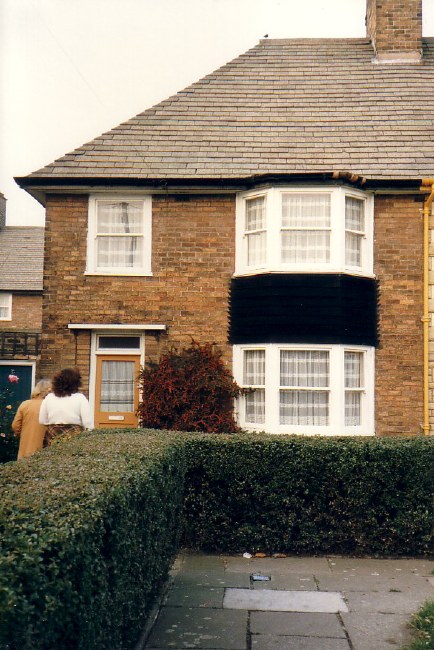
136 Bray Road, Speke, Liverpool · Photographed by Reg Bird
described
The houses were built by the Unit Construction Company to designs by the Liverpool City Architect, Sir Lancelot Keay, and were imaginatively designed to provide a wide variety of styles, thus avoiding any monotony in the blocks of houses. Most of the blocks consisted of six houses in a terrace, and often the six houses would be subtly different from each other. Number 136, Bray Road is situated on the North side of the road and is seven houses along from the junction with School Way. The first block of six from the junction with School Way, numbered 138 to 148, are of a "parlour type" which had a living room, with a bay window, at the front of the house, and a kitchen occupying the rear of the ground floor. These houses were constructed of common brick which had been painted white with cement based paint. The original rent for this type of house was 12/6d. per week. Number 136 was a different design of house and was the first of a row of six which were set back from the building line of the first six houses. These houses were larger and the rent was 18/6d. per week.
Bray Road is a wide road with pavements on each side, as well as a grass verge on each side between the pavement and the road. Because the block of houses in which number 136 is situated is set back from the building line of the adjoining blocks, the extra space in front of the houses was laid out as a shrubbery. This was enclosed with the same style of railing as that used as the boundary of the front gardens of the houses. At the time when the houses were beginning to become occupied, the Liverpool Corporation Electric Supply Department had placed a dummy electric cooker in one corner of this shrubbery, as an advertisement for its services.
Number 136 was the end of a terrace and so had three exterior walls, all constructed of rustic brick, giving a pleasing appearance to the house. The front elevation had a front door to the left of the frontage, and there was a glazed panel or fanlight above the door. The original door had no glazing in it. Above the door there was a sash window to the small front bedroom. The main feature of the front elevation was the double bay formed from the bay windows of both the main front bedroom and the downstairs front room or lounge. All three faces of each bay had opening sash windows. The space between the upstairs and downstairs bays was decorated with overlapping horizontal wooden boards, which were stained.
The side elevation of the house had a window to the upstairs landing, and a small window providing light to the larder off the kitchen. The rear elevation had flat sash windows to the upstairs rear bedroom and ground floor living room below, as well as windows to the upstairs bathroom and toilet and the downstairs kitchen.
When the houses were built, all the windows were subdivided into small panes of glass so that, for example, a bay window had 12 panes of glass in its front face and 8 panes of glass in each of its side faces, making a total of 28 panes in one bay window. This arrangement was typical of houses built elsewhere in that period and whilst it provided a pleasing appearance, it made cleaning the windows or painting the window frames much more difficult than with larger panes. The windows in these houses remained unchanged until about 1970 when the Corporation replaced the glass with larger panes.
There was a side path giving access to the back of the house via a gate in a brick built wall. Those houses which were in the middle of the block had a communal passageway at ground floor level between the two houses, giving them their own access to the rear through separate gates. Alternate houses had a small box room situated over the passageway.
The front door gave access into quite a wide hall from which the staircase ascended on the left hand side towards the rear of the house. On the right hand side of the hall a door gave access to the front lounge in which there was built a fireplace diagonally across the interior corner at the rear of the room. This had a tiled surround and hearth.
Further along the hall, on the right hand side, a second door provided access to the rear living room, which had a fireplace on the right hand wall which was the party wall between that house and the house next door. This fireplace also had a tiled surround and hearth and was fitted with a back boiler for the provision of hot water. The grate had two knobs for operating dampers to control the flow of air through the fire, enabling the fire to be quickly aerated to provide hot water more quickly, or damped down when the extra heat was not required. To the right of the fireplace there was a built-in cupboard from floor to ceiling and its upper portion had glass doors. The lower portion had two drawers above two cupboards.
Another door at the rear of the hall, and facing the front door, led into the rear kitchen, which had a built in larder occupying the usable space under the stairs. This larder had a door from the kitchen. A rear door led directly from the kitchen to the rear yard of the house. There was an electric cooker fitted on the wall between the larder and the door to the hall, and an electric boiler was also provided for laundry.
The straight flight of stairs led from the hall to the upstairs landing which was roughly square in shape. There was a sash window on the landing at the left hand side of the head of the stairs. Opposite the head of the stairs there was the toilet, and next to it at the rear of the house there was the bathroom with a bath and washbasin.
A door facing the landing window gave access to the rear bedroom, which had a built-in airing cupboard on the interior wall adjacent to the window. Inside the airing cupboard was a hot water storage cylinder fitted with an electric immersion heater which could be used to provide hot water when the fire was not lit. On the landing, next to the back bedroom door, another door led to the large front bedroom with the bay window. In this room, on the party wall with the house next door, was a tiled fireplace.
On the landing, the door next to that of the large front bedroom was the door to a store cupboard which was fitted with shelves. George used to keep many of his tools in this cupboard. The last door on the landing was that giving access to the small front bedroom which was built over the hall and partially over the staircase. This room had a built-in cupboard at the rear, occupying space over the stairs. A hinged door in the landing ceiling gave access to the loft.
All the floors in the house were boarded, with the exception of the kitchen which had quarry tile flooring. All the interior walls had been painted by the builders with "Walpamur" paint of a light cream colour. George and Doris laid linoleum on the floors of the living rooms but it was some time before they could afford carpets. Lamp shades were supplied throughout the house and these were of white glass in a shallow conical shape. The electricity meter was located in a small cupboard beneath the stairs.
There were gardens at both front and rear of the house. The back garden sloped slightly upwards away from the house and bordered on to the houses in Rycot Road which ran parallel to Bray Road. The boundaries between the back gardens were formed with chestnut palings. A brick built coal place was provided at the end of the back yard forming a boundary with the house next door, No. 134. A large wooden wind break screen had been provided at the west side of the back yard to provide some protection from the prevailing south west winds which blew in across the Airport, striking the exposed west end of the house.
The front garden of number 136 extended forward on one side to reach the pavement which ran in front of the block of houses next door which were not set back. This garden was somewhat larger than its neighbours, and was one of the reasons George chose the house. The boundaries of the front gardens of the houses were formed from a low fence, about eighteen inches high, constructed of concrete posts with a tubular rail connecting them.
When George and Doris moved in, the houses on either side were not yet occupied, but the house next door but one, Number 132, was already occupied by a family called Roberts, who came to be good friends of George and Doris over the years. The adults in that household were Ted, who was an engine driver at the nearby Speke Junction railway depot, and Lucy, his wife. They had two sons, Ted (junior) and Ron who became a good friend of George's son, Reg. About a week after George moved in, a family called Lindforth moved in to number 134, and soon after that a family called Sweeney moved in to number 138. The Lindforth family did not stay long at their house, but the Sweeney family still remain at number 138. A new family moved into number 134. They were Tom and Ivy Adams, with their two children, Muriel and Roy. They were to stay there many years. In fact many of the families who moved into the new houses in the area did stay there for a long time and George and Doris got to know most of them quite well.
Jack Ireland's
cottage, 1613
Amenities in Speke at that time were almost non-existent. The only shops in the immediate vicinity were a sweet shop run by a family called Sumner in the front ground floor room of one of the original village cottages in Speke Church Road. The head of that family, Alfred Sumner, had been a farmer at Hale Road Farm, but had sold up on 23rd. February, 1937, when his farm was acquired for the construction of the Rootes factory. The Sumners had apparently also been carters, and had run a Post Office from the cottage in Speke Church Road.
By the time George moved to Speke, the Post Office was now being run by a family by the name of Nursall from their cottage in Speke Town Lane. This family had been previously running a tea garden at the side of their cottage in the days when Speke was a rural village, and their patrons were mostly cyclists who were passing through Speke on their way to or coming back from a day's cycling in the country. This Post Office was operated in a wooden lean-to building at the side of the cottage, and sweets and newspapers were sold as well.
Several of the old cottages remained, gradually becoming surrounded by the new housing estate, but some lasted well into the 1960s. The oldest cottage in Speke at that time was also in Speke Town Lane, situated on the north side of the road, which had been the original lane into Speke, and between what are now School Way and Gerneth Road. This white washed, half timbered, four roomed cottage was built in 1613, and in 1938 was occupied by Mr. John Ireland and his niece, Mrs. Frances J. Raper, who had lived there most of their lives. A photograph was published in the Liverpool Evening Express on 3rd. November, 1944, showing the cottage still standing then, but surrounded by new houses, and with a caption saying that Mr. Ireland proclaimed himself to be one of the oldest men in Speke, if not the oldest. He was then 87 years of age and Mrs. Raper was 75. The cottage continued to stand for many years but was eventually pulled down, probably on the death of the occupants, and new houses were built on its site. George's son, Reg, can remember being sent on several occasions to Jack Ireland's cottage for such things as cabbages or other vegetables which Jack grew in his garden and sold to local households. Old photographs show John Ireland's cottage displaying a sign advertising that teas were served there.
The old farmhouse of Greyhound Farm was still standing on the West side of Speke Church Road between Speke Town Lane and what is now Gerneth Road. In 1938, when George first moved in to Bray Road, this old farm house was used by the Liverpool Corporation Housing Department and the Liverpool Corporation Electric Supply Department as offices and sales offices.
An old Smithy stood on the South side of Smithy Lane (now Blackrod Avenue) at its junction with Speke Church Road. The building was not in use at that time, but later became successively a Public Library and then a grocer's shop.
The only original old buildings still standing in Speke, at the time of writing, other than Speke Hall, are All Saints Church, with its Church Hall, which was the former school, and a row of three cottages in Hale Road opposite the church. These were originally tied cottages tenanted by workers from the Speke Hall estate.
cottage, Speke
Town Lane
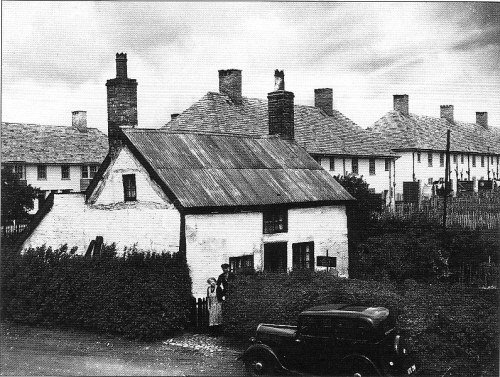
Jack Ireland's cottage, Speke Town Lane · New houses in School Way behind
and the factory
One of the first things that George and Doris had to do on moving into their new home was to arrange a school for the two boys. Reg was seven and Norman had just turned six. On Monday, 2nd. May, 1938, the two boys were enrolled in All Saints Church School, numbers 808 and 809 respectively in the school admission register. The school had been a rural village school until the recent commencement of building of the housing estate and many of its pupils at that time were farm children. There was soon a massive increase in the number of admissions to the school, quickly making it overcrowded, but it was to be the following year before the situation improved with the building of a new school in Hunts Cross to which Reg transferred along with many others on 22nd. April, 1939. Norman stayed at the church school until it closed on 31st. May, 1940, and he was transferred to a new school in Stockton Wood Road, Speke.
Doris was keen for Reg to continue with piano lessons and a piano teacher was found in Garston. She was Miss Hannah Fogg, F.V.C.M (Fellow of the Victoria College of Music), who lived at 83, Canterbury Street. She was a middle aged single lady who worked in the Bryant and May match factory in Garston. She was a very able teacher and Reg took lessons with her for about seven years. At first, Miss Fogg used to come to Bray Road to give Reg his lessons, but after a time Reg started to travel each week to Miss Fogg's home for his lessons.
George and Doris settled in to their new home and the whole family enjoyed the luxury of modern conveniences such as a proper bathroom with a plumbed-in bath. There was an indoor toilet for the first time and there was much more room in the three-bedroomed house than in their former home in Tranmere.
George really appreciated having a garden for the first time in his life and set about cultivating both front and rear gardens. He laid lawns at front and rear and soon acquired a second-hand greenhouse in which to grow his tomatoes and cucumbers and to raise his own seeds for bedding plants. He laid a crazy paving path up the centre of the back garden separating the lawn from the other side where the greenhouse stood and where he grew vegetables. At the front, he laid a lawn on the shorter side of the garden under the bay window, but on the other side of the front path, the lawn only extended as far as the front gate, and the rest of this part of the garden was devoted to the growing of vegetables. At the side of the house he built a shed in which to store his garden tools and he built a bench in it so as to provide facilities for his woodworking. Whilst digging the gardens soon after he moved in, George came across, among other items, two old coins, both of them from the reign of King George III. One was a halfpenny piece dated 1799, and the other was a penny piece dated 1806. Both are in possession of George's son, Reg.
The new house was not without its disadvantages in the early days. The nearest shops for food and other basic necessities were either at Garston, a distance of about two miles by the half-hourly Crosville bus service from All Saints Church, or at Hunts Cross, a walk of about a mile and a half. There was no bus service to Hunts Cross at that time. There was a Garston and District Co-operative Society shop newly opened in Hunts Cross however, and Doris did some of her shopping there. To fill a gap in the shopping amenities in the new Speke estate, various retailers provided a service in the form of mobile shops or home deliveries. The Garston and District Co-operative Society had a large van fitted out as a shop, from which housewives could obtain a wide variety of foodstuffs and other household items, and this would stop at various locations on the new housing estate several times during the week. Other retailers included a greengrocer called Holmes, from Garston, who would arrive with his van from which he sold his produce. There was also a bakery called Hales' in St. Mary's Road in Garston, who delivered bread daily in a van around the estate.
There was no public house in Speke at that time, and if George felt like going for a drink, the nearest public house was the Hunts Cross Hotel, a walk of about a mile and a half along the old Woodend Lane. This lane was a continuation of the original Woodend Lane, part of which still exists in the housing estate, and ran from Speke to Hunts Cross between high hedges, and through fields, between what are now the sites of the Metal Box Factory and the Glaxo factory. The lane led to Speke Railway Station which was located at the railway bridge in what is now Woodend Avenue. The station had originally opened on 1st. July, 1852, but due to a lack of passenger demand had closed on 22nd. September, 1930. The platforms and some of the station buildings remained for many years and were still there in 1938. On the opposite side of Woodend Lane to the station, there stood Speke Vicarage, an imposing black and white half-timbered house called "The Slades". At that time Woodend Avenue between the station and Speke had not been built. As he was fond of walking, George would sometimes, especially in the summer, walk further afield for a drink to such places as the Eagle and Child in Halewood, or the Beehive in Halebank.
The Rootes aircraft factory was only a short walk of about ten minutes from George's home and he walked there via Gerneth Road, Speke Church Road and Speke Hall Avenue. At that time, there was a large hoarding situated in the garden of one of the Hale Road cottages at the junction with Speke Church Road and Speke Hall Avenue. The hoarding contained quite a large electric clock and advertised the services of the Liverpool Corporation Electric Supply Department. The clock was useful to workers on their way to the Rootes factory, letting them know whether they were late for work!
When George started work at the Rootes factory, the plant was not in production and George related how his first job at the factory was to make some goal posts for the benefit of workers who wished to play football during their dinner breaks! After a period of tooling-up for production, work eventually started on building the first aircraft, which was the Bristol Blenheim, Mk 1. This was a metal skinned plane with many wooden components, including some control surfaces and wing tips, on which George worked for some time, constructing these from laminations of plywood. Eventually the first completed aircraft was rolled out of the factory and towed via an access road across Speke Hall Avenue into Speke Airport from where it was to be flown away to enter service with the Royal Air Force. Many of the families of workers at the factory, particularly the children, went to Speke Hall Avenue to see this first aircraft being rolled out of the factory. The factory went on to produce many more Bristol Blenheims, including the long-nosed Mk IV version, and some work was also done on components for other Bristol aircraft such as the Beaufighter and the Bolingbroke, which were being produced at other plants. There was talk that the Bolingbroke might be produced at the Speke plant, but that did not happen. In later years, after George had left the Rootes factory, Handley Page Halifax aircraft were built there, and later still, after the Second World War, the factory was taken over by the Dunlop Rubber Company for the production of tyres.
Factory; Bristol
Blenheims, 1939
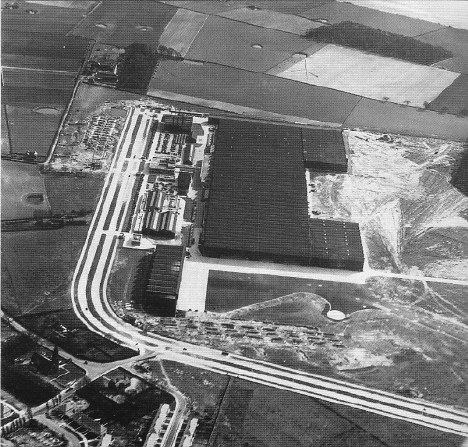
Aerial view of the Rootes Aircraft Factory, Speke
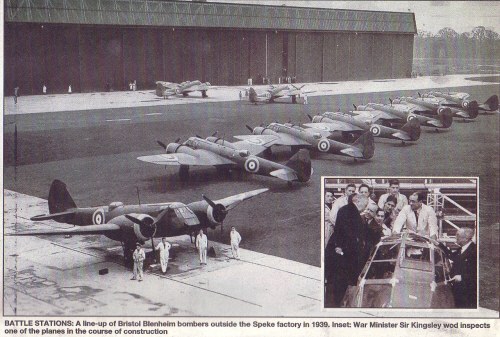
Bristol Blenheim bombers outside the Speke factory · 1939
Summer 1939
Probably with the work and extra expense involved in the move to Speke, no family holiday was taken in the summer of 1938. However, when George had settled into his new job, and the family were established in their new home, he took Doris and the boys for a week's holiday in the Isle of Man during the summer of 1939.
George's Aunt Annie had been holidaying in the Isle of Man for several years and recommended to George the accommodation she had used. This was a small farm at Silverdale, near Ballasalla, in the south of the Island. A man called Lancaster, who had been a Police Constable in "B" Division of the Liverpool City Police, owned the farm. He had retired to the Island, of which he may have been a native.
George and Doris, with their two sons, made the trip to the Island on the Isle of Man Ferry boat "Ben-my-Chree" (4), a Cammell Laird built ship which had been launched in 1927 when George was working at that shipyard. Later that year, on the outbreak of the Second World War, the "Ben-my-Chree" was requisitioned by the Admiralty as a troopship and saw service in that capacity at Dunkirk, the Faroe Islands and the "D"-day landings.
George and his family arrived in Douglas after a crossing of about four hours. They then took the antiquated narrow gauge steam train to Ballasalla Railway Station where they were met by Mr. Lancaster with a pony and trap which conveyed them all with their luggage to the farm, about a mile distant.
The week was spent in sightseeing mostly around the southern part of the Island, with trips to Ballasalla, Castletown, Rushen Abbey, Port Erin, and Peel. A photograph exists of George with the two boys at Peel Castle. Whilst visiting Peel, the family took the opportunity to visit the kipper sheds where herrings, freshly landed by the many fishing boats of the port, were cleaned and smoked by a large staff of girls who could deal with huge amounts of the fish in a very fast time. Manx kippers were, and still are to this day, considered amongst the best flavoured anywhere, and most holiday makers in the Isle of Man took some home with them at the end of their holiday. Also, while staying at the farm, the boys were taken out by Mr. Lancaster in the trap on at least one occasion when he was delivering milk to neighbouring houses. The pony was called "Dolly" and had only one eye.
During this holiday, George's son, Reg, recalls the family going into a "Singing shop" in Douglas. This was a type of establishment popular in seaside resorts of that time where printed sheet music of new popular songs was sold after being performed by a pianist on the premises and accompanied in the singing parts by the customers attending. It was a popular way of advertising and selling the music to songs that the customers may have heard on recent radio programmes.
Another attraction for holiday makers at that time, and to where George took his family while in Douglas, was the "Camera Obscura" on Douglas Head. This consisted of a circular wooden building, the interior of which was in darkness. Ranged around the interior walls were screens on to which were projected images of the surrounding panoramic scenery by means of mirrors and lenses mounted around the conical roof of the building. By means of this, views, throughout 360 degrees, of the whole of Douglas sea front, were displayed including Douglas Bay, the Tower of Refuge, and Douglas Head. At the time of this holiday, preparations were in hand for an imminent war, and military activity was evident in the form of large numbers of soldiers performing drill on Douglas Promenade.
Also visited by George and his family whilst on this holiday was a local beauty spot at Silverdale Glen, only a short walk away from the farm where they were staying. This was very popular with the children. Amongst other attractions at the Glen there was a children's playground, a boating lake and a cafe. In the children's playground there was a roundabout which was driven by gearing from a water wheel in a stream which ran through the glen. The roundabout could be started or stopped by means of a lever which operated a sluice gate to allow or prevent the flow of water to the water wheel. During the week's holiday, George and his family also visited an agricultural show, which it is thought was in the Castletown area.
After a very happy week's holiday, George and his family were taken back to Ballasalla Railway Station by Mr. Lancaster in the pony and trap. They then made the return journey on the steam train back to Douglas, where they embarked on the Isle of Man Ferry Boat, "Manxman" (1), for the trip back to Liverpool. This ship was an elderly two funnelled vessel built in 1904 and was also requisitioned by the Admiralty during the Second World War.
This holiday proved to be the last for George and his family in the years of peace before the Second World War.
and Norman at
Peel Castle, 1939;
the family near
Ballasalla
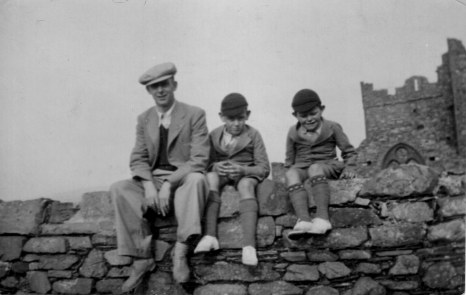
George with Reg and Norman at Peel Castle, Isle of Man · 1939
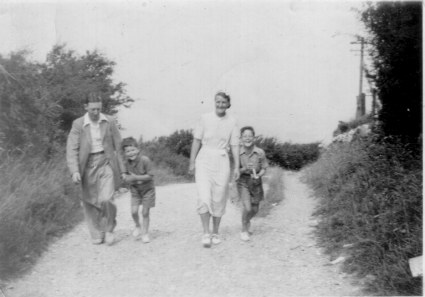
George, Norman, Doris and Reg near Ballasalla · 1939