Mersey Insulation;
Chinatown
During the time George had been working at Maison Fittings, which was just on the edge of Liverpool's compact and bustling 'Chinatown', he had been introduced to Chinese food and provisions. He had been taken to lunch on more than one occasion by his boss, Mr. Lovelady, to the "Far East" Restaurant in Great George Square. He had also visited local Chinese grocery shops, where he had occasionally purchased delicacies such as Kiwi Fruits, known as Chinese Gooseberries, which he brought home for his family to try.
At some time not long after the war finished, George left Maison Fittings and started work for a ship repairing firm called The Mersey Insulation Company Ltd. in Bootle. This firm was an associated company of a large ship repairing firm called A. & R. Brown & Co. Ltd., with Head Offices at Regent Road, Bootle. A. & R. Brown was founded in 1837 and initially specialised in copper and brass work but with the commencement of the First World War became one of the most important general ship repairers on Merseyside. However, like many other large ship repairers, the firm was not complete in the sense that they had workshops for each of the twenty or so trades that were used in total ship repairing. For their joinery work, they relied on workers from their associated company, Mersey Insulation.
The end of the Second World War, far from reducing the amount of ship repair work, actually led to an increase. During the war only essential repairs had been carried out. Ships which had been requisitioned by the government in the war and converted to military use had to be reconverted, the cost being met by the government. There was a huge increase in the number of ship repairers on Merseyside at that time, numbering over 20,000 by the early 1950s. At the Mersey Insulation Company, George was employed as a joiner, working on the refrigerated holds of ships mostly employed in the meat import trade, and which were probably almost exclusively owned by the shipping line, Houlder Brothers, who were the parent company of A. & R. Brown.
All the time he was with that firm he was working on ships in the North Docks of Liverpool and this meant commuting daily between his home in Speke and his work at Bootle. This entailed the long journey on the route 81 bus, a trip of about 8 miles taking about three-quarters of an hour each way. It is not known why George went to work there but it was probably for better wages than he was earning at Maison Fittings, and there was also quite a lot of overtime available.
Also at about this time it is thought that George had a spell of working as a pattern maker at Harland and Wolff, the Belfast shipbuilders who had a ship repair shop in Bootle by the Brocklebank Graving Dock, and who specialised in the repair of ships which had been built at the Belfast yard.
During the time that George was working in the Docks he mingled with seamen of all nationalities and developed a taste for some foreign foods, particularly curry, to which he was introduced through working with Indian seamen. Also at this time he started to use coconut oil as a hairdressing. This was used by the Indians and gave a gloss to the hair as well as having a pleasant smell. George had always used some kind of hair cream throughout his life, progressing through 'Brilliantine', a preparation which was bought in tins and consisted of a fairly hard gelatinous substance of which a little, rubbed between the hands and applied to the hair, gave a shine to the hair. He also used 'Brylcreem' for many years, and when that was not available, particularly during the war, he used a small amount of liquid paraffin. George always had a good head of hair, which, in his younger days was very dark brown, almost black. Although it turned to grey in his later years, it remained quite thick. He always had a centre parting to his hair.
from summer 1945
Soon after the end of the Second World War, Billy Briggs who was married to George's cousin Maggie (nee Fletcher), bought a quite substantial wooden bungalow named "Ayr View" at Talacre, North Wales. It stood in a plot of land of about half an acre, at a distance of about a quarter of a mile from the sea shore which could be reached by walking through large sand hills. In the immediate post-war years Talacre became a very popular holiday location for many Merseyside families and developed rapidly, in the days before planning restrictions, into what can only be described as a shanty-town, consisting largely of converted old buses, furniture vans, railway coaches and the like. Some were roughly constructed of wood or other materials and the general appearance of the area consisted of a hotchpotch of styles of building. Each had its own small area of land upon which it was sited. Access to each site was provided by a concrete roadway called The Warren which started near the Point of Ayr Lighthouse and ran south west for about a mile and a half to Gronant, running inside the extensive sand hills which separated them from the shore. Presumably a ground rent was paid to the Local Council for the use of these sites.
Only primitive amenities were available in most of these temporary holiday homes. However, their proximity to the beach, together with a camping-like atmosphere and the fairly easy access from the Liverpool area drew large numbers of their owners, and the people to whom they let them out, to enjoy a fairly inexpensive summer holiday there. Most of the accommodation had no water supply and water had to be obtained from a few stand pipes which had been set up along The Warren. In the peak season, when numerous families were on holiday there and there was a great demand for water, long queues would form at the stand pipes from which water flowed only as a trickle.
The bungalow, "Ayr View", was rather superior to most of the temporary holiday accommodation which had so rapidly sprung up. It was a sturdily built and quite spacious building, which had probably been built before the Second World War. The surrounding land was sufficient for a small caravan to be placed near the bungalow, and in the summer of 1945, George took his family for the first of many holidays there. They slept in the caravan but ate their meals in the bungalow with other members of the family, including George's mother, who happened to be holidaying there at the time.
George and his family travelled to Talacre by Crosville bus from Birkenhead, changing at Chester, and would alight from the bus on the main coast road at Talacre before walking down the long road to where the bungalow was sited. This was a distance of about a mile and included the climb in the road where it passed over the railway line at Talacre Railway Station.
Almost next door to the bungalow there was a shop where provisions could be obtained, and there was also a Social Club where holiday makers could obtain temporary membership. George enjoyed visiting the Club in the evenings and having a game of snooker there.
As well as visiting the sea shore, George enjoyed taking the two elder boys on quite long walks into the hills above Talacre. These walks usually included a visit by George to a pub in the village of Gwespyr, part way up a steep hill, while the boys waited outside having been provided by George with lemonade. Whilst at Talacre, George also enjoyed taking an early morning walk through the nearby fields where he was sometimes able to find field mushrooms which he could fry for a treat with the breakfast bacon and eggs.
prefabs; Reg's
National Service
1948
Soon after the end of the war, George had to give up the allotment at the rear of Gregory's factory, probably because the land was required for development, but he continued to enjoy cultivating his own garden. A Gardening Club had started up in a prefabricated hut in Clough Road, quite close to his home, and by joining this club he was able to obtain garden supplies such as seeds, bedding plants, fertilisers and peat at discounted prices.
He had also taken to going to Hale where he got to know quite a few of the local inhabitants who were enthusiastic growers of such plants as Tomatoes, Chrysanthemums, and Dahlias which they raised in their small cottage gardens. George was able to buy such plants quite cheaply and the transaction usually included a visit to the local public house, the "Childe of Hale", to put the seal on the deal! George continued his visits to Hale for many years, usually in the Spring when the tomato plants were ready, and sometimes at other times for rooted cuttings of Chrysanthemums, or tubers of Dahlias. He remained just as fond of growing these particular flowers as he had been through all the years he had been gardening and was very proud of the results of his efforts. From autumn into the winter there were always plenty of chrysanthemums for cut flowers in the house as well as to give away to his friends and relations. He grew both early and late Chrysanthemums. The earlies were grown in the open ground in the back garden in front of the greenhouse, and he grew the lates in large plant pots which he would take into the greenhouse when the tomato crop had finished at the end of the season.
About this time, there was a considerable shortage of houses nationally due to the effects of enemy bombing during the War, and Liverpool was no exception. Liverpool Corporation Housing Department started to erect pre-fabricated houses, colloquially known as "prefabs", in various areas of the City, both on bombed sites in the urban areas, and also in suitable new sites in the suburbs. About 1946, erection of these prefabs commenced on spare undeveloped land in Rycot Road and Clough Road, adjacent to Speke Boulevard, where a large number were erected. These single storied houses were manufactured in factories and brought, largely assembled, to their sites. Those in this first series were constructed of timber and clad with asbestos sheeting. The sites had already been prepared with foundations and service utilities. There was only a little work to be done at the site and once the utilities were connected, the houses were ready for occupation. These prefabs were followed shortly afterwards by another batch in newly constructed roads, Dymchurch Road and Appledore Road, to the West of School Way. These were of a different design, and constructed of aluminium. The expected life of all these buildings was about ten years but they did in fact last much longer than that.
George had at that time made the acquaintance of a man called Bert Packman. Bert was the brother-in-law of George's neighbours, Mr. and Mrs. Griffiths, who lived in Rycot Road but whose rear garden backed on to George's. Bert lived in Watergate Lane, Woolton, and was a foreman gardener in the Liverpool Corporation Parks and Gardens Department at Camp Hill, Woolton. George was particularly fond of growing the giant decorative Dahlias and Bert was sometimes able to obtain tubers of these for him. George grew tomatoes every year and his favoured varieties were "The Amateur" for outdoor growing, and "Money Maker" and "Ailsa Craig" for growing in the greenhouse. He also grew many of his own bedding plants from seed, amongst which were white Alyssum, blue Lobelia, Antirrhinums, Petunias and Nemesia. He made his own seed boxes from wood and these would last for many years of annual use.
Until the end of the war there had been no Public Library on the Speke Estate but George's sons used the Library at Bowden Road, Garston. When the war ended, an unoccupied Corporation house in Blackrod Avenue, at the corner of Blacklock Hall Road, was taken into use as a Public Library, and George and his family started using the facilities there to borrow books.
In the summer of 1947, George's eldest son, Reg, left school and started work as a telephone operator with Liverpool City Police. His wages were only minimal but at last there was a second income coming into the home. The following year, 1948, Norman left school and started work as an office boy with the Pacific Steam Navigation Company, also contributing something towards the income of the family.
About 1947, Doris had to go into the Women's Hospital, in Catherine Street, Liverpool, for an operation, probably a hysterectomy. She was in hospital for probably about ten days, and during this time, George's mother, Emily, came to stay with George and his family to do the cooking, washing and other housework in the absence of Doris.
On 30th. August, 1948, Reg was called up for National Service and entered the Royal Air Force. His contribution to the household expenses did not cease entirely, however, as a modest allotment from his pay was made to his mother, who also had the benefit of not having to feed him, apart from the times he was home on leave. On the 1st. January, 1950, Norman decided to enlist in the Royal Air Force as a regular, and so with the two elder boys now away in the R.A.F., George's family was back to one child, Brian, then aged 9, still at home.
houses, Belle Vale
1953
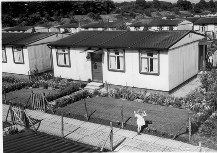
Prefabricated houses, Belle Vale · 1953
Humphreys;
adopted as
Carolyn Marie Bird
9 May 1952
About 1949, George went with Doris's brother, Herbert, for a week's holiday in the Forest of Dean. As Herbert was a bachelor, he was always happy to take one or more of his relatives away for a holiday with him in the summer months. It is thought that this was the only time George went with him.
On 11th March, 1950, Reg finished his National Service in the R.A.F. and was back living with the family. On 14th. April, 1950, he joined the Liverpool City Police as a Police Constable but spent the next three months away from home during the week whilst he was training at the Police Training Centre at Bruche, near Warrington. He did, however, come home for weekends during this training. In July, 1950, his training finished, he started in "C" Division of the Liverpool City Police at Essex Street Police Station, where his duties revolved in a three week shift pattern with one day off each week. His family had to adapt to having a shift worker in the house, although for two out of the three weeks, George was able to eat his evening meal at about 6.0pm. with all his family present, except for Norman. On the weeks that Reg was on afternoon duty, that is 3.0pm. to 11.0pm., George would probably not see Reg who would not be home before George had gone to bed.
At about this time, in the early 1950s, George was again working at Maison Fittings, having for some reason left the Mersey Insulation Company. It was George's custom at that time, when he finished work at about 5.0pm., to walk from Washington Street where he worked, to Park Road, where he would go for a pint of beer in a Public House before boarding the route 82 bus for home. He would only have the one pint but much enjoyed it after a hard and dusty day's work. Reg, who patrolled beats in the Park Road area, would occasionally, when he was on duty on the afternoon shift, come across his father in Park Road, when they would pass the time of day before George's bus arrived.
George's neighbour, Mrs. Nellie Griffiths, had a friend and former work colleague called Myfanwy Hughes, known as "Auntie My", who was then working in the Children's Department of the Liverpool Corporation, which was a forerunner of the Social Services Department. Some time in 1950 Auntie My approached George and Doris to see if they were interested in fostering a baby girl. Doris, who had had three sons but, disappointingly, no daughters, was keen on trying a period of fostering the baby and quite soon the baby, Laura Marie Humphreys, who was then about 18 months old, came to stay with George's family. The circumstances of how the child came into the care of the Children's Department are not fully understood, but it is known that Laura's natural mother, Frances Mary Olive Humphreys, was a stewardess working on Canadian Pacific Line ships sailing to and from Canada. Frances did in fact visit her daughter on several occasions while she was being fostered by George and his family. The fostering continued under the supervision of the Children's Department until 9th. May, 1952, when George and Doris officially adopted the child and changed her name to Carolyn Marie Bird. She was then aged 3 years and 4 months. Carolyn was readily accepted into the family as a new baby sister by her three brothers, and became known to all the family as Lyn. The other children of George and Doris were considerably older than Lyn, Reg being 19 years older, Norman 17 years older and Brian 9 years older.
Lyn with Billy,
April 1951
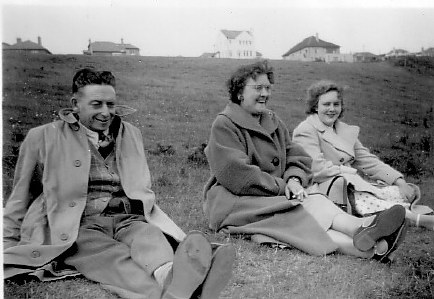
George with Reg, Brian, Maggie Fletcher, Emily, Doris & Lyn · Outside "Ayr View", Talacre · June 1950

Lyn with "Billy" · Front garden, 136 Bray Road · April 1951
the Coronation;
National Insurance
George continued to take holidays at the site at Talacre at some time during the summer months when he was on holiday from work. As Reg was now working and Norman was away in the Royal Air Force, it was only George, Doris, Brian and Lyn who stayed at Talacre, although other relations, including George's mother, Emily, and George's cousin, Maggie Fletcher, were sometimes on holiday at the same time staying in the bungalow, "Ayr View". Reg would occasionally travel by bicycle from his home in Speke to visit his family when they were holidaying at Talacre.
In 1953, not long before the Coronation of Queen Elizabeth II, George decided to buy a television set. Very few households had one at that time but the forthcoming Coronation was a national event to look forward to. It was known that the occasion would be televised and this gave some impetus to the sale of television sets. George purchased a set from Johnson's in Allerton Road, Allerton, for about £90 which was a lot of money then for a working class family. An "H" shaped aerial was erected on the chimney and the set was installed. Those early television sets were in quite large cabinets but the picture was displayed on only a 9 inch screen. Most people had been used to seeing moving pictures in the cinema but it is now very difficult to imagine the amazement and excitement at seeing moving pictures in the home for the first time. On the day of the Coronation, 2nd. June, 1953, the television broadcast occupied most of the day and as George's home was one of the few in the neighbourhood with television, several neighbours drifted in and out during the day to see parts of the pageantry of the occasion.
While he was working at Maison Fittings, about 1953, George had quite a serious injury to a finger tip whilst using a planing machine and had to spend a night in the Royal Southern Hospital. His son, Reg, visited him while he was in hospital.
While he was working at Maison Fittings in Washington Street, burglars broke into the factory and amongst the property which was stolen were some of George's woodworking tools. The offenders were subsequently arrested and George was required to attend Liverpool City Magistrates' Court and give evidence to identify his tools.
Following the acquisition of the television set, it became George's custom for a while to invite his neighbours, Ted and Lucy Roberts, into his home in the evenings, particularly on Saturdays, to watch television programmes. Ted would bring in a few bottles of beer and make the evening a social occasion. This arrangement lasted until Ted and Lucy got their own television set. In the early years that George owned a television set there was only one channel transmitted, that of the BBC, and it was to be some years before other channels became available.
Insurance Card
December 1950
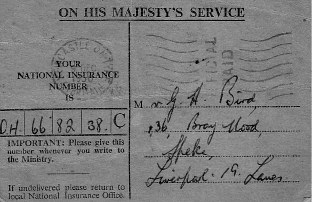
George's National Insurance Card · Sent December 1950 by the National Insurance Office, Newcastle on Tyne
De Havilland,
Broughton;
Reg's wedding
1 October 1955
George had a "Qualcast" side-wheel lawn mower for most of the time he lived in Speke. Ted Roberts was not particularly fond of gardening although he liked to keep his front and back gardens tidy. He did not own a lawn mower but George was more than happy to lend him his as Ted conscientiously cleaned and oiled the machine after using it each time and adjusted the mechanism and sharpened the blades as necessary.
About 1953 or 1954, when Lyn was a teenager, she acquired a bicycle. George had never ridden a bicycle in his life but decided it was time that he learned to do so. He would borrow Lyn's bike on Sunday mornings and set off locally to learn to ride. He would usually go to the quiet roads around the Airport, such as Speke Hall Avenue, and eventually became quite proficient in riding the bicycle. He never became a confident cyclist and did not use the machine for any purpose other than a local ride on Sunday mornings.
When the Second World War had started in 1939, work on the construction of the Speke Estate was suspended and the housing finished with the building of Western Avenue and Linner Road at the eastern end. In fact, some of the houses in Linner Road had not been finished when the war interrupted the building operations and those houses were hastily finished as single storey buildings with flat concrete roofs and no upper floor. They remained like that until the war ended when they were finished to their original traditional design. With the end of the War, building work gradually re-commenced on the Speke estate and the population started to increase. About 1952 Speke Library moved from its premises in the house in Blackrod Avenue to the old Smithy Building in Smithy Lane. The premises in Blackrod Avenue reverted to their intended use as a Corporation dwelling house.
At the end of 1954, Norman was demobilised from the Royal Air Force after having served 5 years as a regular. He had been a wireless and radar fitter during his service and intended to make his career in civil aviation in a similar trade. He needed to obtain a Licence for this and had to work for three years in an aircraft factory as part of his qualification. Early in 1955, he accordingly obtained a post at the De Havilland aircraft factory at Broughton, near Chester, which is still there but which is now part of British Aerospace.
At some time after Norman started at the De Havilland factory, George also decided to go there to work. It was probably about the middle of 1955. It is not known why he again left his employment at Maison Fittings in order to do so, but it was probably because the money was better. George and Norman travelled together daily from Speke to the factory at Broughton. This meant a long journey each way. They travelled on the bus from Speke to Lime Street, Liverpool, where they transferred to special buses laid on by the factory to transport their workers to and from Broughton. The expenses of this travel were re-imbursed by the company. However, this made for a very long day. George also found that the work there was not very congenial. Most of his time was spent on the production line, in the close confines of the fuselages of De Havilland Vampire fighter aircraft, where he was engaged in fitting radio racks inside the fuselage. The work involved drilling out housings for the fittings and required very fine tolerances. George was then in his fifties and it was physically demanding getting access into the fuselage of the aircraft. The tools used in the work were operated by compressed air and were connected to the air supply by a flexible air line. Before entering the fuselage, George had to connect his air line to the supply, and if for any reason the air line was disconnected, often by another worker wanting to connect to it, George had to leave the fuselage to reconnect his air line. This was not only inconvenient but the work was on a "piece-work" basis, and could cost him money in lost production. From time to time the aircraft on the production line were moved to a new position on the line by being lifted by an overhead gantry, with those working inside transported with the aircraft. As George had never flown in an aeroplane at that time, he remarked that these occasions were the only times he had ever been airborne!
At the end of the working day when George and Norman arrived back in Liverpool, they would often have a pint of beer in one of the public houses in Lime Street while they were waiting for their bus back home to Speke.
It is not known for sure how long George worked at the De Havilland Factory, but it was probably less than a year. Norman stayed on there for three years.
On Saturday, 1st. October, 1955, Reg married Edna Frances Mayhew at the church of St. John the Divine, Fairfield, Liverpool. George is standing between the two Bridesmaids on the right of the group. His brother Reg, with his wife, Helen, are at the left, and standing between Helen and Doris is George's mother, Emily, then aged 78. Brian is standing behind Emily, and Norman is the Best Man, next to the Groom. Lyn is the young Bridesmaid at the right of the group of three.
George and Doris had met Edna's parents, Ted and Edith, at their home when the wedding was being arranged. Reg had also introduced Norman to Edna's family and as a result, Norman started to court Edna's sister, Vera. When Reg married Edna, he left the family home in Speke to live temporarily at Edna's family home in Fairfield, Liverpool, while they saved for a deposit on a home of their own.
Norman continued to court Vera, and on Saturday, 1st. September, 1956, they were married, also at St. John the Divine, Fairfield. They stayed with George and his family at 136, Bray Road, Speke, for a few weeks following the wedding. On Friday, 19th. October, 1956, Reg and Edna moved into their new home at 12, Tudor Road, Hunts Cross, Liverpool, and Norman and Vera moved there also, where they were to stay for twelve months before they too had a home of their own.
Norman and Vera had been on honeymoon in Onchan, Isle of Man, following their wedding, and towards the end of their holiday, they were joined there by Reg and Edna who had used the same boarding house there on previous occasions. When Reg and Edna reached the end of their week's holiday, they were about to board the boat at Douglas to return to Liverpool, when they met George and Doris who were landing from the same boat, and who had also booked a week's holiday in the same boarding house at Onchan. George persuaded them to stay for a couple of days more before returning home, so that they could spend a few days together on holiday.
Vampire; factory
at Broughton,
near Chester
De Havilland Vampire
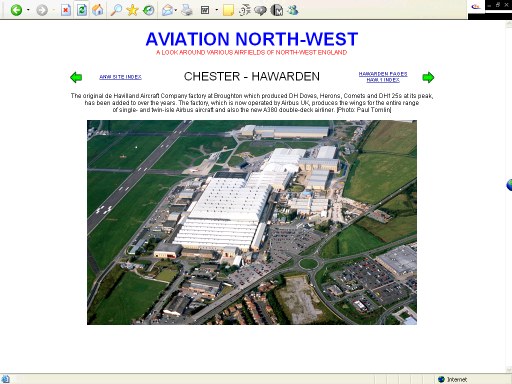
De Havilland Factory · Broughton, near Chester
1 October 1955;
Christmas 1956;
grandchildren
George's family living at Speke now consisted of George and Doris together with the two younger children, Brian and Lyn. Lyn was still at school, but Brian had started work in the local Mothaks Factory in Speke Hall Road, where moth balls were produced. He was engaged in the maintenance of tablet making machinery. However, Reg and Norman's home in Hunts Cross was only a mile or so away from George's home, so regular contact was kept between George and his two elder sons. George was a great help with the initial re-decorating of Reg's home, and also did some joinery work including making a cupboard underneath the kitchen sink.
Reg and Edna now had to decide with which family to spend Christmas. They tried to visit both their families over the Christmas period. Sometimes they would go for a meal to Edna's family home at 4, Huntly Road, Fairfield, and on other occasions they would visit George and Doris.
On Sunday, 10th. March, 1957, George became a grandfather for the first time when Reg and Edna's daughter, Pamela Janet, was born. A little over a month later, on Wednesday, 17th. April, 1957, Vera and Norman's daughter, Jacqueline, George's second grandchild, was born.
One evening, Reg, Edna, Vera and Norman decided they would like to go out for a drink at the Childe of Hale Hotel in Hale Village for a short while, so they took Pamela and Jacqueline, who were still only babies, to George and Doris's home in Speke to see if Doris would like to mind them for an hour or so. Unfortunately Doris had gone out herself for the evening with her friend and neighbour, Nell Griffiths. George said that he had no objection to minding the two babies, who were then fast asleep. They were made comfortable on the settee and left in George's charge. When the parents returned after an hour or so they found a harassed George holding both the two babies who had by then woken up and were crying!
In 1957, Brian, who was then 17, decided to enlist in the Royal Navy, and was to remain in that Service for the next nine years, much of his time being spent at sea. There were now only George, Doris, and Lyn living at 136, Bray Road.
On 26th. April, 1958, George became a grandfather for the third time when Norman's son, Alan Stephen, was born. His fourth grandchild, Michael Robert, the son of Reg and Edna, was born on 30th. July the following year, 1959.
By this time, Norman and Vera had moved away from Liverpool and were living in Weybourne, near Farnham, in Surrey. Reg and Edna were, however, still living in Hunts Cross so George was able to see them frequently.
wedding, 1955;
Christmas 1956;
Onchan, I.O.M.
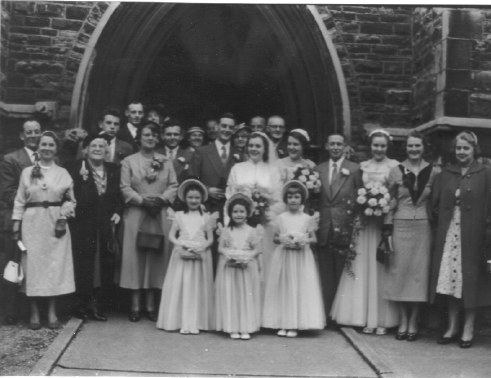
Reg and Edna's Wedding · 1 October 1955
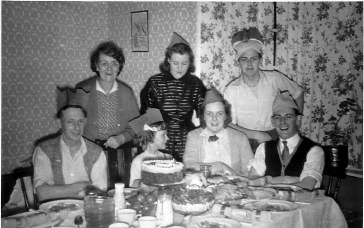
George with Doris, Vera, Brian, Lyn, Edna & Reg · Bray Road · Probably Christmas 1956
at Hunts Cross;
ring culture;
the twins born 1960
George was still a keen gardener and each year he grew most of his own bedding plants from seed. When they were big enough he pricked them out into wooden seed boxes which he made himself. In the Spring and Summer months he would often take some of his home raised bedding plants to Hunts Cross for Reg to plant out in his own garden. Reg was not then an experienced gardener and was still struggling to knock his garden into shape. George was sometimes quite critical about the lack of gardening activity taking place at Reg's home! About this time, however, George's brother, Reginald, was having to leave his allotment at the back of his home in Maybank Road, Tranmere, and the greenhouse which George and his brother had built many years earlier and which was still in good condition, had to be dismantled. Reg hired a van and driver, and George and Reg collected the greenhouse from the allotment and took it to Reg's home in Hunts Cross. George and Reg then re-assembled it in the back garden of Reg's home, where it stayed and performed useful service for a good many further years. From the time Reg acquired this greenhouse his interest in the garden grew and he too started to grow bedding plants from seed. He also started growing tomato plants in the greenhouse, and he and George would go each Spring, usually the last week in April, to Hale village to buy tomato plants ready for planting. George and Reg would then compare notes through the growing season as to how their respective plants were growing.
Throughout his gardening life, George had consistently grown his tomato plants in soil borders in his greenhouse, but about this time he discovered a system of growing tomatoes which was becoming popular and he had heard about through his gardening friends and gardening articles in magazines and newspapers. It was known as ring culture and entailed planting the young tomato plants in suitable compost in a bottomless ring of tough material such as linoleum. The rings were then rested on the top of a bed of water-retaining material such as ash or clinker. The plants subsequently developed two sets of roots, one in the ring of compost, from where they obtained nutrients, and a deeper set of roots in the layer of aggregate beneath, from where they obtained water. This system proved very successful and both George and Reg used it for many years.
George again became a grandfather on 5th. July, 1960, when Norman and Vera's twin daughters, Diane and Alison, George's fifth and sixth grandchildren, were born in Farnham, Surrey. He and Doris went at least once to visit Norman and Vera at their home in Weybourne, near Farnham. George used to like to go for a walk in the mornings, pushing the twins in their pram. On one occasion George discovered a squeak from one of the wheels. There was a motor garage on his route and George went in and asked if anyone could oil the wheels of the pram. One of the mechanics obliged and cured the squeak! On one visit to Weybourne, in 1961, George and Doris went with Vera and Norman and their four children on a day trip to London.
George and Doris continued to take annual holidays, and places they went to included the Lancashire fishing port of Fleetwood and the Irish resort of Bray. Lyn was still a young teenager at this time and used to go with them on holiday. It is thought that the visits to Talacre had ended by this time and that the bungalow there was no longer in the possession of the Briggs family. It is possible that Billy Briggs may have died by this time.
George had been introduced by his friend and neighbour, Ted Roberts, to the L.M.S. Railway Club, Burnsall Street, Garston, where Ted was a member and George was able to join as an Associate Member. For many years George was to enjoy the facilities of this Club, including Snooker and Bingo, and other seasonal events such as Concert Nights. The Club was particularly active over the Christmas Season and the members received tickets for several pints of free beer during that time. George usually went to the Club at the lunch-time session on Sundays and enjoyed a game of Bingo whilst having a couple of pints of beer and chatting to a group of acquaintances who became his friends. George had always been a sociable person who made friends readily. The group of people with whom George usually sat were mainly drivers, firemen and signalmen on the L.M.S. railway, and they always had plenty of interesting anecdotes to recount about their experiences. George's son, Reg, often accompanied George on his Sunday lunchtime visits to the Club.
pigeons, Trafalgar
Square, London
1961
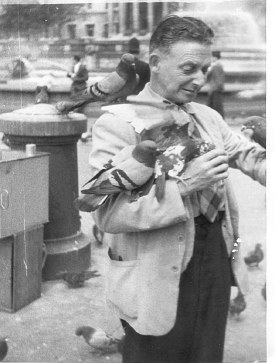
George feeding the pigeons · Trafalgar Square, London · 1961
to Bray Road
about 1960;
dies 14 December
1961
About 1960, George's mother, Emily, who was then well into her eighties, was starting to find it increasingly difficult to maintain her home at 76, Woodville Road, Birkenhead, and to cope with her shopping etc. She was getting quite bad on her feet and had several small accidents including dropping an iron on her foot. She and her family decided that she should no longer live alone, so she went to live with George and Doris, at their home at 136, Bray Road, Speke, Liverpool. So ended a period of about 53 years that Emily had lived in her home in Woodville Road, Birkenhead.
George's home had room enough to accommodate Emily as his two eldest sons had both married and left the family home, and the youngest son, Brian, was away from home serving in the Royal Navy. Carolyn, the adopted daughter, was then aged 11. Emily had the use of the front downstairs room as a bed sitting room. She did not go out much while she lived there except for an occasional visit to the local shops with Doris, but she continued to have visits by her relatives, including her other son, Reginald and his wife, Helen, who were still living in Birkenhead. A visitor whom she was glad to see was her unmarried niece, Winnie Calverley, who also made the journey from her home in Oxton, Birkenhead.
In December, 1961, George's mother, Emily, became ill with heart failure and had to go into Sefton General Hospital, Smithdown Road, Liverpool. After a short illness she died there, at the age of 84, on Thursday, 14th. December, 1961. She lay in the Chapel of Repose of the Birkenhead and District Co-operative Society Ltd. Funeral Service, in Conway Street, Birkenhead, until Monday, 18th. December, 1961, when, on a bitterly cold morning, after a short service in the Cemetery Chapel, she was laid to rest in Landican Cemetery. George and Doris, together with some of their family, including Reg, attended the funeral, as did Emily's other son, Reginald, and his family. She was buried in the same grave as her husband, Robert, who had died 24 years previously. The two sons, George and Reginald, attended to the funeral arrangements.
of the twins, 1961;
George described
George became a grandfather once again when Reg and Edna's third child, Ian Ransford Bird, was born at 12, Tudor Road, Hunts Cross, on Friday, 19th. April, 1963. Ian was George's seventh grandchild.
In 1961, Norman and Vera and their children left their home in Weybourne, Surrey to return to Liverpool. They went to live temporarily with Vera's parents at 4, Huntly Road, Fairfield, Liverpool. On Sunday, 19th. November, 1961, their twin daughters, Diane and Alison, were Christened at St. Hilda's Church, Hunts Cross, which was the parish church for Reg and Edna's home. After the service, the party returned to Reg and Edna's home for tea. It is a rare photograph of the twins, taken there with their two grandmothers holding the babies, with the two grandfathers, Ted (left) and George (right), at the sides. The little girl at the front left of the photograph is the twins' cousin, Pamela, aged 4.
In the summer of 1963, George, Doris and Lyn were invited to the Wedding of Shirley Griffiths to James Flanagan. Shirley was the eldest of the three daughters of George's neighbours, Tom and Nell Griffiths. The wedding took place at St. James' Church, Woolton. George was 62 at the time that this picture was taken, Doris was 59, and Lyn was 14.
In this photograph he is wearing a suit for the wedding. He was generally neat in his appearance but he rarely wore a suit or even a tie. He always disliked being dressed up for such occasions, and much preferred being dressed in more casual clothes. Doris, however, always made sure that he was suitably dressed when he was going out, especially when they were going out together.
George was a small man, probably only about 5'6", and had hazel eyes. He retained a good head of hair even when it was turning grey. He never put on very excessive weight, even in his old age. Despite his small stature he was very wiry and strong. One of his party pieces was to put a hammer across the top of an open door with the shaft towards him and the head the other side of the door. He would then lever the end of the shaft upwards with one hand whilst lifting himself from the floor with the other hand halfway along the hammer shaft. He was right-handed.
Diane and Alison,
12 Tudor Road,
19.11.1961;
Shirley Griffiths'
wedding, 1963
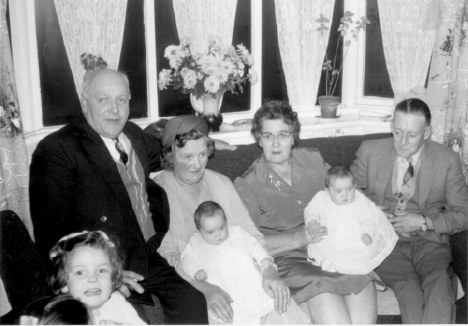
Christening of Diane and Alison · 12 Tudor Road, Hunts Cross · 19 November 1961
George, Doris and Lyn · Wedding of Shirley Griffiths · 1963