28 April 1901
George Henry Bird was born at about 6.0pm. on Sunday, 28th. April, 1901, at 30, Barnston Street, Birkenhead.
He was the first of two children. His father was Robert Bird and his mother was Emily Bird (nee Worrall). When George was born, his father was 27 years of age and was described on George's Birth Certificate as a Car Driver. His mother, Emily, was 23 when George was born. Both of George's maternal grandparents were already dead when he was born. His paternal grandmother had died two years earlier but his paternal grandfather, George Bird, after whom George was named, was still alive and aged 57. It is not known if George was baptised but he almost certainly would have been and it would most likely have been at St. Michael's Church, Carlton Road, in the parish of Claughton, the church where his parents had been married on 23rd. March, 1900.
The house, 30, Barnston Street, no longer exists, having been bombed during the Second World War, but it was a small terraced house in a working class area. Barnston Street ran in an easterly direction from Brimstage Street, between Mount Grove and Brattan Road. It is not known how long the family lived at this address but George's brother, Reginald, was also born at that address on Sunday, 12th. October, 1902. It is not known what this house was like but it was presumably similar to the existing houses in the next road, Mount Grove, where George's mother had lived prior to her marriage. The house was probably a "two up, two down" house typical of a working class area. The remaining houses in Mount Grove are of such a type and have bay windows both upstairs and downstairs, but may possibly have three bedrooms.
Emily Bird
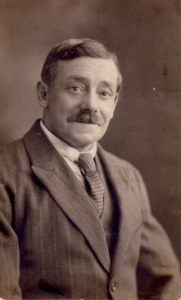
Robert Bird · George's father
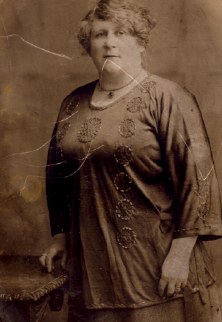
Emily Bird (née Worrall) · George's mother
c. 1906–1907
At some stage after that, Robert and Emily moved with their two sons to 109, Elmswood Road, Higher Tranmere, which was a Chip-shop, believed to have been owned by Emily's sister, Maggie Hope (nee Worrall), but run by Emily. The family probably lived there about 1906 and 1907. The building is still standing but has been a private house for many years. It is a large house situated on the south side of Elmswood Road opposite the junction with Maybank Road and is abutted on its west side by a transverse entry which gives access to the passageway behind the houses on that side of Elmswood Road. A similar house stands on the other side of the transverse entry. The house, No 109, stands slightly forward of its adjoining neighbours and has a substantial stone lintel running across the entire frontage. This lintel was obviously part of the original building which would have included a shop front at ground floor level, but the shop window has long since been removed and the frontage bricked up except for the provision of a small domestic window and front door. Nothing is known of the internal layout of the premises.
George's brother, Reginald, recalled that as a young boy he had been sitting on the top of the rear yard wall when a horse-drawn coal cart came along the passageway. Reginald passed some innocent remark to the coal man who took exception to the boy, considering him cheeky, and gave him a slap with his coal-grimed cap. Reginald was then in further trouble with his mother about his dirty clothes!
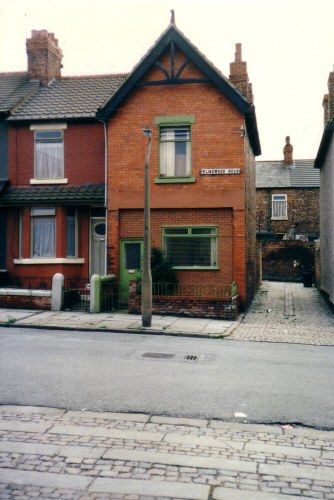
109 Elmswood Road, Higher Tranmere · Photographed by Reg Bird
from c. 1907
About 1907, the family moved to 76, Woodville Road, Birkenhead, which was a small terraced house on the north side of the road, seven houses down from the junction with Woodchurch Road. The front elevation was of yellow brick, relieved by a narrow band of red brick running across the frontage at the level of the upstairs window sill, whilst another rather broader band of red brick ran across the frontage under the eaves at the level of the upstairs window lintel. The piers of the bay window were also constructed of red brick. The front door, which was to the left of the frontage, had a fanlight above it.
The front door gave access through a small lobby to a narrow hall leading to the rear. To the right, off this hall, a door led to a small parlour with a bay window to the front of the house. A large Aspidistra plant was displayed on a small table in the bay window. There was a small cast iron fireplace in this room.
At the rear of the hall, a door led down one step to a small living room, which had a coal fire and black-leaded cooking range built into the right hand wall. A huge black iron kettle was always simmering on a trivet which was built into the range. A high mantel shelf ran across the top of the range.
To the rear of the living room a door led, again down one step, into the small kitchen which had a stone sink, whilst a gas cooker was fitted into a recess in the rear wall. A meat safe with a marble slab top provided a working surface for Emily to perform her culinary skills. A window over the kitchen sink looked out on to the rear yard, whilst a door in the left hand wall opened into the yard.
At one time, Emily had an ice-cream making machine which consisted of a wooden box with an inner box of galvanized zinc into which the cream was placed, while the space between the two boxes was filled with ice. A paddle was positioned within the inner box and by turning the handle which protruded from the lid, for a long time, ice-cream was eventually formed. George's brother, Reginald, recalled being sent on several occasions to the Union Cold Storage in Birkenhead, and having to carry home on a tramcar a large block of ice for the appliance. He also remembered turning the paddle for lengthy periods but he much enjoyed the finished product.
From the living room a staircase ascended from the rear towards the front of the house. At the head of the stairs the facing door gave access to the front bedroom which occupied the width of the house but which had only one window, an ordinary flat sash window above the downstairs bay. To the left at the head of the stairs a door gave access to a small rear bedroom which had a window overlooking the rear yard. A door at the rear of this bedroom led to a small bathroom which was above the kitchen. This bathroom had a large fitted bath supplied with hot water from a gas heater.
A small four roomed house with a plumbed-in bath was very unusual in those days. When, in later years, George was married with children, the children were on occasions taken to their grandparents' house to use the bath, as their own house in Aspendale Road had no such luxury but merely a galvanized bath which was hung in the yard to be brought in and filled with kettles of hot water when required. George's son, Reg, recalls that on occasions after particularly heavy soakings by rain in the wintertime, he was taken to his Nana's house at 76, Woodville Road and bathed in a steaming hot bath to which mustard powder had been added as this was, in those days, a standard efficacious precaution against catching a chill.
At the rear of the house were situated an outside W.C. and a wooden shed. There was also a coal place for storing the coal delivered via the back entry by the coalman. The remaining small yard was lime-washed and had a gate into the rear passageway which ran behind the houses. A dustbin was fitted in the rear wall and its hinged arrangement enabled it to be filled from inside the yard and emptied by the refuse collectors from outside the yard. At the front of the house there was a small area enclosed with a wall and gate, and this was always planted with various plants in season, such as bulbs and wallflowers in spring and bedding plants in summer.
Inside the house, the sitting room was furnished with a dining table in the centre, around which were arranged dining chairs. In the space under the staircase there was a horsehair sofa which could accommodate smaller children at the table. On the mantel shelf above the range there were displayed a selection of Toby-jugs and ornamental plates. On the wall to the right of the range there was a built-in cupboard.
To the left of the range there was a wind-up gramophone contained in a tall wooden cabinet. Underneath the turntable, the cabinet had a cupboard which contained a selection of old 78 rpm records, which George's son, Reg, recalled from when he was a child, included old favourites of the family such as "All the King's Horses", "In a little Spanish town" and "Oh, Miss Hannah". There were also comedy records such as George Formby (senior) singing "When Father Papered The Parlour", "My Grandfather's Clock", and "There's another little room to let". Another favourite record in the collection was one of Charlie Penrose singing "The Laughing Policeman".
A sideboard stood against the wall opposite to the kitchen door, and above it hung an old-fashioned Victorian wall clock with a pendulum.
In the tiny front parlour there was a china-cabinet which displayed various items including tea sets and Victorian bric-a-brac. There was also a small three piece suite in this room. Pictures hung on the walls of both the downstairs rooms and the hall. These included prints of subjects such as highland cattle grazing at the water's edge in the Scottish highlands, and some pictures of Gibson Girls, popular at the time.
The house had no electricity during the time George lived there and it was not until after he was married and had left home that electricity was laid on. Lighting throughout the house was by means of gas lamps with incandescent mantles. Oil lamps and candles provided additional light.
Flies were an ever-present nuisance, particularly during summer, and the house like most others had sticky fly papers hanging from the ceilings in the living rooms. Both the living rooms and both bedrooms were papered with wallpaper and the ceilings were painted white with whiting, which in the days before emulsion paints, was the usual way of decorating ceilings. This whiting was made from powdered chalk, which could be bought at any ironmongers or hardware shop, and was mixed to a thick consistency with water before being brushed on to the ceiling. For added whiteness it was possible to improve it by the addition of some "Reckitt's Blue", a proprietary product much used by housewives for adding to their laundry for extra brightness. This consisted of a small cloth bag, rather smaller than the size of a golf ball, containing a blue washable dye. In the small front parlour, the ceiling was papered with heavily embossed and patterned "Anaglypta" paper which was also painted with the whiting. The whiting dried to a powdery finish and could therefore only be used on ceilings, where there was no chance of its rubbing off on the people's clothing.
as it stands

76 Woodville Road, Birkenhead · Photographed by Reg Bird
childhood
Little is known about George's early years but two studio photographs exist of him as a young child. The first is a posed photograph taken at the studios of Watson Brothers, 85, Argyle Street, Birkenhead, showing George as a child of about 10 to 12 months old, seated in a cane chair and dressed in baby clothes of the period. Propped up in front of him is a small toy horse on wheels which may either have been his own or a prop provided by the photographer. The second photograph was also taken at the same studios and shows George, now about 4 years of age, dressed in a sailor suit which was then fashionable for boys of his age. He is wearing black double-strapped buttoned shoes and long white socks. He is standing alongside, and leaning upon, a chair on which his brother, Reginald, then about 3 years of age, is seated. Reginald is dressed in a frock, the usual dress for children of both sexes at that age and at that period. He is also wearing double-strapped buttoned shoes.
George had a happy childhood as both his parents were of a pleasant nature and easygoing disposition. His mother, Emily, was always at ease with children and had a pleasant singing voice and enjoyed singing to her children and grandchildren. George himself was not particularly musical but did enjoy listening to popular music on records and on the radio. His brother, Reginald, however, did have some musical talent and could play the banjo and ukulele when he was older.
From about the mid 1930's the family had a wireless set, and this was run from heavy glass accumulators. These consisted of a thick glass container, which held the lead electrode plates suspended in acid, similar to a car battery of today. A carrying handle was fitted to the top. When the accumulator became discharged, it had to be taken to a local corner shop specialising in electrical items and, on payment of a small fee, exchanged for a recharged one. A charged accumulator would last about one week. The family must have acquired the wireless set after 1935, because when King George V died on 20th. January, 1936, George's son, Reg, can remember himself and some of his family going into a house occupied by a family called Orme who lived a few doors up the road from Emily, in order to hear radio announcements about the illness and the subsequent death of the King.
about 10 months;
Reginald and George,
aged about 3 and 4
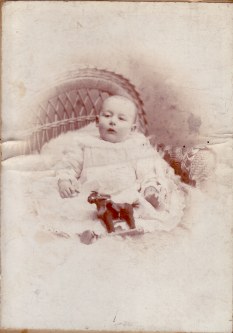
George, aged about 10 months · Watson Brothers studio, Birkenhead
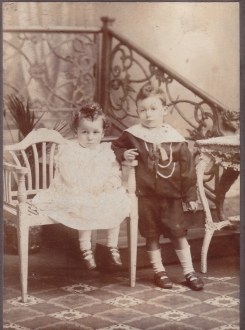
Reginald, aged about 3, and George, aged about 4
Birkenhead
When George was a young child, Birkenhead was a vastly different place to the present day and it is difficult to imagine to any great extent what life was like then in a working class area of a developing borough. When George was born, Queen Victoria had only been dead for a little over three months, having died on 22nd. January, 1901. The country then had, for the first time in over 60 years, a new King, although it was to be the following year before King Edward VII was crowned.
Birkenhead had only been granted its Charter of Incorporation as a Borough 24 years previously in 1877. The Borough was much smaller then and it was not until 1928 that Landican, Thingwall, Prenton and part of Bidston were absorbed into Birkenhead. Even later, in 1933, Noctorum, Upton, Woodchurch and parts of Arrowe and Bidston were absorbed into the expanding Borough.
In the year that George was born, the first electric trams were introduced and started replacing the old horse trams. Tram routes near to George's home were along Borough Road to either Prenton in one direction or Woodside in the other, and along Church Road, Tranmere, to Bebington and Rock Ferry. It was possible to take a tram from Borough Road to Birkenhead Park Railway Station. Birkenhead Corporation did not introduce motor buses until 12th. July, 1919, and from then until the last trams were withdrawn on 17th. July, 1937, tram and bus services existed together. From the introduction of motor bus services, many additional routes were introduced making it possible to travel by public transport to places further afield such as Arrowe Park, Moreton, Thurstaston and Eastham. A bus route which ran near George's home in Woodville Road was the route from Woodside to Oxton Village via Grange Road, Oxton Road, Woodchurch Road and Storeton Road.
In George's youth the streets were lit by gas lamps, which were lit manually each evening and extinguished manually each morning by lamp lighters. They walked the streets carrying either a ladder to reach the mantles of the lamps, or a pole with a hook on the end to operate a lever of the lamp which opened or closed the gas valve when a pilot light was fitted.
Although there had been electricity generated in the town since 1896, there were only 273 consumers by 1900, and these included some shops. The Mersey Railway, which had opened in 1886, was still operated by steam locomotives and it was not until 3rd. May, 1903 that this railway was electrified.
Water supplies were a problem which started to get serious by 1900, as the existing supplies by wells and bore holes within the borough were proving insufficient to meet the rising demand, and it was decided to embark on the Alwen Reservoir scheme, on which work commenced in 1911. Despite the difficult conditions prevailing during the First World War, work continued on the reservoir, but although the dam was completed and storage started in 1916, it was not until 1921 that the Alwen supply became available in Birkenhead. From 1916 to 1921 the available well supplies could not cope with the demands and despite assistance from outside authorities, the position became so acute that the supply to residential areas had to be limited to 4½ hours per day at times, and for a year from 1918, the supply was almost continually shut off from some parts of the town for 12 hours a day! The introduction of the Alwen supply solved the shortage problem and soon the wells were abandoned as a source of supply and were dismantled.
The side streets were mostly surfaced with tar macadam, and the pavements were laid with large flags of York stone, which gave a mellow appearance to the area. Concrete flagstones, almost universal today, did not exist. The main roads, particularly those carrying heavy traffic or where tram tracks were laid, were usually constructed of granite setts. Motor cars were a rarity in early Edwardian days and the streets would have been busy with horse drawn traffic of all descriptions.
Many of the town's tradesmen delivered their commodities directly to their customers' homes. These included the coal man with his large horse drawn cart laden with sacks of coal and a set of scales on the rear of the cart for weighing the sacks. The coal man himself was always begrimed with coal dust. Milk was delivered by a horse drawn cart which contained churns of milk from which the milk man dispensed the milk from the churn into the customer's own jug by means of a long handled ladle. The milk jugs used by housewives were always covered by a muslin cloth decorated around the edge with glass beads which weighted the cloth on the top of the jug, thus providing protection against the numerous flies which appeared particularly in the summer months.
Bread was also delivered to the door by the baker, who had a horse-drawn covered van, and items such as paraffin oil for the oil lamps would be delivered by the chandler. There was also a salt man who carried large roughly cut blocks of salt on his cart, and he would cut the large blocks up into smaller portions according to his customers' requirements.
Itinerant knife grinders would call periodically, usually with a contraption that was mainly a bicycle but which could be instantly converted to a grindstone powered by the bicycle pedals. Tinkers would also call and mend pots and pans. The horse drawn Corporation dust cart used the back entry to empty the dust bins. A lot of ash was created in a household in those days, but there was little in the way of packaging to dispose of and a lot of the household waste was burned on the coal fires in the home.
Meat was delivered by a butcher's boy on a bicycle with a large basket on the front and most of the household's weekly grocery shopping was similarly delivered by an errand boy from the grocer's shop. Some tradesmen, such as bakers and confectioners, delivered their goods by means of a small pavement handcart which was an enclosed box on wheels. The cart was equipped with shafts so that it could be pushed or pulled along the pavements. A hinged lid provided access to the contents. The tradesman's name was painted on the outside. An example of this type of cart is on display in the Liverpool Museum.
With the large number of horses about in the streets there was an abundance of manure which would be eagerly seized upon by gardeners. George's family were no exception and some member of the household would go out into the road with a shovel to collect the horse manure if an obliging horse had been outside the house! Such free fertiliser was used in the small front garden, or later on in the allotments which George cultivated. The streets were swept manually by Corporation workmen, and during the summer months a water cart would travel along the main roads sprinkling water on the road surface to lay the dust.
People did little travelling then and most of their shopping could be done within a short walking distance of their homes. George's home in Woodville Road was well served in this respect with numerous shops in nearby Woodchurch Road, Borough Road, and Oxton Road. In addition, many of the residential streets had "corner shops" where many items could be bought. There were larger shops, including Department Stores, in Grange Road. Birkenhead Market was another popular place for shopping.
Handcarts were a common sight in the streets and were used for a wide variety of purposes. These were generally quite large, with big wheels, and could carry quite a large load. Many, if not most, of working class families would hire a handcart for a day when moving from one house to another within the same neighbourhood. It was common for people to move only a short distance to another house as their family circumstances altered, as most people preferred to stay in the same neighbourhood where they knew everyone.
There was little need for travelling far from one's home as almost all the basic necessities were to be found within easy walking distance of where one lived. George had an uncle, Charlie Ellis, who had been born in Upton, not then part of Birkenhead, and who as an old man had never in his life been out of the village of his birth, even to Birkenhead which was but three or four miles away.
Elementary School
George was a pupil at Woodchurch Road Elementary School, Birkenhead, which had only been newly built in 1905 and so this school was probably only a year old when George started as a pupil there. George would have had only a short walk to school along Woodchurch Road from his home in Woodville Road, a distance of about a quarter of a mile. One of his first teachers was Miss Prouse, who was later to teach George's brother, Reginald, George's two sons, Reg and Norman, and George's nephew, Robert.
George was apparently an able pupil, and a book, The Eagle's Nest, written by S.E. Cartwright and published by Blackie and Son Ltd., was awarded to him by the Headmaster, Frank Dawson, on behalf of the Birkenhead Education Committee, for general proficiency during the year ending 31st. July, 1911. George was then ten years old.
On 25th. March, 1914, George received a bronze medal inscribed on the reverse "In Commemoration of Their Majesties' visit to Birkenhead, 25th. March, 1914" and "James Moon J.P. Mayor". Below the coat of arms of the Borough there is depicted a windmill with the words "The Old Mill, Bidston" inscribed beneath. The obverse of the medal depicts their majesties Queen Mary and King George V. This medal was probably given to each schoolchild in the Borough on the occasion of this Royal Visit, which included the official opening of King George's Way, a pedestrian foot way from the junction of Upton Road and Boundary Road, over Vyner Road North by means of a bridge, and on to Bidston Hill. It is believed that George, together with many other children, was in attendance at this Royal event.
The income of George's family was probably very modest, because at the time George was born, his father, Robert, was a car driver, and by the time the second son, Reginald, was born his father had again become a coachman (non-domestic), the same occupation as shown on his Marriage Certificate.
It is thought that Robert had originally worked as a coachman for his father, George Bird, who had his own coach business in Newburns Lane, Oxton. Newburns Lane was known locally as "Dolly Tub Row", as many of the residents of the cottages on the opposite side of the lane to George's premises used to take in washing. Robert had apparently left his father's business to work for a rival firm who had acquired motor cars for their business. It is a family story that Robert saw the new motor cars as the future of the coach and carriage business whilst his father thought that the new mode of transport would not last and so never ventured into the field of motor vehicles. However, Robert was once again a coachman in 1902 but it is not known for which firm he worked although it was one of the local coach and carriage companies and not in domestic service.
To supplement the family income, George's mother, Emily, worked on occasions for the Toosey family, who had shipping interests and who lived in a large Victorian villa in Rose Mount, Oxton. Emily had worked as a cook there before her marriage, and Robert's sister, Annie Bird, was still working there as a plain cook after Emily's marriage. Emily was employed as a fancy cook when meals of a more elaborate nature were required for dinner parties and the like.
School; George's
book prize, 1911
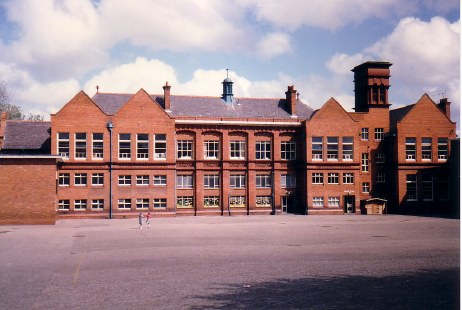
Woodchurch Road Elementary School, Birkenhead
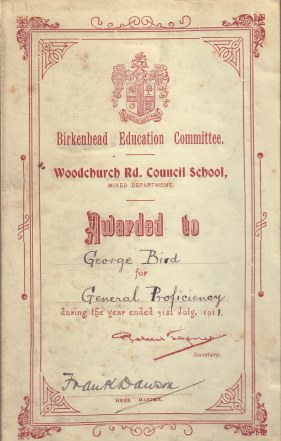
George's book prize, awarded 1911
Boys Own Brigade,
Aunt Annie
Although the family are not thought to have been regular churchgoers, George is believed to have attended Sunday School at the Congregational Church in Woodchurch Road at the junction with Ball's Road, and he is known to have been for some time a member of the Boys Own Brigade attached to that Church. As a young teenager he went, at least once and possibly more, on holiday to Cunningham's Camp, Douglas, Isle of Man, an establishment which specialised in providing camping holidays, under canvas, at modest rates for youth organisations. It is most likely that George went on holiday there with the Boys Own Brigade. The Sunday School also had an annual treat when the children were taken in a horse-drawn wagonette to Barnston Dale where they enjoyed picnics and games. Barnston Dale was a popular venue for outings and it would have been quite busy when various organisations had gone there for the day.
When George and his brother, Reginald, were young, they were frequently taken on outings to places such as Hoylake, West Kirkby, Hilbre Island and Parkgate by their father's sister, Aunt Annie, on her afternoons or days off from service. Aunt Annie was unmarried but very fond of children and the boys had great affection for her. Some thirty years later, Aunt Annie was to resume her outings with the next generation of children, the sons of George and Reginald. It is known that George and his brother were on close family terms with other members of the family on their father's and particularly their mother's side including many cousins in the Birkenhead, Upton, Ellesmere Port and Chester areas.
Some relations were, however, unknown to them. George recalled in later life that as a young man in his twenties he had been having a drink with his father in a local public house when another customer left the premises. Robert told George that the man who had just left was George's uncle, Jack (John) Bird, who was Robert's brother and whom George had never met. Apparently Robert and Jack had become estranged many years before and did not speak or have anything to do with each other. The cause of this estrangement is not known but George always believed it had its origins at the time Robert left the family business. It is not known if Robert maintained any contact with his father or if George had much contact with his grandfather.
It is not known if George's family kept many pets when he was a child but it is known that at one time they had a terrier dog called "Paddy". George's mother was also fond of cage birds and is known to have had, at various times, canaries and budgerigars.
Congregational
Church
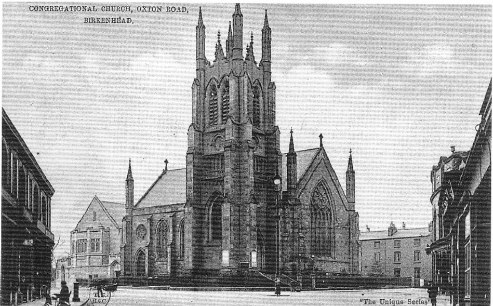
Oxton Congregational Church
maker's trade
George left school at the age of 14 and it is not known if he had any further education but he may have attended night classes. On leaving school he became an apprentice pattern-maker and his first job was with a cabinet maker who had a one-man business in Birkenhead town centre. His brother, Reginald, recalled that on his first morning, George left for work suitably dressed with a new white apron befitting his new trade. On his return in the evening, the apron was covered in black soot and coal dust. Apparently George's first task was to remove and replace some old fire bars in the grate of the workshop!
The First World War started in August, 1914, when George was 13, but it is not thought that the War had any direct impact on his family. The only relative known to have served with the Armed Forces was his Aunt Annie, previously mentioned, who at the end of the First World War was a member of the Queen Mary's Army Auxiliary Corps (Q.M.A.A.C.). George was only 17 when the War ended. His father had not served in the forces, probably being too old for service as he would have been 43 years of age when the War started.
Not many details are known of the firms for which George worked, but early in his working life he was a pattern-maker at the Victory Printing Works, Laird Street, Birkenhead. He later worked for many years in the pattern-shop at Cammell Laird shipbuilders, Birkenhead, where his work was mostly that of producing wooden patterns for castings of items such as ships' pumps and propellers. It is thought that George finished his seven year apprenticeship whilst working at Cammell Lairds.
Throughout his working life George was a member of a trade union, originally the Pattern Makers Union, but later, following amalgamations, the Associated Society of Woodworkers. He was not particularly active in the union and later in life, particularly after he retired, he began to be disaffected by Trade Unionism in general and although he was never very interested in politics his natural sympathies tended towards the right in his later years.
the music hall
Not much is known about George's social life after leaving school, but he did enjoy watching football, particularly Tranmere Rovers whom he supported for many years. He is not thought to have participated to any great extent in sporting activities but he was an excellent swimmer and enjoyed going to the Argyle Street Swimming Baths. He also enjoyed visits to the Cinema and the Argyle Music Hall, particularly when he was courting his future wife, Doris. Acts which George may have seen at the Argyle would include Vesta Tilley, Hetty King, Albert Chevalier, Eugene Stratton, G.H. Elliott, Marie Lloyd, Wilkie Bard, Gertie Gitana, Stan Laurel (later to be part of the Laurel and Hardy duo), W.C. Fields, Webster Booth, Wee Georgie Wood, Donald Peers and Pat Kirkwood. George was more inclined to enjoy comedy and speciality acts rather than singers, who he always referred to as "Bar Turns", due to the fact that many of the male members of the audience in those days retired to the bar for a drink during the less popular performances.
Argyle Theatre,
Birkenhead
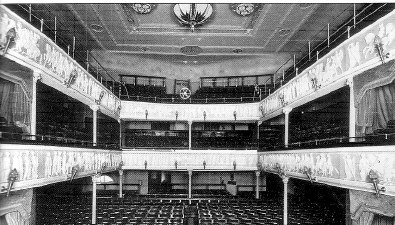
Interior of the Argyle Theatre, Birkenhead
and New Brighton
Another activity which George enjoyed in common with many at that time was a trip on the River Mersey on the ferry boats, "Ruby", "Pearl" and "Sapphire" which were paddle steamers sailing from Liverpool to Eastham Ferry during the summer months. These three steamers had first appeared on the River Mersey in 1897–1898 and remained on the Eastham run, with the exception of the war years, until 1929, when they were sold for scrap. Their perpendicular, rakeless lines gave the impression that they were both coming and going at the same time, and even in those days of peculiar craft they often caused a raised eyebrow or two.
Eastham had been a popular resort for day trippers since early in the nineteenth century and had often been described as "The Richmond of Cheshire". An enjoyable and bracing sail of less than an hour from the Liverpool Landing Stage brought passengers to a delightfully situated resort with wooded sandstone cliffs against a background of silver and brown birches, broad ferns and witches' brooms, a relic of the old Royal Forest of Wirral.
It was famed far and wide for its magnificent woods carpeted with wild hyacinths. There were intimate family picnics, stylish garden parties and elaborate entertainments. There were 'boating fiestas', fireworks and treasure hunts. In the woods, paths had been formed and edged with blocks of sandstone, pits had been dug and cages constructed, and a menagerie of bears and lions, elephants and antelopes, attracted crowds of people. The fattest lady in the world sat squarely in a wooden shack flanked by a pair of tiny unsmiling dwarfs. There was a pickled man with two heads next to Monkey Island, and a crocodile from the Nile, a tank of man-eating spiders, and a sea-horse ('the fabulous hippocampus'), said to have been 'landed by a captain from the Mersey during a round-the-world voyage'. There was even a dimly lit mermaid 'from the South'. Above Azalea Dell visitors queued to throw little red balls at Bonzo, the clown on the trapeze. Hit the spot and his perch would collapse, plunging him into a well of icy water.
There were also slot machines which by inserting a penny and turning a handle would provide the wonder of moving photographs. There had been for some time an early example of a roller coaster, named the loop-the-loop.
The heyday of Eastham Ferry was in the decade following the First World War. The Eastham Ferry Hotel was a focal point, whilst across the road the Vienna Cafe was busy with family groups and flustered waitresses. The Vienna specialised in the most delectable ice creams served in fancy dishes. From the tables outside there was a splendid view of the hotel forecourt and its attractions, including regimental bands playing to attentive audiences. The music played would include such gems as 'Give yourself a pat on the back', and special military arrangements of King Oliver's 'High Society' and Arthur Sullivan's 'Take a pair of sparkling eyes'. The Charleston and Cachucha would also have been heard.
After the concert many would wander down to see the gypsies and to sample their jangling bobby-horses and swing boats. Others would swarm through the great Triumphal Arch, which had been erected in honour of Queen Victoria's Golden Jubilee (and which housed the pay box to the Gardens), to applaud Granville Hope's 'Merry Madcaps'. Mothers and fathers happily abandoned their children while they themselves settled down to marvel at Goldy's lightning smoke sketches of local scenes, to gasp at Mr. Mystery's magic, to join in their favourite tunes with Crystal and Miss Melody (whose speciality was the beguiling 'Where do flies go to in the wintertime?'), and to laugh until they cried at the antics of Beeky the Clown, who twenty-five years later, became Jackson Earle, 'the guv'nor of New Brighton's popular 'Melody Inn'.
New Brighton was also a place that George enjoyed as a young man. It was a bustling resort with amusements of all kinds, including New Brighton Tower, opened in 1900, which was then, at 621 feet above sea-level, the tallest structure in England. On a clear day the Isle of Man could be seen from the viewing platform, as could Blackpool Tower which was some 100 feet shorter. Sixpence gained entry to the 35 acres of grounds and covered entry to most of the attractions, which included beautiful gardens, a lake with gondolas and genuine gondoliers, a fairground, water chute, Himalayan Railway, and the Tower Theatre, which seated 3000, with a stage which could accommodate a whole circus. There was also a ballroom, a billiard saloon, a monkey house and aviary.
Due to a lack of maintenance during the First World War, the steel structure became unsafe and the Tower was dismantled between May, 1919, and June, 1920. The Tower buildings, including the Ballroom, remained until destroyed by fire on 5th. April, 1969. In Edwardian days, New Brighton could be reached by trams or the railway, and there was also a ferry service direct from Liverpool. It is probable, however, that George would have walked part, if not most of the way from Birkenhead to New Brighton as he was a great walker all his life.
Eastham Ferry Hotel
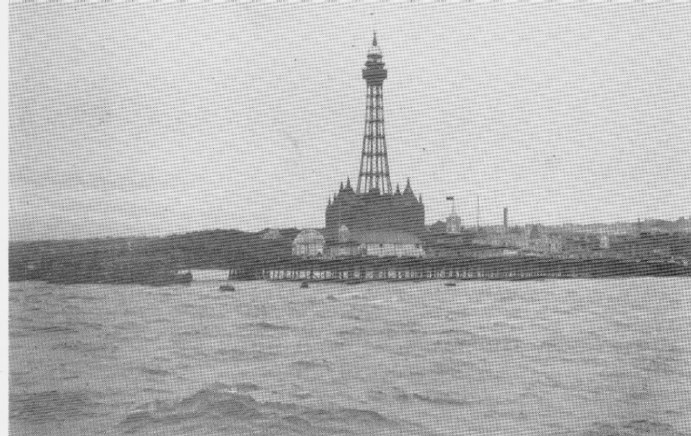
New Brighton Tower · Opened 1900, demolished 1919–1920
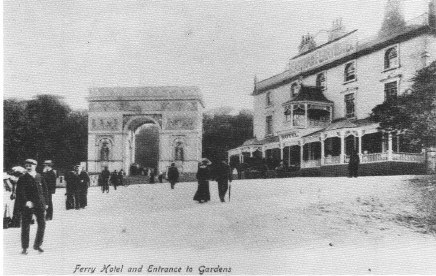
Eastham Ferry Hotel
woodwork and
the allotment
George was also throughout his life an avid reader and was always a member of the Public Library. His son, Reg, remembers going frequently with his father to the old Birkenhead Central Library in Hamilton Street and later to the new Central Library, Borough Road, after its opening by Their Majesties King George V. and Queen Mary in 1934. George's taste in reading was wide, both in fiction and non-fiction. He enjoyed detective novels, historical novels and Western adventures among others. He was also a newspaper reader, taking the Daily Herald in his younger years and in later life the Daily Mail. He also enjoyed trying to solve crosswords, particularly those of the cryptic variety.
As an adult, George enjoyed a visit to the public house where he enjoyed the company of relatives and friends, although he was never a heavy drinker. Sunday lunchtime was a time when George and his brother, Reginald, would go with their father, Robert, for a pint or two of beer in a local public house, and they always brought back with them a bottle of Dinner Ale for their mother to enjoy when they were having their Sunday dinner.
Although a woodworker by trade, George also enjoyed woodwork as a hobby and made many items of furniture and other objects, some of which still exist. His son, Reg, possesses a small money box which George had made in the shape of a book, from which, once the spine is slid off, the front face can also be slid away to reveal a hollow compartment lined with green baize. There is also a small container made in the shape of a barrel with a detachable lid. George used to take a magazine which it is thought was called "The Practical Woodworker", from where he got ideas for making wooden objects, particularly if they were of unusual construction. He enjoyed making things in the nature of puzzles as to their construction and made several love spoons with captive balls in the handles. Among other items he made is an object which consists of two rectangular pieces of wood, each in a contrasting colour, joined end to end by what appear to be dovetail joints on each face, which is obviously impossible. The secret of the construction is that the dovetails are made on the diagonal of the wood and the two pieces could be joined by presenting them diagonally to each other. Another interesting piece he made was a folding stool constructed from a single piece of lignum vitae measuring about fifteen inches by eight inches by about one inch thick. This was partially sawn through so as to make three separate, but captive, pieces which could be folded out to make a small stool. He is also known to have been interested in fretwork when he was young.
The other main hobby that George enjoyed all his life was gardening. His home at 76, Woodville Road had only a very small garden at the front so, as a young man, he and his brother, Reginald, rented various allotments. The earliest such allotment that his son, Reg, remembers is that which occupied vacant land between Woodchurch Road School and Borough Road, where the Birkenhead Technical College now stands. George and his brother built a greenhouse on this allotment and spent many hours cultivating the ground and growing vegetables of all descriptions. George's mother apparently paid for the materials for the construction of the greenhouse. George and Reginald probably made the greenhouse in sections at home and assembled the sections on site at the allotments.
Photo ch1-woodville-road.jpg of 76 Woodville Road missing from this chapter.
Mark to revisit and photograph during May 2026.