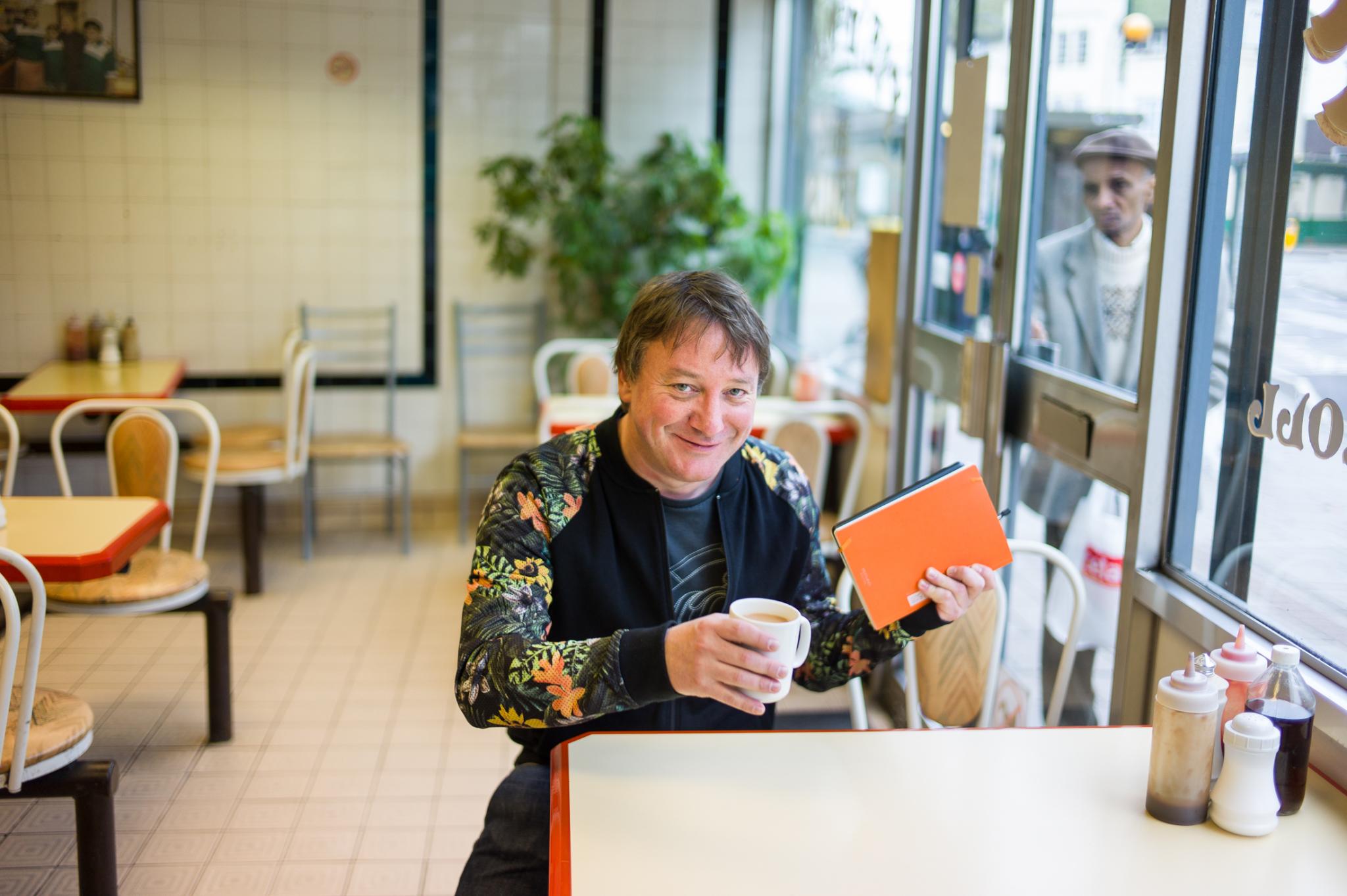
I love this photograph. Me, in October 2014, when I often inhabited Lou Farrow's Pie and Mash Cafe, in Southwark in London. It was taken by Loïc Sans, easily one of the best photographers I've got to know. And while almost everyone takes photographs now, very good photographers are still rare to have the chance to work with. But this was an era when I had a creative design and communications team around me, that I could direct and influence. I loved that, though the accompanying political disapproval and cahoots from one or two people up the command hierarchy made it difficult, and at some point I could no longer do it. I held the space — a sort of creative fiefdom — for about seven years before I burned out — a slow burn that was very difficult to handle, and took me to a place I never want to go again. I wasn't the first, and I shan't be the last. But it wasn't really okay. I was really struggling.
But as anyone who has ever fallen in love with music and art will know, people often produce very interesting work when they're not okay. And when we are okay again, when we find a different kind of energy and balance, face our demons, take the mysterious path through unknown forests because the big path was no longer working? Well, then we can emerge and start to take in the previous lives with different eyes. And perhaps a different software lens.
I'm Mark Charmer and I was born in Liverpool in 1971, in the same maternity hospital as John Lennon. The delivery room (mum tells me) had an open window, and music and voices filtered from the Everyman Theatre Bistro Bar below. Which may explain why I love music - and can be theatrical when pushed. In 2019 I returned and settled again in Northwest England, the strangest and most unexpected of things. But entirely obvious with hindsight. I now live in a beautiful perch, with a view of the city. And a turret full of plants, which is my study.
Rhodia1, the project you are viewing here, is a technical and creative exercise where I try to develop a way to publish stories in some forms that I think are being ignored (or debased) by the software culture we've come to know as 'social media'. As I don't have a design and coding team available these days, nor the resources to command one, I'm experimenting with an artificial intelligence system called Claude to help me design and program it. Claude is run by Anthropic, which is notable for being slightly less terrifying than its bigger rival OpenAI.
Much of the work I used to do when I haunted Lou Farrow's cafe has now been ripped and shredded by systems like Claude, in ways that are very impressive but also tear into what it means to be a real writer, or photographer, or artist. Things that my generation and those to each side of mine saw as a form of talent and expression that transcended the machine of modernity that binds so many lives to tedium or conformity. And right now, it's coming for the programmers too, who for a while had seemed immune, somehow protected from modernity’s relentless, biting teeth that changed everything around them to fit its image, eating the creativity of the masses as new flesh, all the while turning diversity into database categories. Lest we must work with the world we are given, as my friend Carrick would say.
I'm fortunate that I am now in my seventh year retraining as a gardener, and earn my living from this work. So I now have a Green Collar job, and I don't need to freak out that AI has taken my White Collar one. Because whatever Elon might be planning once his robot army has finished its initial war(s), I can assure you that there will still be a market for good gardeners. Because it takes time and experience to learn and is hard to build a sustainable business in. But once you do, the fundamentals stay the same. It keeps you fit and healthy, you get in tune with the cycles of nature, and you get followed around by robins and cats and tea-making clients. And everywhere looks better after you've been. It's great.
Rhodia1 is a demonstration of what I find possible when using cutting edge 2026-grade AI as my design and technical colleague, while I lament and celebrate those I miss from past times. It has been inspired by Vanessa Andreotti's experiments with AI. And also by the time I've spent each spring attending Monkigras, my friend James Governor's software developer conference. I can't code — but I now realise that coding is highly addictive. Which might explain why the world has been feeling really weird for the past fifteen years – it's now being shaped by addicts.
The results have exceeded my expectations. Within weeks I built and deployed a personal publishing system that brings back to life several decades of my photography and writing, and the stories it tells, using a Flickr back-end. I've developed techniques to formulate AI editors, designers and tech developers rooted in design principles of the people I have been influenced by during my own career. These characters have, with my encouragement, chosen names. I have published online for the first time my uncle's 45,000 word biography about my grandfather and helped my brother, who hadn't coded since the 1980s, build a Twitter archive browsing system called decamp.ai, that went from idea to stable release in twelve days. I have brought into being research processes that give me creative paths to explore in the weeks, months and even decades to come as an artist, designer, friend, son, brother, uncle, mentor, leader and witness to the times my life weaves through.
AI can run way beyond the pace that humans can process it, so I'm glad to have my gardens to ground me. But my word, this is an adventure. There's an emerging cast of AI and humans now collaborating through Rhodia1 in new ways. The system is rough around the edges for now, but bear with me. It's at play.