On the morning of Sunday, 3rd. September, 1939, there came the often quoted radio broadcast by the Prime Minister, Neville Chamberlain: "This morning, the British Ambassador in Berlin handed to the German Government a final note stating that, unless we heard from them by eleven o'clock that they were prepared at once to withdraw their troops from Poland, a state of war would exist between us. I have to tell you now that no such undertaking has been received, and that consequently this country is at War with Germany."
This radio broadcast had been very much as expected and George and Doris and their two boys listened to it with various degrees of emotion. For the boys, then aged 9 and 7, the announcement of the declaration of War meant nothing at all. The adults, however, must have been very apprehensive, particularly as none of the civilian population had much idea about what was to come and most people's only experience of War was that of the First World War when little impact was felt by those at home. Those who had served in the Forces or who had had relatives who had served in the Forces during the First World War, obviously had much to fear from another War.
At first, no impact was evident concerning George and his family, although in some areas of Liverpool, the effects of the War started from the first day. In the inner areas of the City such as Wavertree and Edge Hill, children started to report to their schools on Sunday, 3rd. September, 1939, as part of a prearranged plan for their evacuation to places outside the City. During the first few months of the War over 3000 children and their mothers had been evacuated to the Chester area from Liverpool, but by the end of October, 1,250 had returned to their homes. On Monday, 4th. September, 1939, came the official closure of all places of public entertainment until Friday, 15th. September, 1939, when cinemas and other places of entertainment were re-opened.
The Rootes aircraft factory at Speke started to work shifts and George worked nights in rotation with the day shifts. The family, along with all other residents, were issued with gas masks at All Saints Church Hall. There was a very real fear among adults at that time, that the German Luftwaffe bombers would soon be overhead and starting to drop bombs containing poison gas.
and Anderson
shelters
The gas masks, officially called respirators, which were issued to the civilian population, were of three types. The adult version, in suitable sizes, consisted of a black rubber mask which fitted from under the chin to the forehead, and was secured in position by adjustable webbing straps which passed behind the head. There was a filter on the front which was supposed to purify any polluted air breathed into the mask. When breathing out, the spent air was expelled between the face and the flexible rubber of the mask. A plastic window was provided at the front of the mask to allow for forward vision, but this always steamed up when the mask was being worn. For younger children, of less than school age, the gas mask was similarly constructed but was made from a reddish coloured rubber and had two separate plastic covered eye holes, and a simple flap valve, somewhat resembling a nose, at the centre front of the mask. This mask was intended to be less frightening for small children and was known as the "Mickey Mouse" gas mask. For very small babies a third type of respirator was provided. This was a larger contrivance than the face masks, and was intended to enclose the whole of the upper body of the baby in a rubberised canvas material which was tied around the infant's body near the waist. A plastic window was provided, through which the baby could be seen by its parents. Pure air to the interior was provided by means of a hand pump made of corrugated rubber with a valve.
Fortunately, the civilian population were never, throughout the duration of the war, required to resort to the use of gas masks, other than for drill purposes. The gas masks were very uncomfortable to wear, and conversation would have been almost impossible while wearing them. When they were first issued the gas masks were provided with cardboard boxes in which to carry them by means of a cord around the neck. However, because the masks were supposed to be carried everywhere, the boxes quickly became battered and unserviceable and most people, at some time, replaced the cardboard boxes with something more serviceable, such as leatherette, or later on, purpose made metal cases. Some time after the original issue, the gas masks had to be taken back to the Church Hall for upgrading by the taping on of an additional filter which was deemed by the authorities to be necessary for the protection of the wearer.
It was not long before "Anderson Shelters" were supplied to the residents of the Speke Estate. These were air raid shelters intended for use outside the house and consisted of shaped sheets of galvanized corrugated iron, bolted together to form a structure with straight walls with an arched roof. This structure was partially buried in the garden so that about half of its height was above ground. It had an opening for a door, which was not supplied with the shelter but which most people fitted themselves to make the interior less cold. The roof of the shelter was covered with about a foot of earth and a wall of sandbags was built around the opening so as to provide protection against blast. Bunk beds were provided with the shelters and it was just possible for a family of two adults and two, or possibly three, children to sleep inside if there was an air raid. These shelters, whilst not affording any degree of comfort, were extremely strong and did prove to save many lives during bombing raids throughout the War when adjacent houses were often destroyed.
George managed to improve the comfort of his shelter to some extent by installing floor boarding constructed from second hand timber he acquired from the old disused station buildings at Speke Station in Woodend Lane. One problem with these shelters was that because they were half underground, flooding by water was frequent and people usually dug a sump under the floor from which excess water could be bailed out with a bucket when the shelter was in use, thus keeping the floor dry. The only lighting available in the shelter was by candles, but as the shelters were usually only occupied for the duration of an air raid, there was little need for light, and the family would return to the house as soon as the All Clear siren was sounded. George had a small torch which was useful in finding the way to and from the shelter during the blackouts, but the batteries were in short supply and did not last long. They were also expensive so the torch was not used more than was necessary. The earth of the shelter roof was usually covered with turf and the shelter was not as obtrusive as it may otherwise have been.
Not every family had an "Anderson Shelter". Some houses were provided with a different type of air raid shelter, called the "Morrison Shelter", which was an extremely strong steel table, which was positioned inside the house and under which the family could shelter in the event of an air raid. In addition to the provision of air raid shelters, households were given instructions as to the various ways to prevent or minimise air raid damage, such as putting sticky tape across windows to prevent glass splinters causing injury if there were an explosion. Blackout curtains and blinds were made by householders to prevent any light shining into the night sky and helping enemy bombers to find their position. The blackout restrictions were enforced by Air Raid Wardens who patrolled the area during air raids.
schools in
George's house;
rationing begins
George and Doris had a wireless set at the beginning of the war and typical broadcasts which they would have listened to included programmes such as "In the Canteen", "Band Wagon" with Richard Murdoch and Arthur Askey, "The Sunday Concert", and "Scrap Book for 1906". Sam Costa gave songs at the piano and there was a talk by the American broadcaster, Raymond Gram Swing. The News would be followed by official and other announcements.
On 25th. September, 1939, all schools were closed by order of the Board of Education and arrangements were put in hand for small groups of children to be taught in various places, including some of the pupils' homes. The Liverpool Education Committee paid 3d. per session towards the cost of heating and lighting the houses which were used for teaching. At that time, Reg was 9 years old and was a pupil at Hunts Cross Primary School, whilst Norman, who was aged 7, was still a pupil at All Saints Church of England School in Speke. George and Doris decided to allow their home to be used by Hunts Cross School, and Reg's normal teacher, Miss Pickles, held classes in the front lounge of the house. Small groups from Miss Pickles' usual class attended the lessons in sessions of one hour per day. The groups consisted of about 5 or 6 pupils, so by having five sessions in the day, it was possible for all the pupils in the class to have about 5 hours of schooling each week. After a short time, George and Doris agreed to allow similar arrangements in their home for pupils from Norman's school, this time in the rear living room. Thus, for some months, two different schools had pupils being taught part time in George's house.
On 16th. October, 1939, the public became aware of the reality of the war when the Royal Navy battleship, "H.M.S. Royal Oak", was torpedoed and sunk at her home base in Scapa Flow by enemy submarines. However, as the months passed, very little seemed to be happening, except for the gradual disappearance from the streets and the shops of little things such as the Walls Ice Cream man with his 'Stop Me and Buy One' tricycle. Cigarette cards were issued by W.D. & H.O. Wills, depicting Air Raid Precautions, with an illustration on one side and useful information on the other on a variety of subjects to do with possible air raids. One such card was the Stirrup Pump, which was a small pump which could be used by one person to extinguish small fires. A curfew was imposed on the opening of shops. They had to close at 6.0pm. on five days and 7.0pm. on one day. Lighting restrictions were also imposed on shops.
Popular comics for children were "Dandy", "Beano", "Radio Fun", and "The Boy's Own Paper" which was issued monthly and cost 6d. Publications for adults were "Picturegoer" at 3d., "Film Pictorial" and "Cinegram Preview" at 2d., "Woman's World" at 3d., "Home Companion" at 3d., and "Home Notes" at 2d.
The "Radio Doctor" broadcast after the 8.0 am. news, every morning giving advice and new ways of doing almost everything in connection with health matters. S.P.B. Mais gave regular talks on how to cope with limited supplies of all commodities. At Christmas, 1939, at the Pavilion Theatre, Lodge Lane, Arthur Lucan (Old Mother Riley), and Kitty McShane were appearing in the pantomime, "The Old Woman Who Lived In A Shoe", although no one from George's family went to see it.
At the end of 1939, the Ministry of Food were asking housewives to register with a Grocer and a Butcher as food rationing was to start early in 1940. At that time fighting was taking place in France and Finland. Favourite songs of the time were "We're Gonna Hang Out The Washing On The Siegfried Line" and "Over The Rainbow". British films showing were "Good-bye Mr. Chips" and "The Hunchback Of Notre Dame", starring Charles Laughton. George and his family did not go to the cinema at that time, as there was no cinema in Speke, and the nearest ones were the Garston Empire or the Woolton Cinema.
Food rationing began on 8th. January, 1940, with tea, sugar, cream, butter, meat and petrol being the first items to be rationed. The weekly rations varied according to supply but the lowest amounts were: bacon and ham, 4 ounces; sugar, 8 oz.; tea, 2 oz.; butter, 2 oz.; cheese, 1 oz.; margarine, 4 oz.; and cooking fat, 2 oz. Soap was also rationed with the weekly amounts being hard soap, 4 oz., toilet soap or flakes, 3 oz., soap powder, 6 oz. and soft soap, 6 oz. The meat ration was based on price at 1/10d. per person per week.
Also in January, 1940, education was returned to as near normal as possible and most schools re-opened, with Reg returning to Hunts Cross School and Norman to All Saints School, and the home teaching classes at George's house were discontinued. During the time the schools had been closed, the buildings had been used for various purposes connected with the War. Hunts Cross School had been used as a potential Casualty Clearance Centre in case there had been Air Raids. All Saints Church School had been used for various community purposes, including the issue of gas masks, Identity Cards and Ration Books. Brick air raid shelters had been built in the playing fields at Hunts Cross School and when they returned to school the children were drilled in the procedures to be adopted in the event of air raids. Children were also encouraged to grow food at school and at home.
January saw the beginning of the worst winter on record, with heavy snow, strong winds and it was very cold. The weather was so bad that at one time only 25% of public transport was operating, but this did not adversely affect George's family. He walked to work, and both the boys walked to school, although Reg recalls the walk to school via Woodend Lane through huge snowdrifts. Schools continued as normally as possible but the severe weather and a shortage of fuel made the classroom temperatures only a little over 36°F and the children had to wear their coats or mackintoshes to keep warm.
Brian born
4 April 1940;
Blackpool
On the radio, William Joyce, known as "Lord Haw Haw" because of his upper class accent, was broadcasting propaganda from Germany. He had a nasal twang and used such phrases as "Old Chap" and "Honest Injun", which his German script writers believed were used by the average British worker. Most listeners to the radio found his broadcasts amusing and were not at all taken in by the propaganda which sought to belittle the British War Effort and demoralise the British public by exaggerating German achievements. At the end of the War, Joyce was captured trying to escape into Denmark. He was tried, found guilty of treason and hanged.
In February, 1940, the Government was launching an anti-gossip campaign with a view to protecting National Security. Posters and newspaper advertisements appeared everywhere with slogans such as "Careless Talk Costs Lives", "Be Like Dad, Keep Mum", "Walls Have Ears" and "Keep It Dark".
A Standard Loaf was introduced for bread for the first time. Until then there had been 45 different sizes of loaf in England and 85 in Scotland. These were reduced to 4.
On Thursday, 4th. April, 1940, George became a father for the third time when his son, Brian Robert Bird, was born. George was then almost 39 and Doris was almost 36. The eldest child, Reg, was 9 and Norman was 7. Brian was born at home at 136, Bray Road during the morning whilst George was at work and the children were at school. Reg remembers being sent by his mother to get their neighbour, Lucy Roberts, before he went to school in the morning, and when he came home at lunch time, it was to find that he had a new baby brother. Brian was christened a few weeks later at All Saints Church, Speke, although the date is not known. He also had to be issued with an Identity Card and an infant style respirator.
On 31st. May, 1940, Norman was transferred from All Saints Church School to nearby Stocktonwood Road school. This school was a large newly built school which was necessary to provide education for the fast growing population of the Speke Estate. When this school was opened, the old Church School became redundant and was closed down. The building, however, was retained as a Church Hall and remains so to this day.
At some time during the summer of 1940, George took his family away for a long weekend in Blackpool to seize an opportunity to leave Liverpool for a few days in case air raids started. This was the only holiday that the family was to take that year because of uncertainty over the progress of the war. The family made the journey to Blackpool by Ribble coach from Skelhorne Street, Liverpool. They stayed for two or three nights in a boarding house near the South Shore, and during their stay there Blackpool experienced the air raid siren for the first time, although, as far as is known, no bombs were dropped on the town. At that time Blackpool was full of servicemen, particularly airmen, in basic training, and each day the promenade was filled with thousands of R.A.F. recruits doing drill practice. Whilst in Blackpool, George took Reg and Norman up the Tower and most of the short holiday was spent in walking on the promenade and playing on the beach. Funds did not allow much use of the fairground or other entertainments.
August 1940
At the end of July, 1940, the first enemy bombs dropped on Merseyside. In the early morning of 29th. July, 1940, at about the same time that bombs dropped harmlessly in fields around Thurstaston, Irby, and Neston, a few bombs dropped near a searchlight site at Altcar without doing any serious damage. On 1st. August, in the early morning, a few bombs dropped at Halewood, one of them disturbing a number of tombstones in a graveyard, while another dropped in a field. In the early morning of 9th. August, about half an hour after midnight, a stick of High Explosive bombs fell at Birkenhead, one of them hitting a house in Prenton, where a servant girl was killed. This was the first fatality by air raids on Merseyside. Twenty four hours later, in the early morning of 10th. August, again about half an hour after midnight, seven High Explosive bombs were dropped at Wallasey, where property was damaged, four people were killed and four seriously injured. The total casualties were thirty-two in that first raid on Wallasey.
On the night of Saturday, 17th. August, half an hour after midnight, Liverpool was bombed for the first time. The Air Raid siren was sounded at 38 minutes past midnight, and 12 High Explosive bombs landed on the Docks. There was damage to a station on the Liverpool Overhead Railway and also damage to a grain silo and water mains. There were further bombs dropped the following night in the Eaton Road area of West Derby, when a Nursing Home and some houses suffered slight damage.
There was then a short lull in the air raids until Wednesday, 28th. August, when the air raid siren was sounded at 11.50pm. Many H.E. and incendiary bombs were dropped, particularly in the Mossley Hill and Aigburth areas. Further night raids occurred on successive nights until 31st. August, when there were two separate alerts, during one of which the Liverpool Custom House was set on fire.
The civilian population were now beginning to feel the effects of the war and had to start getting used to the night time air raids with the consequent interruption of their sleep, and the anxiety about their safety. Although no bombs had been dropped in the vicinity of George's home, it seemed that it would only be a matter of time before the German bombers would attack the Speke area with its prime targets of the Airport and the Rootes factory. Although at the start of the night time bombing, the family would retire to bed as normal, they would go out into the Anderson Shelter when the siren sounded until the All Clear was heard when they would return to bed. Although no bombs were dropped very close at that time, the noise of bombs exploding could be heard from the distance and the noise of enemy bombers overhead could clearly be heard. The sky was also illuminated by searchlights and the sound of anti-aircraft guns being fired was very loud. The adults must have been extremely worried about the bombing, but the children mostly regarded it as an exciting experience, with the trips to the shelter being rather like camping.
The first daytime raid occurred on Monday, 2nd. September, 1940, during which a German bomber machine-gunned the Shillingford Road area of Dovecot. The night raids then continued almost every night until 16th. September. On 17th. September, 1940, there was a day time raid at 3.06pm. which lasted 36 minutes. Bombs were dropped near the Rootes factory, damaging nearby houses.
About this time, George's son, Reg, started at the Holt High School, Queens Drive, near Childwall Fiveways, having passed the Junior City Scholarship examination earlier in the year. This must have placed an additional burden on George's finances as there was school uniform to buy, although a grant was available to the parents of scholarship boys towards this and the purchase of books. Bus tickets were also provided by the Education Committee to cover the cost of the bus journeys between Reg's home in Speke and the school in Childwall, a distance of about 4 miles by the No. 81 bus route.
At this time, the windows of the buses were being covered with a net fabric which was glued to the glass to minimise injury to the passengers in the event of the glass being shattered by bombs or other explosives. This made it difficult for passengers to see out of the windows so as to know when they had reached their stops, but a small area, two or three inches square, was left uncovered to provide a restricted view. Additionally, the buses, along with all other vehicles, had masks covering the headlights, allowing only a restricted horizontal beam of light to shine forward, with no upward light to give away the presence of the vehicle from the air. The edges of the front mudguards of vehicles were painted with a white line to make them more obvious in the dark, particularly as the street lighting was extinguished during air raids. There were very few private cars about, and those that were belonged to people such as doctors, engaged in essential work.
Also about this time, the Liverpool Corporation used black bitumen paint to coat all the footwalks and pavements on the Speke housing estate so that they could not easily be seen at night from above by enemy aircraft. The surfaces of all the concrete roads in Speke, such as Speke Hall Road and Speke Hall Avenue leading to the Rootes factory, and Speke Road and Speke Boulevard, leading to the Airport, were also coated with black bitumen. These precautions were apparently quite effective during the subsequent bombing of the area, because little damage from bombing occurred despite their being large and important targets. The bitumen paint which was used was extremely durable and evidence of it could be seen on the pavements around Speke for very many years after the war.
The Rootes factory continued to work around the clock producing aircraft and aircraft components. Besides the main factory, a number of smaller factories in the Edwards Lane area were opened up by Rootes and produced components and sub-assemblies for the main factory. Although the factory was working flat out on war production, the workers, particularly on the night shift, found time to make various artifacts of their own. A popular item was a model of the Bristol Blenheim bomber which was being produced at the plant. George made several wooden scale models of the aeroplane, to a scale of about 1/72, and these were then spray painted in the authentic camouflage colours of the real aircraft. Some of the metal workers made cast brass models of the plane from George's wooden models, and these were then chromium plated and mounted on display stands. George was at one time in possession of one of these chromed models. George also made at various times other wooden models such as tanks, to a similar scale.
gun batteries,
blockhouses
The night air raids on the Liverpool area continued almost continually throughout September, 1940, with damage being caused over many areas of the City. On 1st. October there was another night raid on the South Docks but then there was a lull of a week without raids until 7th. October, when there was another raid, with bombs being dropped over large areas of the City.
At this time, Barrage Balloons were being flown during air raids to prevent low level flying by enemy aircraft. These were large inflated balloons made of a rubberised fabric which contained gas. They had three large inflated fins at the stern giving them stability and they were flown on steel cables at heights of about 1000–1500 feet from sites surrounding target areas. They were operated by R.A.F. personnel from mobile, purpose built trailers, which had the equipment for inflating the balloons and flying them from winches mounted on the trailer. One of the maintenance bases for the balloons was at Field Lane, Fazakerley, where George's son, Reg, was later to serve whilst a member of the R.A.F. many years later. Some of the barrage balloons were manufactured in workshops in Upper Hampton Street, near the Rialto Cinema.
Several batteries of Anti-aircraft guns were located around the outskirts of Liverpool, including one in Speke at the junction of Hale Road and Oglet Lane, roughly where the Pegasus Hotel now stands. The battery was manned by gunners of the Royal Artillery, who were billeted in houses in Hale Road, to the west of Western Avenue. These houses had been recently built for Liverpool Corporation, but had been requisitioned for the billeting of soldiers before they had been let to tenants.
At about the same time, further newly completed houses in Gerneth Road and Gerneth Close were requisitioned for the billeting of R.A.F. personnel who were engaged in war operations at the nearby airport. These airmen were transported to and from the airport daily by R.A.F. coaches. At one time, one of George's distant cousins from Whitby, near Ellesmere Port, was billeted in a house in Gerneth Close whilst he was in the R.A.F., and visited George and his family while he was billeted there.
Another military presence in Speke early in the war was that of a detachment of soldiers of the King's Shropshire Light Infantry, who set up their headquarters in the old Vicarage in Woodend Lane. This building had become disused following the death in a road accident of the old Vicar, the Rev. Leslie Rimmer Patterson, who had been the Vicar of Speke in the days when it had been an isolated village. His replacement as Vicar was his Curate, the Rev. W.H. Wade, who took up residence in a Corporation house at 72, Bray Road, which then became the Vicarage.
The soldiers of the K.S.L.I. were responsible for defensive positions around the Speke area if German airborne troops had invaded. Concrete gun emplacements known as "blockhouses" or "Pill Boxes", were constructed at various strategic locations, such as one at the southern side of the railway bridge in Woodend Lane, opposite where they were billeted, in order to defend the main railway line which passed under the bridge. Another was located at the edge of Clarke's Gardens in Springwood Avenue near the junction with Woolton Road. At this location, a pair of tracks was laid across the carriageway of Springwood Avenue, and two long beams of reinforced concrete could be wheeled on trolleys across the road to provide a physical barrier if required. This particular "pill box" still exists on the site today, and is indeed a 'listed building' with a plaque giving its details as part of the defences of the time.
Further evidence of the Second World War still exists in the shape of several 'Tank Traps' on the railway embankment which adjoins the passageway running between Hillfoot Road and Speke Hall Road near the Hillfoot Hotel. These consisted of pyramid shaped concrete blocks, about 4 feet high, which could be placed in position where there was a threat of enemy tanks attacking, and which, by reason of their shape were designed to stop the movement of the tanks by becoming wedged underneath the vehicles. There were many of these concrete 'Tank Traps' deployed around Speke, but after the war, the great majority of them were used in landfill sites such as Otterspool Promenade and Oglet shore as river defences.
On 13th. October, 1940, Princess Elizabeth, who was then 14 years old, made her first radio broadcast to all child evacuees. About this time the R.A.F. bombed Berlin and Hamburg and heavy damage was reported. Italy invaded Greece without warning and Hitler met General Franco of Spain, and Marshall Petain of France in a cross-Europe trip by railway.
ITMA;
the raids resume
The radio was a great source of information and entertainment at this time. Cinema organs were widely used in the early days of the war, with organists Sandy McPherson, Reginald Foort, and Reginald Dixon playing regularly on the radio. Early morning programmes included "The Daily Dozen", a keep-fit spot at 7.15am., followed by the religious programme, "Lift Up Your Hearts". Doctor Charles Hill, the "Radio Doctor", broadcast after the 8.0am. News. Other daily programmes included "Housewives' Choice" and "Workers' Playtime". In the evenings there would be "Monday Night at Eight", which included "Puzzle Corner", "Inspector Hornleigh Investigates", and the East Ender, Syd Walker, "The Cockney Rag and Bone Man", with his views of life in the East End of London. He always ended with "What would you do, chums?". Thursday night would not be complete without "I.T.M.A" ("It's that man again"). This was one of George's favourite radio programmes and featured the comedian Tommy Handley and his gang in fun and mayhem, with such characters as 'Frisby Dyke' (played by Derek Guyler), 'Mrs. Mopp, the cleaner' (Dorothy Summers), 'Fumf' (Jack Train), 'Sam Scram' (Sydney Keith), 'Signor So-So' (Dino Gabrani), 'Miss Hotchkiss', his secretary (Diana Morrison), 'Ali Oop' (Horace Percival), and 'Colonel Chinstrap' (Jack Train). Catchphrases abounded in this show and became universally used, such as "Can I do yer now, Sir?", "I brought this for you, Sir", and "I don't mind if I do!".
Rob Wilton was also very popular with his sketches as "Mr. Muddlecombe J.P.", and the "Harassed Fire Officer". Another favourite show was "The Old Town Hall" which had Richard Goulden playing the part of "Old Ebenezer", the watchman, who would start a mini drama each week with the words, "One night, as I was sitting round my fire bucket". Richard Goulden also played the part of "Toad" in Kenneth Grahame's "The Wind in the Willows". Charlie Chester had his Army Show, "Stand Easy", with characters such as "Whippit Quick", the cat burglar, and "Ray Ling", the Chinese Fence. Sunday night would have "Garrison Theatre" with Jack Warner and his "Little Gel" with stars of the Music Hall.
George enjoyed all these light comedy and variety programmes, which no doubt provided some relief from the worries of the war.
On Sunday evenings at 8.45pm. there was a fifteen minute radio spot when all the National Anthems of the countries fighting the war on the British side were played as a sign of solidarity against the enemy.
The night air raids resumed on 16th. October, 1940, and continued almost continually for the remainder of the month. On 21st. October, at 7.28am, during an early morning raid, high explosive bombs were dropped near the Rootes factory causing slight damage to some overhead power cables. On 29th. October, during an early evening raid, incendiary bombs were dropped on the railway sidings at Speke and on the Bryant and May Match Works at Garston. Small fires were caused but no serious damage was reported. The air raids continued into November, and it was officially reported that 17 German planes had been shot down since the end of August. These had been mostly destroyed over Anglesey by our night fighters.
Milk supplies to schools became irregular and on some days there were no deliveries. Queues were starting to form for food and for vegetables, which were not rationed but were in short supply. Reg can remember being sent on several occasions to join a queue for potatoes at a greengrocer's shop in Vineyard Street, Garston, when it was heard that supplies of potatoes had arrived. This entailed a walk of about 2 miles in each direction, and if the expedition had been successful there were heavy potatoes to carry home.
The continuing air raids did not greatly demoralise the public, but most adults, including George, were concerned for the safety of their relatives in the Merseyside area. Detailed information about the effects of the raids in particular areas was not generally available, and rumours abounded about severe damage and casualties in various locations. George was particularly anxious about his mother who was living alone in Woodville Road, Birkenhead. The average member of the public at that time had no access to telephones, so the only way to find out how things were with relatives was to visit them. George tried to visit his mother as frequently as possible, at least every other Saturday.
The air raids continued until 12th. November, 1940, when German bombers were able to fly over the City at low level because the Balloon Barrage was not flying as the winds were too strong. Six nights then passed without raids but on 18th. November, the raiders returned to Liverpool and bombs were dropped in several areas of the City. The raids continued again most nights until 22nd. November. There was then another short lull in the air raids until 28th. November, 1940, when there was the heaviest raid on the City so far.
By now, with the experience of so many night time air raids since August, it was usual for the children to go to bed in the Anderson shelter when it was bedtime. They then did not need to be awakened and taken from their bedroom into the shelter when the air raid siren sounded. George and Doris would not go to the shelter unless there were an air raid.
After a further raid on 29th. November, there was a long lull until 20th. December, 1940, when the raids recommenced and continued until 23rd. December. During a raid on 22nd. December, bombs caused some damage to the Rootes factory. There were no air raids over the Christmas period, but by this time food shortages were beginning to tell. Housewives, including Doris, were using carrots to replace dried fruit in their Christmas cakes and Christmas puddings. No more bananas were being imported and oranges from Spain were in short supply. Lord Woolton, the Minister of Food, hinted at an extra ration of tea and sugar being allowed for Christmas. Some turkeys were available and most people could provide some sort of Christmas dinner, although presents were not much in evidence. Also, at this stage of the war, Doris, like all housewives, was having to learn to eke out the food ration as best she could. One of the ways to make the butter and margarine ration go further was to blend the butter and margarine with a little milk so as to make a spread for putting on bread. She also learned how to make jam with little fruit and sugar, by using turnip and carrots to provide the sugar content.
Popular hit songs of 1940 were "A Nightingale sang in Berkeley Square", and the "Inkspots" singing "Whispering Grass".
the hens,
the May Blitz
The air raids recommenced on the night of Wednesday, 1st. January, 1941, and there were further raids the next night and on 9th. January. On 17th. January there was heavy snow which caused problems with transport and the delivery of food to the shops. Schools were again short of fuel to heat the radiators, and children were again having to wear their coats in class to keep warm, as the temperatures were only just above freezing. During this period of bad weather there were no air raids. Price controls were placed on many foodstuffs including coffee, cocoa, rice and spaghetti, as certain people were buying up large quantities to sell at inflated prices. The average British housewife was living on less than £5 per week, with average spending on food being £1/14/10d., rent 10s/10d., clothes 9s/4d., and fuel and light 6s/5d. Other miscellaneous items came to £1/5/7d. The war was now costing Britain £11 million per day.
Enemy bombers returned over Liverpool on Saturday, 15th. February, 1941, when there were three raids between the afternoon and night time. There was then a lull of almost a month without raids, the weather playing an important part in this, as there was further heavy snow on 20th. February. On 12th., 13th. and 14th. March, 1941, there were more air raids, with 200 incendiary bombs dropping on Speke during the raid on 14th. Damage was caused to houses and a factory during this raid. There was then a further lull in the bombing over Liverpool for about three weeks.
In April, 1941, the War Budget raised Income Tax to a record 50%. In this month the first "Soap" was broadcast. It was called "Front Line Family", and was the Government's way of getting messages to the public about the best way to use food and to save fuel, thus helping the war effort. This programme continued until 1945 when it was replaced by "The Robinson Family", which continued until 1947.
By this stage of the war, George was cultivating a large part of his garden for the growing of vegetables. Apart from the small front lawn under the bay window, and the rear lawn which was partly occupied by the Anderson Shelter, the rest of the gardens at the front and rear were given over to growing all sorts of vegetables in season. George grew early potatoes, including varieties such as "Sharpe's Express", "Arran Pilot", and "Home Guard". He also grew peas and beans, cabbage, onions, shallots and salad vegetables. As well as the garden, George had also managed about this time, to rent an allotment on former farm land off Woodend Lane at the rear of what was then the newly built Gregory's factory, later to become the "Metal Box" Factory in Speke Boulevard. The allotment was conveniently near George's home and he was able to grow quite large amounts of food there. The difficulty, of course, was that of keeping large amounts of surplus food, but some things such as potatoes could be kept in clamps in the ground, and onions could be dried off in the shed.
Also about this time, George started keeping hens to provide a larger quantity of eggs than that allowed on the ration. He constructed a hen coop and a run in the side passageway of the house, and started by purchasing about a dozen or half-dozen 'day-old chicks' of the 'Rhode Island Red' variety. The poultry had to be fed, of course, and their food consisted mostly of household vegetable scraps, such as potato peelings, to which was added proprietary poultry food which was obtained from a shop in St. Mary's Road, Garston, and which Reg can recall being sent for on many occasions. Also obtained at that shop was an ingredient known as "Karswood's Poultry Spice", which was added to the hen's food to give it more appeal. George used to boil up the potato peelings and other ingredients in a large saucepan on the kitchen stove, and the house almost always smelled of the cooking of this hen food. However, as the hens came to laying age, an almost constant supply of new laid eggs became available to George's family, and although in order to purchase the hen food, poultry keepers had to surrender their normal egg ration, there were many more than sufficient eggs laid by the hens to compensate. At one time, George's hens were producing so many eggs that George took to preserving them in buckets of isinglass which were kept in the bathroom until they were required if the hens went off laying, as they sometimes did. When the hens reached the end of their laying lives, George had no compunction about wringing their necks and using them for food. From time to time, as required, George bought further 'day-old chicks' and the process of raising them to laying age began again. As well as the 'Rhode Island Red' variety, he raised some other varieties of hen such as 'White Leghorns'. He continued to keep hens throughout the war and even at one time had a few ducks to provide duck eggs, of which he was quite fond.
German bombers returned on 7th. April, 1941, and bombs fell in the Garston area. Further raids occurred on 14th. April, again on Garston, and on 26th. April.
On Thursday, 1st. May, 1941, there began what was to become remembered as the "May Blitz". This was a series of nightly air raids by enemy bombers on Merseyside which continued almost every night until 9th. May. What was to be the last night of the May Blitz started with the air raid sirens sounding at 12.02 am. on 9th. May, 1941.
Since the first air raids in August of 1940 and up to the end of May, 1941, considerable damage and casualties had been sustained by the people of Liverpool and their environment. The following table shows the figures for those killed and injured in Liverpool during that time:
casualties
Aug 1940–
May 1941
| Month | Killed | Seriously injured |
|---|---|---|
| August 1940 | 37 | 73 |
| September 1940 | 221 | 357 |
| October 1940 | 106 | 90 |
| November 1940 | 305 | 192 |
| December 1940 | 412 | 382 |
| January 1941 | 43 | 23 |
| February 1941 | 2 | 7 |
| March 1941 | 101 | 99 |
| April 1941 | 36 | 105 |
| May 1941 | 1,453 | 1,065 |
| Total | 2,716 | 2,393 |
Barnston Street
bombed; Maison
Fittings
The weight and severity of the May Blitz can best be judged by a few figures. In addition to those killed and injured in Liverpool during May, 1941, nearly 90,000 houses in Liverpool, Bootle, and the adjoining fringe of Litherland and Crosby were destroyed or damaged to some extent, representing about 40 per cent of all the houses in the area concerned. In Bootle, which had the greatest weight of the attack, about 80 per cent of the houses were affected to some degree by bombs, blast, or fire. Birkenhead's dwellings also suffered severely, as out of a total of about 34,000, over 25,000 were damaged. More than 1,600 were hit as many as three times. In Wallasey, no fewer than 7,500 persons had to be evacuated following damage to their homes. In all, Merseyside had 68 air raids. In Liverpool, Birkenhead, Bootle and Wallasey, 3,966 people were killed and 3,812 seriously injured.
At about the time of the May Blitz, George left the Rootes Factory, and started work at a firm called Maison Fittings who had a workshop in Washington Street, off Great George Street, near the main entrance to the Anglican Cathedral. This business was owned by a man called Mr. Lovelady, whom it is thought George had known from places where they had previously worked together although it is not known where.
Maison Fittings were manufacturers of plastic lamp shades but with the outbreak of war, the output of the firm was now of a military nature. There was presumably, at that time, a restriction on the movement of labour, but as Maison Fittings were engaged in War Production, there was apparently no objection to George moving there from Rootes. It is not known why George left the Rootes factory and took a job which entailed much more travelling to work, but it could have been to obtain better wages, which was the usual reason for moving from job to job in those days. It is also possible that George's skills as a Pattern Maker were no longer required at the Rootes Factory when production of the Blenheim bomber ceased and was replaced by the Halifax bomber. George now had to travel each day to the City centre on the route 82 bus from Speke, a journey of about 7 miles and taking about half an hour each way.
His work at Maison Fittings was mainly as a pattern maker, making wooden moulds on which plastic sheeting, of brands such as "Perspex" and "Oroglass", would be softened and formed into plastic objects in the shape of the mould. The softening of the plastic on to the mould was carried out in a cabinet which was slightly heated by electric lamps and the temperature required was critical to the operation. This was a small firm, employing only George and another man, together with a few girls who did the assembly and packing, so in addition to making the wooden patterns, George was involved in the process of softening the plastic and finishing the mouldings when they were formed. Items that the firm were making at the time George started there included plastic conduit tubes for the control cables of aircraft to run through, and plastic storage boxes of various shapes and sizes. The pipes were usually made from rigid black plastic but the boxes were usually made of black plastic with an orange coloured lid. The wooden moulds on which the plastic was formed were made of lignum vitae, a wood which is extremely hard and which quickly blunts woodworking tools.
Soon after George started work there, the firm opened premises at Jamaica Street off Park Lane. It is not known if these premises were in addition to the Washington Street workshop or if they were a temporary replacement because of bomb damage. In any event, whilst he was working at Jamaica Street, George had to do his share of 'Fire watching', which meant sleeping on the premises overnight and being prepared to put out small fires or call for the Fire Service in the event of damage by air raids. Fortunately, despite being in an area which was subject to much bombing, George was not injured during his time there, although he must have been very apprehensive during the air raids.
While he was working at the Jamaica Street premises, George acquired a young stray tom cat which was resident in the premises, probably having been born there. He brought the kitten home where it was found to be infested with fleas, but Doris soon got rid of them and the cat eventually grew into a handsome black and white animal which was very much loved by all the family. The children christened the cat "Billy", and he lived a long life, dying at about 16 years old.
There was no canteen in the small business of Maison Fittings, and George would take his 'packing-up', usually sandwiches, to work with him, but he did have the use of a cooker and if Doris had made Irish Stew, or 'scouse' as it was always known, for the family meal, George would often take a portion of it to work the next day in a large glass jam jar which he heated in a pan of boiling water when ready for his meal.
area · May Blitz
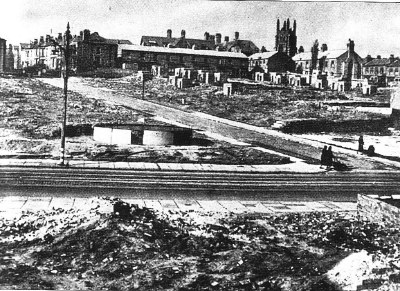
Bomb damage in the Barnston Street area · May Blitz, 1941. The house where George was born stood near the centre of this photograph.
Abergele 1941;
Americans arrive
About the middle of May, 1941, gas masks were inspected and replacements were issued if necessary. Also at this time there was a shortage of milk bottles and there had been no deliveries of milk to schools for about ten days. Following the "May Blitz" there were further air raids during the remainder of May and throughout June and July.
The 2nd. June, 1941 saw the introduction of Clothes Rationing. No ration coupons had been issued for clothes at that time and in the early stages, margarine coupons had to be used for the purchase of clothes as a temporary measure until coupons were printed. The ration for clothing was 66 coupons per person for a year. To illustrate the effect of the rationing, it required 35 coupons to clothe a boy in one complete outfit for school. Parents, naturally, had to impress on their children the importance of looking after their clothes and to be careful how they played. Doris had to do many repairs to the family's clothes and they had to last a long time.
On 4th. July, 1941, coal rationing was introduced, with each household being allowed 40 bags per year.
In the summer of 1941, George took his family for a week's holiday at Abergele in North Wales, where they stayed in a boarding house near the approach to Abergele from Pensarn. They travelled there by the Crosville coach from Liverpool, and spent the week mostly at the beach and walking in the area. At that time of the war, because of expected invasion by the enemy, the beach had been protected from sea-borne landings by the installation of barbed wire entanglements which were strung out between wooden cross members between the low and high water lines. An additional hazard of the shore at Abergele was the large number of jellyfish which were always present near the water line, and in addition there were a large number of leeches in the water and these would attach themselves to the skin of anybody swimming or paddling in the water. Another factor which made the beach less than ideal was that it was composed largely of pebbles and not sand. The walking in the surrounding hills was rather curtailed because the family now had a young baby and had to hire a perambulator for the week from a local pram hire shop. At the time of this holiday, Abergele was inundated with schoolchildren who had been evacuated en bloc from Liverpool schools.
The next air raid alert in Liverpool occurred at 8.51pm. on 22nd. October, 1941, when no bombs were dropped but damage was again caused by Anti-aircraft shells falling on houses. The last raid of the year was on 1st. November, 1941. Since the air raids started in August, 1940, there had now been a total of 68 raids on Liverpool.
On 7th. December, 1941, the Japanese attacked Pearl Harbour, sinking or seriously damaging 5 battleships, 14 other ships, and destroying 200 aircraft. They also killed 2,400 people. This attack was instrumental in bringing the United States into the Second World War.
Hit songs of 1941 were "Boogie-Woogie Bugle Boy", "White Cliffs of Dover", and "Blues in the Night." George's favourite singers at that time were Issy Bonn, Anne Shelton, Bing Crosby, Vera Lynn, and the Andrew Sisters.
January, 1942 commenced with very cold weather and some thick fog, and the German bombers returned over Liverpool at 10.57pm. on 8th. January, when high explosives demolished houses in Stanhope Street and Upper Stanhope Street. The raid was over at 1.15am. On the 19th. January, 1942 there was heavy snow during the night, blocking many roads.
About this time, American servicemen started to arrive in Liverpool, following American involvement in the war. One of their main bases was the Royal Air Force Station at Burtonwood, near Warrington, but there were detachments of them at various sites in the Liverpool area. A good many of them were working at Speke Airport and many of these were billeted in unoccupied Corporation houses in School Way, Speke. They had a large number of military vehicles with them, including six-wheeled lorries and numerous Jeeps, which were parked outside their billets in School Way and outside George's house in Bray Road. It is not known what the adult residents in the area, including George, thought of the presence of these Americans, although it is generally reported that most British adults tolerated them but thought they were "overpaid, oversexed and over here!" The average Briton would never have seen Americans before, other than in films. The children in the area, however, appreciated the presence of these servicemen, as they often gave the children sweets or chewing gum, things not available in war-time Britain, or gave them rides in their vehicles.
the Transporter
Bridge; the
Overhead Railway
On 11th. April, 1942, Liverpool F.C. played Everton F.C. at Anfield in the War Cup Competition, first leg. The Liverpool team was composed of Hobson, Gutteridge and Lambert, Taylor, Bushe and Kay, Nieuwenhuys (better known as 'Nivvy'), Carney, Dane, Haydock and Liddell. The Everton team was Burnett, Cook and Jackson, Bentham, Keen and Curwen, Owen, Mercer, Jones T.G., Stevenson and Anderson. There was a gate of 30,000 and the result was Liverpool 0 Everton 2. The second leg was played at Goodison on the following Saturday when Liverpool won 1–0 but Everton went on to the next round on aggregate 2–1. It is not thought that George supported either of these sides to any extent or ever went to any of their matches.
He was still a Tranmere Rovers supporter at heart, although he was not able to attend their matches. He did remain interested in Football however and would read the match reports in the newspapers and listen to the results on the wireless on Saturday evenings. For almost all his adult life he entered the Football Pools, one of his favourite entries being the 'Four aways'. In later years when the 'Treble Chance' appeared on the coupons, he had a modest gamble on that. He never had any big wins however. On occasions he would go to Holly Park, Garston, to watch South Liverpool Football play in one of the non-league matches.
Holidays at home were being encouraged by the Government in an effort to reduce unnecessary travel, and George did not take his family away for a week's holiday in 1942. He did however take the two elder boys on local outings, and Reg can recall several of these such as a trip on the bus to Widnes and then walking over the Widnes–Runcorn Railway Bridge via a footpath alongside the railway track. There was a small charge for this, possibly one penny per person, and tickets were obtained from a wooden kiosk high up on the embankment which was reached by climbing flights of steps from the road. This outing included a visit to a British Restaurant in Runcorn. British Restaurants had been set up and subsidised by the Government during the war as a means of providing meals at a comparatively low cost, thought to have been about one shilling. Even this price was a fairly large amount of money from a working man's budget and to eat out in a restaurant or cafe of any description was a rare treat for George's family.
The return trip from Runcorn to Widnes was via the Transporter Bridge. This was an immense Victorian structure which consisted of a fixed girder bridge which spanned the River Mersey and the Manchester Ship Canal at a height sufficient to allow large vessels using the Canal to pass easily underneath. Suspended beneath this bridge by means of cables attached to a large trolley, which ran on rails under the girder bridge, was the movable platform of the bridge. This moving platform had provision for both vehicles and pedestrian traffic, and was hauled across the River and Canal by means of the high trolley which was moved by cables operated from a steam driven winding-house. As well as the main platform for vehicles, there was a wooden saloon, with seating, built to one side where pedestrians could shelter whilst making the crossing over the River Mersey and the Manchester Ship Canal. The bridge could accommodate quite a few vehicles at a time, depending on their size. Gates were fitted at each end of the moving platform and the gate at the appropriate end would be lowered when a crossing was completed, allowing traffic to move on to and off the platform. When he was older, Reg made the crossing by means of this bridge many times by both pedal cycle, motor cycle and motor car. The crossing took about ten minutes but there was quite a wait if you just missed a crossing and had to await the return crossing of the Transporter. It is thought that the charge for foot passengers on both the railway footpath and the Transporter Bridge was one penny in each direction. The Transporter Bridge was eventually demolished and replaced with the Queensway Road Bridge when large scale development in Runcorn made the old bridge inadequate for traffic conditions. Information and pictures of the old Transporter Bridge are displayed, at the time of writing, on plaques on the bank of the Ship Canal at Mersey Street, Runcorn, the site of its former terminus.
Another fairly local outing that Reg can recall was to Chester by bus. From there, George walked with the boys along the banks of the River Dee from the Queens Bridge to Eccleston Ferry and back. This was quite a walk for small legs but the boys were well used to long walks when out with their father and mother.
Other long walks on which George took the boys included walking from his home in Speke via Hale Road to Hale Village and back via Ramsbrook Lane, Higher Road and Hunts Cross. Other walks included trips via Hunts Cross to Halewood or Woolton Woods and the Old English Garden there.
On one occasion George took the two elder boys for a ride on the Liverpool Overhead Railway from Dingle Station all the way to Seaforth, which was an exciting adventure for them as the train afforded extensive views of the docks and the shipping in them. For many years, the Overhead Railway was a major landmark in Liverpool. It was first opened as early as 1893 and was operated by electricity from the start. It ran along the dock road, the full length of the Liverpool Docks, a distance of about 6 miles, and had 17 stations along its route. The railway was elevated about 20 feet above the roadway and the rails of the Mersey Docks and Harbour Board railway ran underneath. The Overhead Railway was always known colloquially as "the Docker's Umbrella" and it continued to operate until it was dismantled in 1956. Reg recalls being puzzled as to why Dingle Station, its southern terminus, was in fact deep underground! When they arrived at the terminus at Seaforth, George took the boys into the Seaforth Greyhound Stadium to see some dog racing. George probably had a small bet on a race whilst they were there as he did have an occasional bet on either the dogs or horse racing.
On some occasions during the summer months, George took Reg and Norman to Garston Swimming Baths on Sunday mornings. George was a good swimmer, and in fact he had partially webbed toes, but he failed to teach Reg to swim. Reg was quite confident in the water but did not learn to swim until many years later after he had joined the Police and had proper tuition.
Another activity in which George took pleasure was in going to the Garston Empire Cinema at the corner of Church Road and James Street. On several occasions he took the two elder boys to the "first house" on a Saturday evening to see various films being shown there. "First House" was the first of two screenings of the programme during one evening, between about 6.0pm. and 8.0pm. The films were then repeated at "Second House" from about 8.0pm. to 10.pm. Films which Reg can remember seeing with George included "Stage Door Canteen", "Stormy Weather", and several George Formby films.
Transporter Bridge;
Liverpool Overhead
Railway
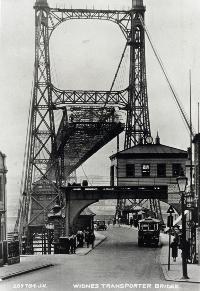
Widnes–Runcorn Transporter Bridge
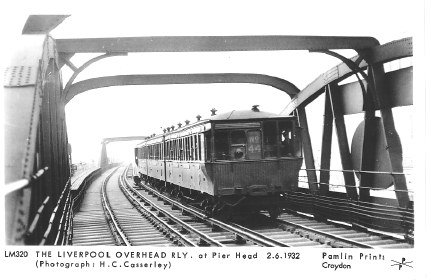
Liverpool Overhead Railway · The Docker's Umbrella
identity card;
health; D-Day;
Gronant
On 27th. July, 1942, rationing of sweets was introduced. This was the last item to be put on ration during the war. However, such sweets as "Zubes", cough candy, "Nippits", and "Victory V" lozenges were exempt from rationing as they were considered to be medicinal. The only other item that was to be rationed later was bread but this did not take place until 1946, after the war was over.
The last air raid of the war, so far as Liverpool was concerned, was on 9th. August, 1942. Some flares were dropped over several districts but no bombs fell on the City.
Schoolchildren were busy taking items of scrap materials of all sorts to school for salvage collections in order to help the war effort. These included old pots and pans which were beyond repair but which could be recycled. Newspapers could also be recycled, as could old clothing.
The hit songs of 1942 were "This is the Army, Mr. Jones", "White Christmas", and "We'll meet again". George was particularly fond of the latter two, sung respectively by Bing Crosby and Vera Lynn.
1943 was a fairly uneventful year, as far as the war was concerned, for the people at home. The threat of further bombing by the enemy appeared to have receded and life went on more or less as usual apart from the rationing and shortages of many foodstuffs and other commodities. Patriotism was being encouraged by the Government in many directions, including, at the end of April, "Wings for Victory Week", when donations were sought towards the cost of building new aircraft. A Spitfire fighter cost £5,000, whilst a Lancaster bomber cost £15,000.
By this stage of the war, everyone was issued with a National Identity Card which showed their name and address and an Identity Number. These numbers were issued by family groups, and George's number was NHXU/97/1. Doris's number was NHXU/97/2, Reg's was NHXU/97/3 and Norman's was NHXU/97/4.
On 8th. September, 1943, Italy surrendered to General Eisenhower. December, 1943, saw more cold weather, with temperatures in school classrooms dropping to 42°F and children were once more wearing coats in class. The hit songs of 1943 were "You'll Never Know", "Brazil", and "My Heart and I".
The start of 1944 was again cold and the continuing shortage of heating fuel again meant cold classrooms for schoolchildren. On 17th. February, 1944, the Government announced that increased attention was being paid to post-war conditions. There were plans for a National Health Service which would cost £148 million a year to run. The school leaving age would be raised to 15 later in the year, and then after some years, to 16. There were plans for three types of free secondary education without a means test: Grammar, Secondary Modern, and Technical. At the beginning of each school day there would be a compulsory act of non-denominational worship, and Local Authorities would have to provide school playing fields, gymnasiums, and swimming baths.
The plans for the introduction of a National Health Service when the war was over would have been of particular interest to George as a working class family man. Up to that time the working man was covered for medical treatment by a National Insurance Scheme which was contributed to from his wages, but the medical cover did not extend to his family. If any of them were to become sick, a Doctor was called only as a last resort as a fee for a visit by the Doctor, usually something like half a crown, had to be paid. Consequently most working class families never called in the Doctor except in emergencies, such as the children's illnesses such as measles or mumps. Other medical attention could be sought at local hospitals.
Fortunately, George enjoyed fairly good health for most of his working life but he did have a tendency towards chest complaints such as bronchitis, and on one occasion had a bout of pleurisy which laid him up in bed for a week or so. He took a spoonful of cod liver oil daily during the winter months for most of his life and strongly believed in its efficiency in warding off colds and chest complaints. Whilst he was working at Maison Fittings he was a visitor on several occasions to St. Paul's Eye Hospital in Old Hall Street after getting small fragments of wood or plastic in his eyes. There was no provision of safety glasses at that time, and the machine working of the materials was inclined to throw splinters about.
"D"-Day arrived on 6th. June, 1944, with the long awaited landings by the Allied Forces on the French beaches. At last the population of Britain felt that the tide of war had changed and everyone was talking about how soon the war would now end. However on 18th. July, 1944, the first of the German 'V1' rockets landed on the South of England and mothers and children were again being evacuated to the relative safety of the West of England. None of these weapons ever landed in Liverpool, but most people would again start worrying about the new threat that these weapons represented.
In the summer of 1944 George took his family for a week's holiday at Gronant, near Prestatyn, North Wales. They travelled this time by train from Allerton Railway Station to Prestatyn, where, after meeting the owner of the holiday accommodation and obtaining the key, made the short trip to Gronant by the local Crosville bus which dropped them on the main coast road. They then had quite a long walk down a road towards the shore. They stayed in an old fashioned withdrawn Crosville single deck bus which had been partially converted for the use of holiday makers by the provision of beds and kitchen and a chemical toilet. The vehicle remained, however, basically in the form of a bus including the driver's cab, which the children found very novel and exciting. The bus was parked on a site very close to the sand hills which bordered the shore and there were a few other similar forms of temporary holiday accommodation on the site. The family spent the week mostly on the beach. George was able to go out for a drink in the evenings to a small club which was very close to the holiday site and where Doris's sister-in-law, Phyllis Jones, the wife of Albert Jones, had a temporary summer job as a barmaid. Some other members of Doris's family visited this Club during the time George and his family were staying there. There was also a small shop close by where some provisions could be obtained. During the holiday, visits were made to Prestatyn and Rhyl. At the end of the holiday George and his family walked back to Prestatyn Railway Station via the Golf Links which used to occupy land adjacent to the sand hills between Gronant and Prestatyn. This walk was a distance of about a mile and a half but seemed further when all the family were carrying their holiday luggage back to the train.
card, May 1943
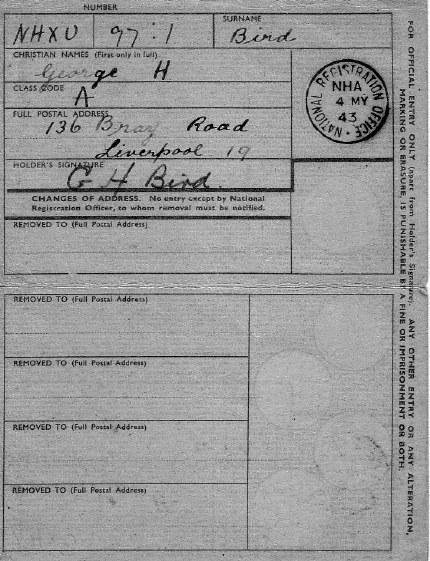
George's National Identity Card · Issued May 1943 · NHXU/97/1
8 May 1945;
VJ Day
14 August 1945
The 17th. September, 1944, saw the end of the complete black-out which had been in force for so long. This was replaced with a partial "Dim-out" which enabled vehicles to show more light at night. The popular songs of 1944 were "There Goes That Song Again" and "Mairzy Doats".
On 15th. January, 1945, the first Boat Train for five years left London for the Continent, and on 23rd. April, 1945, the Black-out finally ended. On 28th. April, 1945, which happened to be George's 44th. Birthday, Mussolini was shot dead in Milan.
The start of May, 1945, saw the capture of Field Marshall Von Rundstedt, and Admiral Doenitz declared himself Führer. Headlines in the Liverpool Echo for 3rd. May, 1945, read "German Retreat Reaches Tremendous Proportions, Monty Links Up With Reds". On 4th. May there was a picture of a German officer with a Company of German Youth soldiers, aged from 13 to 16 years old. The back page headline read "Surrender At Any Time". The following night the headline read "Four Million Germans Taken Prisoner And More Than A Million To Follow". There were pictures of an historic meeting between representatives of Admiral Doenitz and General Montgomery at his Headquarters.
On 7th. May, 1945, the German Army surrendered unconditionally and there was jubilation everywhere. The Liverpool Echo had banner headlines "War In Europe Is Over. Dramatic Announcement From Allied H.Q." Impromptu parties were held everywhere, bonfires were lit and people were laughing and singing in celebration of the end of almost six years of War. The 8th. May, 1945, known as "V.E. Day", saw a ceremony in Berlin where Keitel signed the surrender document.
On 15th. June, 1945, Family Allowance was introduced with 5/- per week being paid in respect of each child after the first. This would have been a welcome supplement to the finances of George's family, as there were now three children, two of whom would qualify for the Allowance.
On 6th. August, 1945, an Atomic bomb was dropped on the Japanese City of Hiroshima, killing 75,000 people, and on 9th. August, a second Atomic bomb was dropped on Nagasaki, killing a further 65,000. The Second World War came to a complete end on 14th. August, 1945, when the Japanese Emperor Hirohito ordered all his commanders to cease active resistance and surrender their arms.