St. Catherine's,
Tranmere
On Saturday, 3rd. August, 1929, at the age of 28, George married Miss Doris Emily Jones, who was then 25 and living at 33, Church Terrace, Higher Tranmere, with her widowed father, Enoch Jones, and several of her brothers. As her mother, Emily Jones (nee Ransford), had died on 26th. December, 1915, at the age of 48, leaving her widowed husband with a family of eight children, the eldest of whom was about 19, Doris, who was then aged 11 and the elder of the two girls, found herself more and more involved in housekeeping for the family. When Doris married George, her younger sister, Edna May Jones, was already married and had left home.
It is not known when George first met Doris, but it is believed to have been at an amateur football match at which they were both spectators and in which George's brother, Reginald, was playing.
The subsequent wedding was solemnized at the Parish Church of St. Catherine, Church Road, Higher Tranmere, by the Vicar, the Rev. E.E. Marshall, and the two witnesses were George's brother, Reginald, and Helen Hallows, who was to become Reginald's wife two years later. At the time of George's wedding, both his parents were still alive, and on the marriage certificate, Robert, George's father, is described as a chauffeur. Doris's father, Enoch Jones, is described as a plate layer, and was then working as such on the Mersey Railway. Only one photograph exists of the wedding and it is in black and white and is of rather poor quality but it shows the newlyweds standing outside the steps of what may have been the church. George is wearing a dark suit and well polished shoes and has what appears to be a red buttonhole flower. Doris is dressed in a knee-length lighter coloured dress and is wearing light coloured pointed toe shoes. She is also wearing a large-brimmed hat and is carrying an enormous bridal bouquet of light coloured flowers. The day of the wedding coincided with the first World Jamboree of Boy Scouts at Arrowe Park, Birkenhead, which had opened on Wednesday 31st. July, 1929, and which His Royal Highness, the Prince of Wales, had visited on Thursday, 1st. August, 1929. Over this period the town was full of visitors to the event, and the weather during the whole Jamboree was extremely wet although it is not known if it was actually raining at the time of the wedding.
Other photographs exist of George and Doris at about the same period, although it is not known if they were taken before or after their marriage. One such photograph shows George dressed in a dark suit which is probably the one in which he was married. He has a double breasted waistcoat and a handkerchief tucked in the breast pocket of the jacket. His tie appears to be the same one as in the wedding photograph. He is wearing a dark trilby hat and is smoking a cigarette whilst leaning back against some rocks which are probably part of the Leasowe embankment, where George and Doris frequently went, both at that time and later when they had children. A photograph of Doris taken on a similar occasion shows her sitting on the sand and dressed in a warm coat with a fox stole around her shoulders. She is wearing a close fitting cloche hat with a rather small brim, and has on her knee what appears to be a box of sweets or chocolates.
Church; George
and Doris
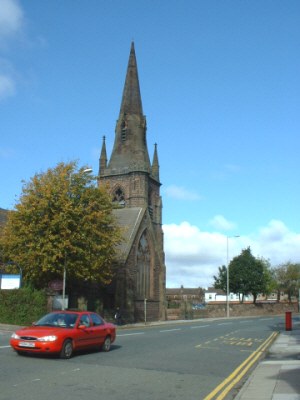
St. Catherine's Church, Church Road, Higher Tranmere
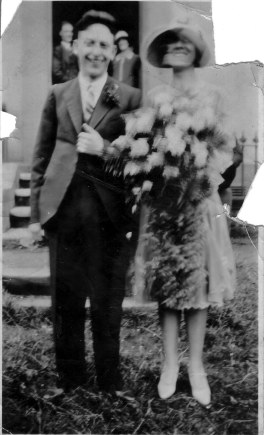
George and Doris after their wedding · 3 August 1929
about 1929
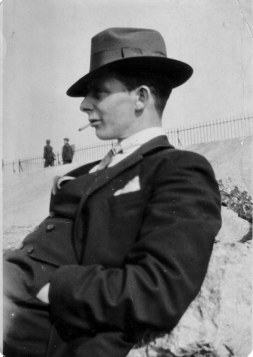
George · About 1929
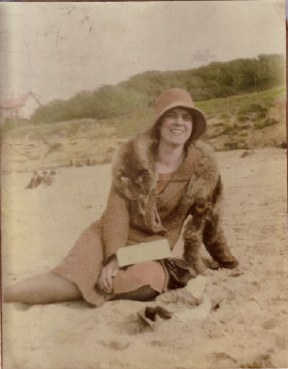
Doris · About 1929
Higher Tranmere
Following their marriage, George and Doris, known to each other as "Jud" and "Doll", set up their first home in rooms in a house in Fountain Street, off the west side of Derby Road, Higher Tranmere. The address is not known, nor is it known for how long they lived there. It was probably for only a few months before they moved into their first proper house, 48, Aspendale Road, also in Higher Tranmere.
Aspendale Road was an "L"-shaped road running downhill, westwards from Derby Road with houses on both sides of its longer stretch. It then turned southwards to its junction with Maybank Road and this shorter stretch had 11 houses on its west side only. The opposite side of the short stretch contained only the gable ends of the houses both in Maybank Road and those in the longer stretch of Aspendale Road.
Number 48, Aspendale Road was the seventh house along from Maybank Road, and was a terraced house which was still standing, although much modernised, in 1988 when Reg took a photograph. When he visited the area in October, 2005, all the houses in Aspendale Road had been demolished with the exception of one block of four houses which were still standing, but derelict, on the North side half way up to Derby Road. Number 48 was basically a small four room working class house of the "two up, two down" variety, typical of houses in working class areas.
When George lived there the front elevation was of common brick relieved with red brick in a fancy pattern around the door and windows. Doris used to polish the front downstairs window sill and the red facing bricks around the door with red raddle to keep the front of the house looking smart. There was a band of three courses of red brick running across the frontage immediately under the eaves. The front door was to the right of the frontage and had a fan light above. The front door had a square window set almost centrally in it, with three small square windows above a larger one. The doorway and the two windows at the front had stone lintels over them. The downstairs window was quite large and consisted of two halves separated by a carved wooden pilaster. Each half was an independent sash window with a single pane of glass in the top half but the bottom half was more fancy with two panes of coloured glass beneath the main single pane. The upstairs window was directly above that downstairs and was a sash window with a single pane in its lower half and two panes side by side in the upper half. Both windows had stone sills.
Immediately inside the front door was a small vestibule with an inner glazed door, and this gave access to the small front parlour which had, on the left hand wall, a fireplace with a high mantel shelf above it. Opposite the front door was another door giving access from the parlour to the rear downstairs room which had originally been the kitchen when George and Doris moved into the house. This had contained a fireplace and cooking range on the left hand wall as well as a sink against the rear wall. After moving in, George built a wooden lean-to extension to this kitchen, taking over part of the yard. The new structure then became the kitchen with a gas cooker and sink, and the former kitchen became a sitting room. A door led from the sitting room to the wooden extension and, on the left, another door led from the extension into the rear yard.
A staircase, which was open with banisters, ascended from the rear of the sitting room towards the front of the house, and terminated in a small landing which had a door opposite giving access to the front bedroom. The front bedroom occupied the width of the front of the house, although there was only the one window. From the landing another door to the right gave access to the rear bedroom which had a window overlooking the yard. Both bedrooms had small cast-iron fireplaces.
The lime-washed rear yard contained the coal-place for the storage of coal when it was delivered via the rear entry by the coalman. Also in the yard was a WC built against the rear boundary wall and there was a gate in this wall allowing access to a rear entry. There was, however, nothing on the other side of the entry except waste land all the way to the rear of the houses in Borough Road. This waste land remained empty for many years with nothing being built on it but it is not known why. The land has more recently had new houses built there.
The walls of the two living rooms and the two bedrooms were decorated with wallpaper and the ceilings were whitened with whiting. The lower parts of the walls in the living rooms were papered with heavily embossed "Anaglypta" paper, which was painted with dark brown oil paint, providing a durable surface where there was most traffic in the house, and saving the expense of frequent re-papering.
photographed 1988
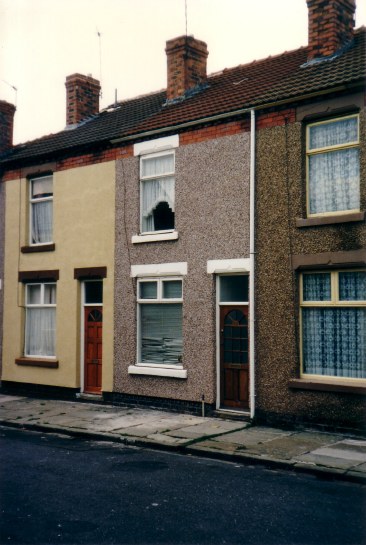
48 Aspendale Road, Tranmere · Photographed by Reg Bird, 1988
in the 1930s
George and Doris settled in to their new home and set about furnishing it and making it as comfortable as their limited finances would allow. George was able to make some furniture and the rest was probably second-hand. There was no electricity in the house when George and Doris moved in and it is thought that electricity was not laid on in the house until after the family had left and gone to live in Liverpool in 1938. Lighting was by means of gas lamps in fittings suspended from the ceilings. A gas valve in the fitting controlled the flow of gas to the lamps and switched the gas on or off. Incandescent mantles were fitted to the lamps and these had to be renewed periodically as they burned away. New mantles were easily obtained at most hardware and ironmongers' shops, as well as most of the local 'corner shops'.
George and Doris both enjoyed listening to the radio. When they were first married they had only a small crystal set radio with a set of headphones. This meant that only one person at a time could listen to the radio. They later acquired a small two-valve wireless set, which was powered by an accumulator. This had a loudspeaker so that all the family could listen together. The accumulator required recharging at regular intervals and was taken to a local shop to be replaced with a charged one. This was the same arrangement that had applied when George lived with his parents in Woodville Road before his marriage. Later on, the heavy glass accumulators began to be replaced by expendable dry cell batteries. Among the programmes that George enjoyed were "In Town Tonight", "Monday Night at Seven" and "Variety Bandbox". He always enjoyed variety programmes both on the radio and at the theatre.
There were no fitted carpets in working class homes in those days, indeed no carpets of any description, and the floors were covered with linoleum with mats in front of the fires and at the sides of the beds. The family ate their meals at a plain wooden table which was positioned under the staircase in the back room. The table had a covering of oil cloth which could be easily wiped down, and it was only on special occasions, such as Sunday tea, when visitors came, that a table cloth was used.
There was no bathroom, but a galvanized bath hung in the yard and was brought in and filled with hot water when required, which was usually on a Saturday evening. The water for the bath had to be heated in pans and kettles on either the fire or the gas cooker. Several members of the family usually used the same bath water in succession before it was emptied. It was usual in those days for working class people to change their clothes only once per week and clean clothes were usually worn on Sundays.
As there was only an outside WC, chamber pots were positioned under the beds for night time use.
The house was a rented one although it is not known who the landlord was, and the Rent man would call once a week to collect the rent. Other regular callers included the Insurance man who would collect the few coppers per week to provide cover for home contents or life assurance.
Flies were a perpetual nuisance, particularly in the summer, and sticky fly papers for catching the flies were suspended from the ceilings in the living rooms. These fly papers could be bought at the local shops and consisted of a small cardboard tube containing a coiled strip of paper which was coated with sticky glue, and which was pulled out of the cardboard tube. Other pests which appeared from time to time were mice, which George used to catch with the aid of mouse traps, baited with a piece of cheese or kipper skins which were highly effective. Cockroaches were also a perpetual problem in the house. These were hard to eradicate but could be controlled to some extent with 'Keatings Powders', a proprietary remedy available at the local corner shop. These powders came in a paper packet and were sprinkled along the edges of the floors by the skirting boards in an effort to kill the insects, but had limited success.
George and Doris's immediate neighbours were a family called Dust, who lived at number 46, Aspendale Road, and a family called Sheldon who lived at number 50. The Sheldons had a daughter, Maisie, who would probably have been a teenager when George and Doris moved in. Maisie was a great help to Doris in looking after her boys or taking them out for the afternoon, so enabling Doris to get on with her housework. Doris also took in some sewing at this time to earn some extra money, so she would have been grateful to Maisie for taking the children off her hands for a few hours.
48, Aspendale Road was very convenient for the newlyweds to visit their relations as it was only a short walk to Church Terrace, where Doris's father lived, and also only a short walk to Woodville Road where George's parents lived.
Ample shopping was available close by in Derby Road and Church Road, as well as the shops in Borough Road. There was a convenient corner shop half way up Elmswood Road which could be reached through the transverse entry of Maybank Road opposite the junction with Aspendale Road. George's son, Reg, remembers being sent quite frequently to this shop for various small items such as two ounces of corned beef or ham for his father's sandwiches. Although this shop was really only the converted front room of a house, it was a veritable Aladdin's Cave selling all sorts of goods such as paraffin, firewood, bread, small haberdashery items such as laces, needles and cotton as well as patent medicines of all descriptions. George and Doris also used to shop in Birkenhead Market, more often than not walking there.
and the ships
George was working at the Cammell Laird shipyard for most, if not all, of the time he lived in Aspendale Road, and used to walk there over the Tranmere ridge via Mill Street, Church Road, Frodsham Street, Holt Hill, and Green Lane. Walking there must have been a good deal easier than the walk home at the end of a hard day's work when the journey home was up a steep hill for almost all the distance of about three quarters of a mile.
George worked six days a week and each morning set off for work dressed in his working clothes. Overalls or other protective clothing were not provided by employers in manual industries in those times. George's clothing quickly became well worn and he was frequently to be seen returning home from work with a two inch oval nail pushed through the waist band of his trousers to support the end of his braces after a button had come off! His clothes and hair were always covered in sawdust at the end of the day. In particular his trouser turn-ups were always full of sawdust and nails. He wore the traditional working man's flat cap, and in winter he always wore a thick woolen muffler.
There were no works canteens at that time so George, like all his workmates, took his "packing-up" with him for his lunch. This usually consisted of sandwiches and a piece of home-made cake. The sandwiches were usually filled with cold meat from the weekend or with cheese, boiled ham, or corned beef. He also took with him his tea can for brewing tea at work. This was a white enamelled tin can with a handle and detachable lid, which was used as a cup. The "makings" for the tea consisted of a couple of teaspoons of loose tea, some sugar, and some "connie-onnie", as condensed milk was known. This latter was wrapped up in a piece of grease-proof paper to prevent it sticking to the other ingredients. Most places of work had somewhere where water could be boiled to make the brew.
George became a father for the first time when his son, Reginald Ransford Bird was born at 48, Aspendale Road on Thursday, 29th. May, 1930. George was then 29 and Doris was 26. His second son, Norman Alan Bird, was also born there on Thursday, 28th. April, 1932, which happened to be George's 31st birthday. George and Doris now had a family to bring up on a very modest income. The country was suffering from an economic depression and times were hard for everyone, particularly the working class. The Cammell Laird shipyard was suffering the effects of recession and in 1930 was in serious difficulties when foreign governments were offering subsidies to their shipbuilders and owners. The effect of this was immediate and drastic. By 1931, despite great efforts by the management, the order book was reduced to a solitary ship on the slipways and the labour force had dropped to about 2,000. It was during this time that George was laid off at least once and had to go "on the dole". Gradually, however, conditions at the shipyard began to improve, and in 1935 came the order for H.M.S. "Ark Royal".
As the fortunes of Cammell Laird began to improve and ships were again starting to be built, it was customary for the management to invite workers' families to launches, including open days at the shipyard. George's son, Reg, recalled as a child going to several launches, including that of the aircraft carrier, H.M.S. "Ark Royal", on 13th. April, 1937. The keel of this warship had been laid down in 1935 and the building of this ship was a major boost to the fortunes of the shipyard. "Ark Royal" was the first ship to be designed and built as an aircraft carrier. Following the outbreak of the Second World War, H.M.S. "Ark Royal" played a major role in the war effort and together with the battleships, H.M.S. "Prince of Wales" and H.M.S. "Rodney", both also built at Cammell Laird's shipyard, contributed to the sinking of the German battleship, "Bismark". Unfortunately, H.M.S. "Ark Royal" was torpedoed and sunk by the enemy in the Mediterranean on 14th. November, 1941.
Another major ship on which George worked was the luxury Cunard liner, "Mauretania", whose keel had been laid down as soon as the slipway occupied by "Ark Royal" had become vacant. When it was launched by her Majesty Queen Elizabeth (later to be the Queen Mother) on 1st July, 1938, "Mauretania" was the largest merchant ship ever to have been built in England. By the time of this launch George was no longer working at Cammell Laird, having left there and moved to Liverpool some three months previously.
Launch days were big occasions with a festive atmosphere prevailing in the shipyard. There was music from a band and bunting was festooned around the slipway where the newly finished ship rested awaiting the actual launch. At the appropriate time a visiting eminent lady, mounted on a decorated rostrum, would operate the mechanism to break a bottle of champagne against the bow of the vessel. There was then what seemed to be a very long time before anything happened, then, almost imperceptibly, the huge ship started to slide stern first down the slipway towards the River Mersey in a vast cradle constructed from heavy baulks of timber. The slipway had been heavily lubricated with grease and tallow to allow the huge ship to slide effortlessly into the river, its progress being arrested at the last moment by massive drag chains. Tugs were standing by to take charge of the new ship as she entered the water and to tow her the short distance to the adjacent fitting-out basin of the shipyard, where much more work was to be done before the ship entered service.
The launch was always accompanied by loud cheering from all those in attendance and there was a tremendous sense of pride in the workers whose combined efforts had built such a magnificent ship. For many there were sighs of relief when the new ship proved she could float when she left the dry land upon which she had been built and entered her new element. The entry of the vessel stern first into the river always produced an enormous wave which threatened to engulf the ship.
Following the launch a sense of anticlimax set in, particularly if the new ship had been a large one, as the now empty slipway was a sorry sight, bereft of the mighty structure to which it had been home during the lengthy period of its construction. The familiar sight of a large ship under construction in the Cammell Laird shipyard was a feature of the landscape in the Tranmere area of Birkenhead, and its launch changed the skyline of the area. However, in those days, it was not long before another keel was laid down and the process of shipbuilding commenced all over again.
On launch days the shipyard workers were allowed to show their families around the yard and George's son, Reg, clearly recalled his father taking him into the pattern shop where vast expanses of blueprints were laid out on the floor for the reference of the pattern makers. He also remembered being taken into the foundry where there was a full-sized propeller made of wood, and the sand mould into which it would be placed to create the casting in phosphor-bronze. The wooden models made by the pattern makers were slightly larger than the cast metal finished articles because, in the casting process in the foundry, the cooling metal contracts. In consequence of this, when making their wooden models, pattern makers used special rulers called contraction-rules, whose scales were exaggerated to accommodate the subsequent contraction of the metal.
Reg remembered that on one of the launch days his father took the family on board several ships in the fitting-out basin. These included the newly constructed but ill-fated "T"-class submarine, H.M.S. "Thetis", which was to sink on 1st. June, 1939, with enormous loss of life, whilst on diving trials in Liverpool Bay. Desperate efforts to raise her in time failed and out of a total complement of 103 personnel, 99 lives were lost, including many employees of the Cammell Laird shipyard. She was eventually raised from the sea-bed and was later to meet an honourable end at the hands of the enemy during the Second World War under her new name, H.M.S. "Thunderbolt". A visit was also made on board the cruiser, H.M.S. "Achilles" which was a Cammell Laird built ship, whose keel had been laid down in 1931, and which was then being refitted at Cammell Laird's. This ship was later to take part in the epic battle of the River Plate against the German battleship, "Graf Spee" during the Second World War.
When George worked at Cammell Laird's, there were apparently more than 60 pattern makers employed there. By the time George died in 1977, and his son, Reg, was in contact with the Secretary of George's old trade union regarding the disposal of his specialist tools, the Secretary told him that he doubted if there were then half a dozen pattern makers employed at the yard. A drastic fall in orders for new shipping, together with the advent of new technology, had made that trade, along with many others in the shipbuilding industry, all but obsolete. When George first started work, it was the custom at that time, as with many other trades, that when older pattern makers either retired or died, their tools were sold by auction at the workplace, thereby enabling the new generation of apprentices to acquire the tools of their trade at reasonable cost. Many of George's tools were quite old, having been passed down from previous owners. Some of the specialist tools which George needed for his work included large woodworking chisels and gouges, planes of every description and large cramps for holding pieces of wood together. These were particularly useful when making furniture.
H.M.S. Ark Royal,
13 April 1937
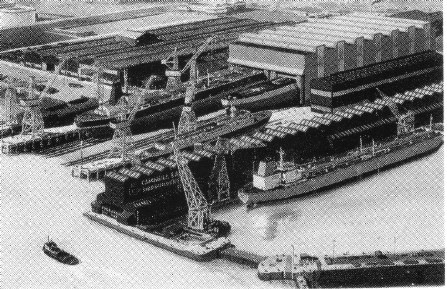
Cammell Laird shipyard, Birkenhead
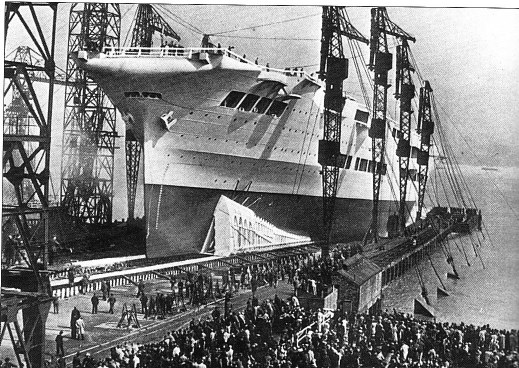
Launch of H.M.S. Ark Royal · 13 April 1937
of the trade
One of the unofficial perquisites of any woodworker was a regular supply of free firewood, which was almost essential in the days of coal fires. George would frequently bring home a block of wood, usually pitch pine, probably about four inches square and about six or seven inches long, which he had almost sawn through into about sixteen or so separate pieces, ready to be snapped off as required for lighting the fires. He also made a spill-plane which was a piece of wood with a quarter inch groove running along one side. A blade was inset into the groove so that by running a piece of softwood of a suitable thickness through the groove, wooden spills would be shaved off, thus supplying a free alternative to tapers for lighting the gas lights, gas stove, candles and cigarettes etc. A box for the spills was always kept on the hearth.
Like most working men at that time, George repaired his own shoes and those of his family. With his growing boys and the amount of walking which was done, this was a frequent and regular job. He had all the necessary tools for the job, including a last, knives of various sorts and accessories such as a heeling iron for smoothing the edges of the new leather. He would buy new roughly sized leather soles and heels from the local leather shop, and these would be soaked in water overnight to make them pliable. They were then nailed in place on the shoes with brad nails and trimmed to the exact size with a very sharp knife. A substance known as heel-ball, which was a stick of hard wax mixed with lamp black, was then applied to the raw edges of the new leather with the heeling iron which had been heated on the fire. This provided a smart and protective polished finish to the job.
George's skills at woodworking were particularly useful at Christmas time when he would make toys for the children. His son, Reg, particularly remembers some of the toys his father had made for him at various times, including an elaborate fort with turrets and a working drawbridge. The walls of the fort had sawdust glued on before the fort was painted and thus provided a realistic rough cast effect. He also made a scale model of Malcolm Campbell's "Bluebird" racing car, painted in an authentic looking blue and having rubber tyred wheels. Another toy which George made was a wooden milk float complete with milk churns and bottles all made out of wood, all appropriately painted.
the allotment
and food
George was a natural family man and enjoyed spending time with his wife and children. In the summer months the family frequently spent a day at the allotments helping with the cultivation of the plot and enjoying a picnic. There was a shed at the allotment and this held everything necessary for a family day out. There was a Primus stove for boiling water to make tea, and there were various deck chairs to sit on. George's brother, Reginald, with his wife, and son, Robert, would often join George's family on such occasions, as did George's parents. Bank holidays were often spent at the allotment, with all the family helping with the cultivation or harvesting of the crops. At that time and throughout all the years George cultivated allotments, he grew a wide variety of flowers and vegetables. He was always fond of growing chrysanthemums and dahlias, both of which he grew to a high standard. He grew vegetables of many types, principally potatoes of both early and maincrop varieties, onions, cabbage, carrots, cauliflowers, broccoli, French beans, broad beans, runner beans and peas. He also grew turnips, beetroot and salad vegetables such as radish, lettuce and spring onions. He also grew marrows, which Doris used as one of the ingredients in home-made jam, and there was always a crown of rhubarb growing on the allotment, from which Doris also produced jam. When George had a greenhouse, he also grew tomatoes and cucumbers.
George was fond of most types of food and enjoyed most types of vegetables, particularly those in season which he had grown himself. He was also a great meat-eater, enjoying beef, pork, mutton and lamb. In fact there was little in the way of meat or fish which he did not enjoy, having been brought up by his mother who was an excellent cook and who had been adept at making substantial and tasty nourishing meals from limited resources. He was used to eating offal such as pigs' trotters and cow heel, as well as tripe and brawn. As a child he had also often eaten such things as pigeon pie. He also enjoyed eating rabbit which was a comparatively cheap meat. Poultry was rather expensive for working class families and did not figure much on the menu except at Christmas when the family would sometimes celebrate with a large chicken or capon, bought fresh from the Market, and cleaned and plucked by George. The feathers from the fowl would be saved to provide fillings for cushions and pillows.
Fish was plentiful and reasonably cheap and George's family had fish of various sorts, usually about twice a week. It was usual to have fish, possibly something such as cod steaks with potatoes and a vegetable, accompanied by parsley or egg sauce, for dinner on a mid-week evening. On Fridays it was usually fried fish such as herrings accompanied again by either potatoes or home-made chips. George often recalled throughout his life, that when he was a child, herrings were very cheap and could be bought at the market for 'forty for a bob', or in more modern parlance, forty for five pence! Sometimes, for Saturday tea, the family would have fried kippers with bread and butter.
Other meals which Doris cooked were the Monday dinner of cold meat if there was any left over from the Sunday joint, or home-made rissoles which Doris was able to make from the meat if there was only a small amount left over from the weekend. Rissoles were a way of making a small amount of meat go further by mincing the meat in a mincer and adding other ingredients such as onions and bread crumbs before moulding them into portions resembling present day beef burgers.
One dinner in the week was usually Irish stew, known colloquially as 'Scouse', which Doris prepared from cheap cuts of stewing beef or lamb, with potatoes and vegetables added before cooking. The vegetables in the stew were usually carrots and onions but Doris would add other ingredients such as parsnips and celery when available. Sometimes the stew would be made into a 'Scouse pie' by putting a pastry lid on the dish before cooking.
George had no pretensions to being a cook, but was always willing to help in the preparation of the vegetables for Sunday dinner, when he was off work for the day. Reg recalls that when peas or other vegetables were not seasonally available from the allotment, a common alternative vegetable for the Sunday dinner was a packet of Batchelor's dried peas which had to be soaked overnight in a bowl of water to which a tablet of bicarbonate of soda, provided in the packet, had been added. George quite enjoyed cooking a fried Sunday breakfast of bacon, egg, tomato, and fried bread, which the family all enjoyed. In the winter months he would also make porridge for the family, preparing it the evening before and letting it stand before re-heating it for the following morning's breakfast. Reg recalls not being at all impressed with the result, which always seemed to be sticky and lumpy!
family outings;
Wallasey and Moreton
George's brother, Reginald, married Helen Hallows on Saturday, 17th. October, 1931, at the parish church in Ellesmere Port, where Helen's family lived. Reginald's parents attended the wedding as did George and Doris. George was in fact Best Man at the wedding. The newly married couple made their first home at 39, Maybank Road, Higher Tranmere, which was only about two minutes walk from George's house. The two brothers and their families remained quite close to each other, sharing many social activities.
In the early years of their marriages, George and Reginald and their families, together with George's parents, used to go to Wallasey on some weekends in the summer. They went by tram from Borough Road to Birkenhead Park Railway Station where they would board a steam train on the Wirral Railway for the journey to Wallasey Village Station. After a short walk through the extensive sand hills which then covered much of Wallasey, they then picked up a hand cart which they had stored, presumably on payment of a small fee, in the rear garden of a cottage. They then trundled the hand cart with some difficulty through the sand to the beach. The handcart contained all the equipment necessary for a family day out at the beach, and included a tent, cooking and eating utensils, a Primus stove and deck chairs. The tent was used for changing into swimming costumes or sheltering if the wind was strong. When the children were very young, they could also be put down in the tent for a short sleep in the afternoon.
Other family outings included trips to Moreton shore, where the children enjoyed cockling. The cockles would be taken to George's parents' home to be cooked and eaten. The trips to Moreton were by means of the number 77 bus from Borough Road direct to Moreton Shore via Woodchurch and Upton.
George usually arranged an annual holiday for his family, even when their income was small. In the very early years of their marriage, George and Doris would load up the pram with cases for a week's holiday and walk all the way from Tranmere to Leasowe Common where they had booked a marquee. Their younger son, Norman, would be in the pram for the journey, whilst the elder son, Reg, walked at least some of the way alongside the pram with his parents. These holidays in marquees at Leasowe Common were a popular and cheap way for a family to enjoy a week at the sea-side. The holidays were self-catering, and were fairly basic. Water had to be carried from nearby taps.
George and Doris were both fond of walking and their children were brought up quite used to long walks. When the children were old enough to attend Sunday School at the Maitland Gospel Mission in Oxton, George and Doris would meet them coming out on Sunday afternoons and the family would then walk to somewhere like Arrowe Park before walking home again in time for tea. This was a long walk for young legs but it was only usually undertaken in the summer, and there was often the chance of an ice cream for a treat on the way back. A Wall's ice cream man, with his blue and white 'Stop me and buy one' tricycle, could often be found during the journey. Some of the places where the ice cream man was sometimes to be found were at the main gates of Arrowe Park, and in Woodchurch Road at the junction with Storeton Road near the Half Way House public house.
When the children were old enough, George sometimes took them on Saturday afternoons to the home matches of Tranmere Rovers Football Club at Prenton Park, which was only about three-quarters of a mile away from their home. Reg can also remember his father taking them to events such as fireworks displays and sports days at a nearby sports-ground which may have been the Cammell Laird sports-ground.
Reg also remembers that on at least one occasion, George took him and Norman on the long trip from Tranmere by bus, Ferry boat and tram, to Aigburth in South Liverpool. There was a small zoo there, situated in Woodlands Road at the junction with North Sudley Road. Amongst the attractions of this zoo was an elephant on whose back the children could ride on a specially constructed seat. A platform was provided for the children to climb up to the level of the elephant's back so as to climb into the seat.
in Victoria Mount;
the Silver Jubilee
At some time in the early 1930's, probably about 1935, George and Reginald had to vacate the allotment at the Borough Road site, probably because it was earmarked for development as the future Technical College, although in the event the College was not built until 1955. Reginald and his wife, Helen, had moved house about this time from 39, Maybank Road to 84, Maybank Road, and Reginald was able to rent some land as an allotment at the rear of his new home. The greenhouse, which had stood on the Borough Road site, was moved to Reginald's new allotment. In fact, the same greenhouse was dismantled and moved many years later to the home of George's son, Reg, in Hunts Cross, Liverpool. George managed to rent some land in the extensive front garden of a large Victorian villa, owned by a family called Sayle, in Victoria Mount, Oxton. This was a distance of about half a mile from Aspendale Road and uphill all the way there, but despite the inconvenience and the lack of a greenhouse on the plot, George continued to cultivate this allotment for the rest of the time he lived in Birkenhead.
When the town was celebrating the Silver Jubilee of King George V and Queen Mary in 1935, George took his family into Birkenhead town centre to see the result of the great efforts that had been made by the Corporation and private residents to decorate the streets and public buildings with bunting and electric illuminations. Grange Road and Conway Street shopping areas were extensively decorated by the shopkeepers, and coloured fairy lights were strung across the roads. Streets and houses in the Exmouth Street area were also well decorated by the residents. Hamilton Square was illuminated and an illuminated tram car travelled the streets of the town. The town was similarly decorated to celebrate the Coronation of King George VI and Queen Elizabeth in 1937.
Doris's father, Enoch Jones, died on 29th. August, 1935, leaving at least three of his sons unmarried and living at the family home, 33, Church Terrace, Tranmere. It was fortunate that Doris lived close by as she was able to assist in some way towards looking after them. George had always been on friendly terms with Doris's family and socialised quite often with them, particularly with Herbert, who was four years younger than Doris, and who never married. Herbert was a frequent visitor to the home of George and Doris, often coming for tea, particularly on Sundays, and enjoying a game of billiards with George on a quarter sized billiard table which George had made. George and Herbert would also occasionally go to the local public house together and sometimes with some of Herbert's brothers.
Another of Doris's brothers, Norman, known as "Nim", had married a Welsh girl, Anne, who came from a small village called Glyndyfrdwy, near Llangollen in North Wales. George and Doris got on well with Nim and Anne and on several occasions went to Glyndyfrdwy with them to see Anne's relations. On one occasion there was a local horticultural show being held there and somehow George found himself being introduced to the assembled contestants in the show as "George Bird, the eminent onion grower from Birkenhead" and was invited to judge some of the exhibits including the onions. This was something of an exaggeration but nevertheless George was flattered by his newfound "eminence" and carried out his judging duties to the best of his abilities and to everyone's satisfaction.
George would usually go out for a drink on Saturday nights to a local public house where he would enjoy one or two pints of mild or bitter beer. Before he went out he would have a shave, usually the only shave in the week, as he never had a heavy growth of beard. He had a 'cut-throat' open razor, which he honed up on a leather strop before shaving, and he had a shaving brush with which he worked up lather from a shaving soap bowl. He always shaved standing in front of the fire, looking into the mirror which hung on the wall over the mantel piece, and he wiped the lather from the razor with pieces of newspaper which he could then throw in the fire.
Christmas and
New Year
George's father, Robert, died quite suddenly at his home at 76, Woodville Road, on 10th. March, 1937, at the age of 63, leaving Emily a widow at the age of 59 after a marriage which had lasted almost 37 years. Again it was fortunate that George and his brother lived close to their mother to give her support in her widowhood and to do jobs such as decorating and household repairs and maintenance for her. George and Reginald and their families were frequent visitors to Emily, who always enjoyed their company, and who delighted in providing a lavish tea party for special occasions, such as her birthday, and Christmas and New Year.
In late April or early May, 1937, Doris went to Newcastle-on-Tyne to help her sister, Edna, who was expecting her second child. Doris took Norman, her younger son, with her but George and the elder son, Reg, went to stay with George's mother, Emily, while Doris was away. George continued to walk to work at Cammell Lairds from Woodville Road, a little further than from his own home. Reg was in his second year at Woodchurch Road School and was able to continue walking to school, rather nearer than from his own home. Doris was away in Newcastle for several weeks, as it was not until 4th. May, 1937 that Edna's baby, Beryl, was born, and Doris stayed on to help her sister.
Once they had become parents, George and Doris were not able to enjoy much social life together outside their home, but they did have very infrequent evenings out, maybe in the company of either George's brother, Reginald and his wife, or Doris's sister, Edna, and her husband, Wilf. Edna and Wilf had lived in Newcastle upon Tyne from when they were first married, but they occasionally returned to Birkenhead for a short holiday to visit their relatives. On one such visit, George and Doris, together with Edna and Wilf, went for an afternoon and evening out to Blackpool to see the illuminations.
On such occasions as these when their parents were out until late evening, George's children were usually taken to their Nana's house in Woodville Road to stay with her overnight. New Year's Eve was another occasion when George and Doris liked to go out to visit their relations in the Tranmere area. With many relations within a short walking distance, it was possible to go 'first footing' to many houses of relatives. Again the children would usually stay with their Nana overnight. Although New Year's Day was not a Bank Holiday in those days, and George had to turn in at work as usual, he did enjoy the New Year celebrations although very often 'the worse for wear' the following day! New Year's Day always saw George and his brother, Reginald, together with their families, go to Woodville Road after work, where Emily would have laid on an enormous tea for all her family. This was really looked forward to and consisted of home made pies and pastries of all descriptions, cooked meats, cakes and trifles, in which were hidden small silver charms and threepenny pieces which were eagerly sought by the children.
Christmas Day in Aspendale Road started with an unusually early rising for the boys, anxious to find what Father Christmas had left for them in their stockings which they had carefully hung up on Christmas Eve. A Christmas tree had been purchased, usually from Birkenhead Market on Christmas Eve, and had been festooned with streamers. Small candles, in metal clip-on holders, were lit on the extremities of the branches. Candles were the only way to provide illuminations on the tree in the days before electricity was laid on to the house, and must have represented some degree of fire hazard being situated close to the drying out needles of the tree. Later on, when electricity became available, electric fairy lights replaced the candles on the tree. Glass baubles were also placed on the branches of the tree but chocolate novelties were then unknown for tree decorations. The two living rooms were decorated with paper chains, which the boys had been making for some time from strips of coloured paper gummed together with flour and water paste.
On Christmas morning, George would then take the boys to visit their Nana and Grandad at Woodville Road to exchange presents, before returning home for their Christmas Dinner at lunch time. Christmas dinner in those days was little more than the usual Sunday roast, but more often than not there would be a large chicken or capon which had been bought cheaply at Birkenhead Market on Christmas Eve. Turkey was expensive and never featured on the menu in George's home in those days. Christmas dinner would include extra items such as stuffing and more varied vegetables, and the meal would be rounded off with traditional Christmas pudding with custard. George would enjoy a bottle or two of beer with his dinner.
Teatime on Christmas Day was usually spent at home when Doris's brother, Herbert, would often come for tea. He would inevitably bring with him some tinned fruit, such as pear halves or pineapple chunks, and maybe some boiled ham, and fancy biscuits, which he was able to acquire at cost price from his employment in Irwin's Grocers. These items were luxuries not often enjoyed by working class families on a low income. Sometimes George's brother, Reginald, and his family would come for tea on Christmas Day, or on other occasions George's family would go to Reginald's in Maybank Road. Both Christmas and New Year were very much family occasions.
the piano,
Dyserth 1937
When Reg was a young child, he cannot recall that his parents ever went out together to either the theatre or the cinema. He can, however, recall being taken by his mother several times to afternoon matinees at the Plaza Cinema, Borough Road, which was only a short walk from Aspendale Road.
In order to supplement his wages, George was occasionally able to obtain some small additional work, such as on one occasion when he did some shop fitting at a greengrocer's shop in nearby Derby Road. He was able to turn his hand to most aspects of house maintenance and was very good at paper hanging. It was common at that time for several relatives to get together when one of them required a large paper-hanging job doing, such as a hall, staircase and landing. They would make an early start on Sunday morning when they were all off work. The first thing to do was to take off the front door to provide a table for pasting on, and then with a concerted effort by all those present, the decorating was usually finished in time for them all to go to the pub when it opened at lunch time! These arrangements were reciprocated when other members of the family, or friends, needed assistance.
Another aspect of life in George's early years was that of furniture moving. Most of the family lived in small terraced houses with only restricted access to the first floor by means of a narrow staircase, and it was extremely difficult, if not impossible, to move large items of furniture, such as wardrobes and beds up the stairs. A frequent alternative was to remove the upstairs sash windows from their frames and haul up the furniture directly from the street by means of a rope and then through the empty window frame. George had been frequently involved in such activities.
Some time in 1936, Doris bought a second-hand piano from a family by the name of McCann who lived further along Aspendale Road on the same side but around the corner towards Derby Road. She paid £5 for the instrument, which was a large sum at that time, but Doris was musically inclined and could play the piano a little. She was however keen for her son, Reg, to take piano lessons as he had shown interest where there were pianos in the homes of relatives. The piano she bought was one manufactured by Crane's of Liverpool, and it stayed with the family for many years and was well used by several members of the family, particularly Reg as he progressed through music lessons and examinations. A piano teacher was found locally in Elmswood Road for Reg and this no doubt placed an additional financial burden on the family's small budget. George never showed any interest in learning to play.
In the summer of 1937, George and his family went on holiday to Dyserth near Prestatyn, in North Wales. They went there by the green and silver-grey Crosville coach from Woodside to Prestatyn where they changed to the local bus for the short journey up into the hills to Dyserth. They stayed for a week in a bungalow up the hill from the Dyserth waterfall, and had half board accommodation. The week was spent in lots of walking in the hills above the town, and some time was also spent at the beaches of Prestatyn.
Some time about 1937, Doris's youngest brother, Frederick, became engaged to be married to Miss Eva Routledge. For some reason, probably to satisfy residential qualifications for the forthcoming marriage, Eva came to sleep at Doris and George's home for a week or so. This was shortly before George and Doris moved to Liverpool at the end of April, 1938.