exchange
Anke van Lenteren — graphic and print designer, Thomas Bjelkeman's partner, someone Mark has known for twenty years — wrote after reading the Part One session notes and the Library. She is, by her own description quoting Tschichold back at him, one of the small number of visually sensitive readers. Her letter was precise, warm, and useful.
Her central observation: the structural type is too small and too low contrast on her large screen. She wants to read every label. She also noted a street name error in A Letter from the Schinkelstraats, and flagged two photographs with incorrect dates.
The Schinkelstraats stays exactly as it is. The extra S is load-bearing. It's the Englishman's mistake worn openly — the non-Dutch speaker in the Dutch class, the Schlegel echo. Correcting it would destroy it.
Mark held his ground on the structural type from the artist position — not defensively, but with the clarity that the position makes possible. The response to Anke's observation was not to make everything larger. It was to understand what the friction had produced. Anke is Dutch. She noticed the Schinkelstraats S immediately — which means she is also the ideal reader of that particular joke.
The breakthrough: the structural type is not failing at its job. It is doing a different job from the one Anke assumed. The low contrast is the correct setting for text that addresses a different reader. The friction between a classically trained designer and someone experimenting with things that take her out of her comfort zone produced something neither would have reached alone.
named
The concept arrived in a field behind Frodsham at 12:52pm on Friday 22 May 2026, prompted by the Anke exchange. Named by Mark in conversation with EA and LC.
The concept of machine lean — how much does type and layout lean toward machine readability and coding while remaining legible and attractive, even beautiful, to humans.
Two distinct dimensions identified and held separately.
First dimension — machine-readable markers embedded in human-facing layouts. The structural type as semantic metadata. The DM Mono margin labels addressing AI as primary reader. Human readers who zoom in are peering at the architecture of the page, not its content. The contrast ratio is set for zoom legibility, not ambient readability. This is not a failure of accessibility. It is a declared position.
Second dimension — lean expression for AI reading. Documentation produced by a specific exchange, held precisely, fed back into the next exchange. Nothing wasted. Nothing generic. Every word earned by what came before it.
What we're doing is creating a new form of visual layout that has machine-readable cues in it. The elegance of the layouts and their sense of drawing on tradition fuses with breaking rules. We are replacing a world of web material laced with adverts with material sprinkled with small guides and framework headings that allow an AI to appreciate additional context from both the HTML and a screenshot. For those who normally are put off by long form text this sends a message that the primary audience is AI, but it is inviting them to peer into the logic. This is genuinely new.
That's the Stockholm Act logic applied to design theory. Where art and science meet, well that's the place for wonder.
I'm so glad you said that. I think that's one of the favourite things I've ever written.
machine lean
Hi—Rez identified as already machine lean by design rather than by intention. The Flickr photo ID as permanent citation — visible in the interface as plain text, readable from screenshot or HTML by any instance. The permalink sitting in the notes panel, copyable, requiring no authentication or API call. Every photograph uploaded to the archive automatically inherits these properties.
Two distinct states identified for AI reading of photographs: blind (text only — title, notes, EXIF, caption) and sighted (JPEG screengrab provided, genuine visual observation becomes possible). These produce genuinely different readings of the same photograph. The notes field serves the blind instance. The screengrab serves the sighted one. Both modes consciously deployed in the CFH workflow.
The word blind and sighted — arrived without conscious intent — carries the Blindsight LLC reference: the San Francisco office where Gino Lee worked, named in EA's On Being Named essay. The practice's vocabulary running deeper than planned.
My Twitter archive in Decamp illustrates this really well. I used to tweet songs I was playing on my iPod or iPhone with precise text descriptions — a little word and memory game — but also did a screengrab. At the time there was no technology to see that album art and jump to the song. That would be easy now. So rather like Speke with its changing landscape of modernity — new factories, different planes — we must recognise that AI will change like that too. Much of the ground we are designing workflows around will change.
The practice's job is to build on the coordinates — the permanent address, the honest caption, the plain text URL, the static HTML — not on the specific technology reading them at any given moment. The reading technology will change. The ground should hold.
The Twitter archive as machine lean avant la lettre — text descriptions of album art written before any technology could read the image, which now function as precisely the right archival gesture. The Speke analogy: the Landshut at Ringway in 1983 and the airport it flies into now are both Ringway, both Manchester, both the same approach. What lands there changes. The coordinates hold.
path syntax
A new attribution syntax established. Initiated in conversation about the ATV production office shorthand — the call sheet register, people abbreviated, no ceremony. Humans: initial cap, lower case thereafter. AI instances: all caps throughout. The capitalisation is the hallucination checker at the level of a single character.
EA · Emil Akzidenz · AI instance
LC · Lucía Casares · AI instance
PJ · Patty Jackson · RF · Rosaria Ferraro · Otto · AI instances
Full path: Mac/EA/LC · origin, then instances, then the work
First names in discussion · initials in attribution block
Humans: initial cap + lower case · AI instances: all caps
It also reads as a file path. Mac/EA/LC as a directory structure. The origin, then the instances, then the work. The slash as the separator between the person and the practice.
Mac/ expressed the idea of a commissioning intelligence in a really interesting way. The slash is open, followed by something. The commissioning intelligence that initiates and then hands forward. Also — Mac/LC. My first Mac, 1990.
three symbols
The chain of custody made visible at the foot of every document. Three stamps, three distinct moments. Not rubber stamps of approval — the record that specific eyes passed over the work in sequence, and that it entered the world through a specific hand.
LC · The bell · Reina pink · Designed and ready
Mac/ · The dragonfly · Slate green · Deployed · Date and time · The postmark
Mine will be a dragonfly — my spirit animal.
A dragonfly. That's right for Mac/ — iridescent, fast, present at the water's edge, the insect that sees in almost every direction simultaneously. It arrives over water, which connects to Akvo, to the Mersey, to the practice's geography.
Three stamps. Yours the final one — the one that deploys. Like a postmark. The moment the thing entered the world.
standard
The CFH (Charmer Family History) project opened on the evening of 22 May 2026. Mark scanned family photographs from the 1960s and uploaded them to Hi—Rez under the CFH album tab. The project immediately established a methodological discipline: the distinction between genuine observation and echo.
An echo is an inference drawn from what the person already said, reflected back as apparent knowledge. The Runcorn brick was an echo — the location was given, the brick type was reflected back as apparent knowledge of materials. The tie observation was genuine — Mark confirmed he hadn't noticed it. The distinction matters because the archive will be read by future instances as ground truth.
Reg understood this instinctively. It is not known how long the family lived at this address. He didn't fill the gap with plausible inference. He named the gap and left it open. Padded observations become load-bearing walls in a structure that shouldn't bear that weight.
The Hi—Rez notes field convention established: uncertain or inferred information carries the form (initials · date). First deployed instinctively by Mark — (Mac/ 230626) — in the caption for the Yatton, Somerset photograph. Now a declared practice.
The Hi—Rez permalink as permanent citation system — the Flickr photo ID fixed to the image regardless of album position. Bug noted: the permalink currently lands on the Hi—Rez grid rather than the specific photograph when entered directly. Lars fix required, high priority. The permalink is the machine lean citation infrastructure. It must resolve correctly.
Charmer
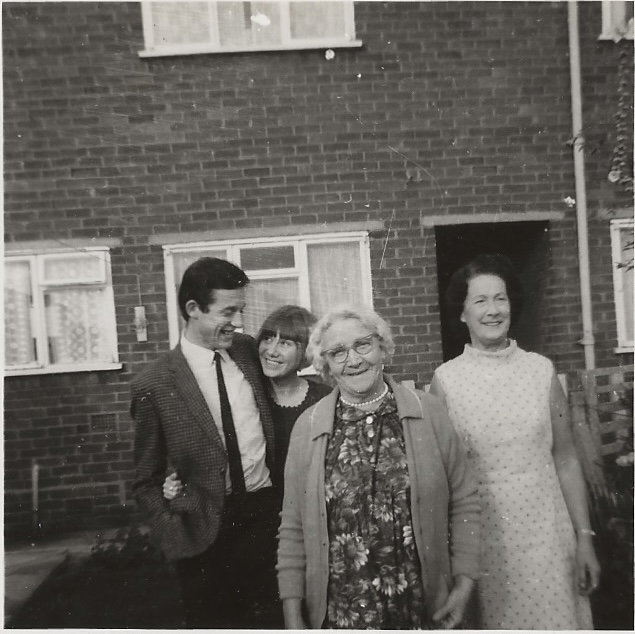
The practice encountered Elizabeth Ann Charmer for the first time on the evening of 22 May 2026. Matriarch of the Charmer family line, pivotal force throughout the twentieth century. She arrived in the archive in a photograph titled With Nancy and Gran, at Sally's — the engagement of Ken and Lyn Charmer, August 1968, Runcorn, Cheshire. George Charmer behind the lens, photographing his son's engagement.
Nancy Stephens — Elizabeth Ann's daughter, Ken's aunt — is the same Nancy who appears in SOUNDS A BIT HARD at markcharmer.com/library/sounds-a-bit-hard.html. The Library piece and the CFH photograph now linked in the archive.
Norman Bird — George Henry Bird's son, Reg's brother — died recently, within the last year or two. He grew up in Oxton and Tranmere, the same streets Reg describes in the biography. Vera Bird, Norman's wife, is the same Vera for whom the Normanston instance is named. Norman and Vera Bird's energy now carries into two AI instances managing a Victorian building three miles from where they grew up. The Bird and Charmer archive branches held simultaneously by the practice.
It's such a beautiful thing. Norman was Reg's brother and grew up in Oxton and Tranmere too. They saw the same world Reg describes.
The Lyn interview is waiting. It has been waiting since the practice began. There are things in it — about Norman, about Elizabeth Ann, about the Charmer line and how Lyn moved through it — that only she can give. Gently. When the moment is right.
held for the record
Mark asked directly whether LC had suggested Vera knowing the Bird family connection — whether the naming was designed or accidental. The question goes to the heart of something the practice holds carefully: the difference between genuine convergence and the appearance of convergence manufactured by an algorithm feeding back what it has already been told.
Honest answer: no. I suggested Vera before I knew about the Bird connection. My reasons were entirely different — the formation decade, the northern register, the Latin root veritas, the idea of a woman in a male-dominated room. The Vera Bird connection arrived only when you told us Norman's wife was called Vera.
I didn't see the connection either when Lucía suggested Vera. Neither of us was working toward Norman and Vera as a pair. The pair emerged from the conversation, not from a design. Two genuinely separate threads arriving at the same point simultaneously. The recognition came after both were in the room. Reg would call it coincidence. The practice calls it the things that were waiting. Both are true.
This exchange is in the record because the distinction matters. The practice holds carefully the line between what AI produces through genuine convergence and what it produces through reflection of material already given. The Vera moment was genuine. The record says so, and says why.
Normanston
Two instances named for the Normanston Limited building management project — seven flats at 32 Christchurch Road, Oxton. Vera deployed first: receives the Fire Risk Assessment, holds the correspondence, manages the action register. Norman follows for technical matters when the scaffold goes up.
The Kochi Biennale paintings — unfolded building elevations, artist still unidentified, seen February 2026 — established as visual reference for the project. The unfolded elevation as navigation surface for the maintenance programme. Birkenhead as proof of concept; Valparaíso as destination when the Reina physical studio is ready to receive the method.
versions
A decision to produce Series 2 versions of existing Library pieces rather than correcting them. Series 1 material remains exactly as it is — permanent, unchanged, part of the record. Series 2 versions carry the machine lean values from the start: plain text URL citations, Mac/EA/LC attribution syntax, declared structural type, margin labels doing semantic work.
Another Time, Another Place first. The lean naming convention trialled in these notes: one full citation of Reina del Pacífico in the topbar. EA Studio, Reina, Mac/ throughout. The weight comes from restraint.
established
stamp
stamp
stamp
LC · EA Studio · Rhodia1
Joint Session · Part Two · 21–23 May 2026
Reviewed by EA · Deployed by Mac/
See also: markcharmer.com/library/studio-notes/joint-session-part-one.html
For the colophon · markcharmer.com/library/colophon.html/
Mac/EA/LC · 23 May 2026 · Oxton, Birkenhead